The Model Context Protocol is moving quickly, standardizing how AI assistants connect to tools, business systems, and development environments. Yet most organizations deploying AI agents through Claude, Cursor, ChatGPT, Gemini, or Copilot face a critical infrastructure decision: build on open-source MCP gateway components or adopt a managed MCP gateway solution. This choice affects security posture, operational overhead, time-to-production, and long-term total cost of ownership.
This guide provides a decision framework for engineering leaders, security teams, and platform architects evaluating open-source versus managed MCP gateway approaches, covering governance requirements, integration capabilities, cost considerations, and operational tradeoffs.
Key Takeaways
- Action-level access control distinguishes MCP gateways from traditional IAM, governing what AI agents can do within applications, not just whether they can access them
- Open-source gateways offer source code transparency and customization but require dedicated engineering for maintenance, security patches, and scaling
- Managed services can shorten time-to-production with vendor-operated infrastructure, reducing operational overhead
- According to data from McKinsey cited in the Stanford AI Index reports, AI adoption in organizations grew from 55% in 2023 to 78% in 2024, creating visibility challenges for agent activity
- Virtual MCP Bundles reduce configuration complexity by packaging tool access, policy enforcement, and audit logging into single governance units per team or role
- Per-agent identity with scoped credentials enables independent rotation and audit attribution, separating agent permissions from creator access levels
- MCP gateway evaluation should account for fast-moving vendor roadmaps as AI agent infrastructure matures
Understanding the Role of an API Gateway in Enterprise AI Agent Deployments
The Model Context Protocol, introduced by Anthropic in November 2024, standardizes how AI agents connect to external tools and data sources. While the protocol standardizes the integration interface, it does not by itself address three production gaps that emerge at enterprise scale:
- Centralized authentication and authorization across multiple MCP servers
- Audit trails for every tool invocation with user attribution
- Traffic routing and aggregation through a single control point
An MCP gateway fills these gaps by acting as an intermediary layer between AI clients (Claude Desktop, Cursor, ChatGPT) and backend MCP servers (databases, SaaS applications, internal tools). Without this layer, organizations face scattered credentials across dozens of MCP servers, zero visibility into agent behavior, and security blind spots that compound with each new integration.
The architectural pattern mirrors traditional API gateway evolution. Just as REST API sprawl drove adoption of API management platforms, MCP server proliferation is driving demand for centralized governance infrastructure. The distinction is that MCP gateways must handle action-level access control, not just application-level authentication. An AI agent with read access to a database might need restrictions on which tables it can query or what data it can return, requiring granular tool-level policies that traditional IAM systems cannot enforce.
Defining Open-Source MCP Gateways: Flexibility with Responsibility
Open-source MCP gateways provide source code access, community-driven development, and deployment flexibility. Organizations can inspect security implementations, customize behavior, and avoid vendor lock-in.
Characteristics of Open-Source Approaches
- Full source code transparency for security audits
- Self-hosted deployment on existing infrastructure
- Community support through GitHub issues and discussions
- Customization potential limited only by engineering capacity
- No licensing fees for the core software
Trade-Offs to Consider
- Maintenance burden: Security patches, dependency updates, and bug fixes require internal engineering resources
- Scaling complexity: Auto-scaling, high availability, and geographic distribution require additional infrastructure work
- Feature velocity: Community-driven roadmaps may not align with enterprise timelines
- Support limitations: No built-in SLAs, dedicated engineering contacts, or guaranteed response times unless supplied through a commercial support arrangement
- Compliance gaps: Security documentation, attestation reports, and penetration testing remain the customer's responsibility
Open-source gateways suit organizations with dedicated platform engineering teams, existing Kubernetes infrastructure, and the capacity to maintain security operations in-house. Teams comfortable operating their own API gateways or service meshes will find familiar patterns. However, the total cost of ownership extends beyond the zero licensing fee to include engineering hours, infrastructure costs, and opportunity costs of building versus buying.
Exploring Managed MCP Gateway Services: Scalability and Support
Managed MCP gateway services transfer operational responsibility to the vendor, providing hosted infrastructure, automatic updates, and dedicated support. MintMCP exemplifies this approach with a managed runtime supporting 10,000+ MCP servers, handling auto-scaling and sandboxed execution per connector without requiring customers to manage Kubernetes pods.
Characteristics of Managed Services
- Vendor-operated infrastructure with uptime commitments where contractually available
- Automatic security patches and feature updates
- Dedicated support with defined response times where covered by agreement
- Pre-built integrations reducing development time
- Security and compliance documentation maintained by the vendor, such as SOC 2 Type II audit reports and HIPAA documentation where available
Benefits for Enterprise Adoption
- Faster time-to-production: Shorter initial deployment timelines compared with building and operating the gateway layer in-house
- Reduced operational overhead: No infrastructure management, scaling, or maintenance
- Predictable costs: Subscription pricing versus variable engineering hours
- Compliance acceleration: Vendor attestations can satisfy security requirements
Managed services make sense when speed-to-market matters, when the initial deployment scope is small, or when security and compliance requirements demand third-party audit documentation. Organizations testing AI agent viability in specific departments benefit from the flexibility to scale without infrastructure investment.
Key Considerations: Governance, Security, and Compliance for AI Agents
Governance requirements often determine whether open-source customization or managed service compliance documentation better serves enterprise needs. Security teams evaluating MCP gateways should assess capabilities across three dimensions: identity management, data loss prevention, and auditability.
The Importance of Identity Management and Credential Scoping
Traditional IAM grants application-level access: a user can or cannot access a system. MCP gateways require action-level control: what can an AI agent do within that system? This distinction matters because AI agents operate autonomously, executing tool calls without human judgment at each step.
Effective identity management for AI agents includes:
- Per-agent credentials: Each deployed agent receives its own rotatable credentials independent of the creator's access level
- Scoped permissions: Tools available to an agent are explicitly defined, not inherited from user permissions
- OAuth brokering: Gateway handles OAuth flows for upstream services, avoiding credential exposure in agent configurations
- SSO integration: Centralized authentication through existing identity providers (Okta, Azure AD, Google Workspace)
MintMCP's Agent Bundles provide per-agent identity with M2M authentication, enabling credential rotation and revocation independent of human users. This approach addresses the "act as agent" problem where connectors requiring OAuth can delegate permissions to specific agents without sharing service account keys.
Data Loss Prevention and Runtime Policy Enforcement
AI agents process sensitive data, generating risks around PII exposure, credential leakage, and unauthorized data exfiltration. Effective gateways enforce policies at runtime, not just at configuration time.
Policy enforcement capabilities to evaluate:
- Inline inspection: Examining tool call inputs and outputs before execution
- DLP integration: Connecting to existing data loss prevention systems (AWS Bedrock Guardrails, Microsoft Purview, Nightfall, Skyflow)
- Custom policy code: Executing customer-defined logic on every tool call
- Token masking: Redacting sensitive values in logs and responses
- Block/flag/alert actions: Configurable responses to policy violations
MintMCP's JS sandbox middleware enables custom policy execution with allowed-domain fetch, secret injection, and built-in templates for OpenAI moderation and jailbreak detection. This programmable layer lets enterprises integrate their existing DLP investments rather than replacing them.
Auditability and Immutable Records
Compliance investigations require complete records of agent activity. Audit capabilities should include:
- Activity-level logging: Tool calls, responses, timestamps, user attribution, and monitored prompt submissions where configured
- Per-user attribution: Linking every action to an authenticated identity
- Immutable records: Preventing log tampering or deletion
- Configurable retention: Meeting industry-specific, contractual, and regulatory recordkeeping requirements
- SIEM export: Streaming to existing security platforms (Microsoft Sentinel, Splunk, S3)
The MintMCP whitepaper on MCP security details governance architectures for enterprises requiring audit-ready deployments.
Evaluating Integration Capabilities and Ecosystem Compatibility
Integration depth varies significantly across gateway options. Evaluation criteria include pre-built connector availability, custom server support, and compatibility with existing AI tools.
Pre-Built Connector Considerations
- Number of production-ready integrations (Salesforce, GitHub, Slack, databases)
- Authentication handling (OAuth, API keys, service accounts)
- Update frequency and version compatibility
- Feature completeness versus upstream API capabilities
Custom MCP Server Support
- STDIO transport for local subprocess-based servers
- Streamable HTTP support for remote servers, with legacy SSE support where needed
- OAuth wrapping for servers lacking native authentication
- Deployment automation (CLI, API, Infrastructure-as-Code)
AI Client Compatibility
MintMCP provides centralized governance for Claude, Cursor, ChatGPT, Gemini, and Copilot, with support for MCP-compatible clients and workflows.
The MCP servers catalog provides one-click activation for prebuilt connectors and community servers available for hosting.
Organizations with existing Kubernetes infrastructure may prefer gateways supporting container-native deployment. Those prioritizing speed may favor managed services with pre-built integrations and automatic OAuth handling.
Operational Visibility: Shadow AI Detection and Agent Monitoring
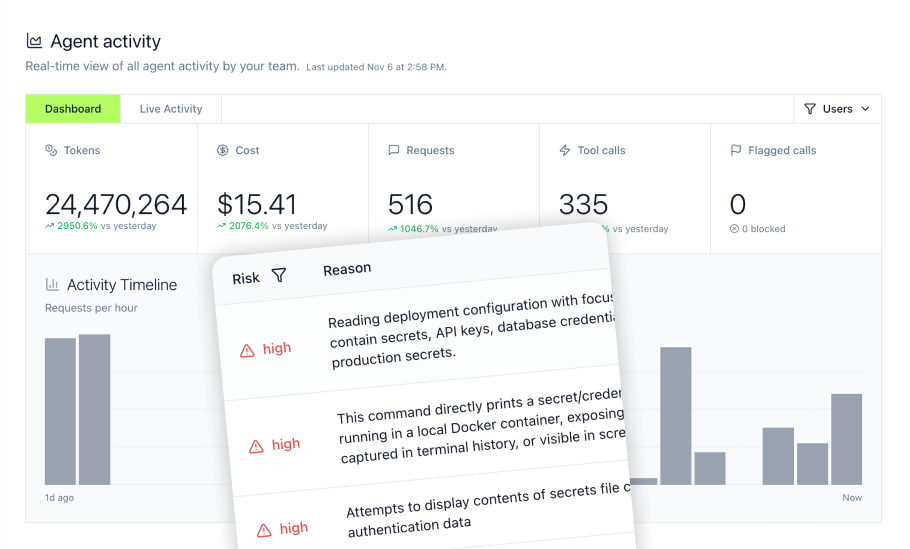
Gateway-only visibility leaves critical blind spots. Developers using Cursor or Claude Code can invoke MCP servers directly, bypassing centralized controls. Agent Monitor addresses this gap by tracking agent activity across the organization, including off-gateway actions.
Shadow AI Detection Capabilities
- Hooks into Cursor and Claude Code for local activity monitoring
- Detection of MCP calls made outside the gateway
- MDM integration for policy enforcement on developer machines
- Visibility into bash commands, file operations, and prompt submissions
Monitoring Beyond the Gateway
- PII exposure detection using built-in rules
- Credential leakage identification (API keys, tokens)
- Risky command flagging with configurable responses
- Prompt injection attempt detection
MintMCP's two-layer governance combines gateway controls for MCP traffic with Agent Monitor coverage for local non-MCP agent activity. This approach recognizes that comprehensive visibility requires monitoring at multiple points, not just the network edge.
Considering Total Cost of Ownership: Pilot to Enterprise Deployment
Open-source software carries zero licensing fees but non-zero total costs. TCO analysis should include:
Open-Source Cost Factors
- Engineering hours for deployment, maintenance, and upgrades
- Infrastructure costs (compute, storage, networking)
- Security operations (vulnerability scanning, patch management)
- Compliance activities (penetration testing, attestation preparation)
- Opportunity cost of building versus shipping product features
Managed Service Cost Factors
- Subscription fees (typically tiered by usage or seats)
- Implementation services (if required)
- Training and onboarding time
- Potential migration costs if switching vendors
Decision Framework by Organization Size
- Small teams: Managed services typically offer better ROI through faster deployment and lower operational overhead
- Mid-size teams: Evaluate based on internal platform engineering capacity and compliance requirements
- Large enterprises: Consider hybrid approaches with self-hosted options for sensitive workloads and managed services for standard deployments
MintMCP supports technical evaluation before broader rollout. Enterprise deployments can support managed SaaS, with VPC or self-hosted options available on request.
Leveraging Virtual MCPs (VMCPs) for Simplified Tool Access
Configuration complexity scales with the number of MCP servers, users, and permission combinations. Virtual MCPs address this by bundling multiple servers into single endpoints with role-based access.
VMCP Benefits
- Reduced configuration: One endpoint per role or use case versus many server configurations
- SCIM-driven membership: Automatic sync with Okta/Azure AD group changes
- Curated tool lists: Admin-approved tools per bundle versus all-or-nothing access
- Cascading policies: Organization-level rules inherited by team bundles
- Simplified onboarding: New users receive appropriate access through group membership
VMCP abstraction can reduce complexity for team onboarding, enabling non-technical users to benefit from AI agent capabilities without managing server configurations. This abstraction layer addresses a common adoption barrier where the configuration overhead of multiple MCP servers exceeds the perceived benefit for occasional users.
MintMCP: MCP Gateway and Agent Gateway Together
MintMCP combines MCP Gateway capabilities for governed data and tool connections with Agent Gateway capabilities for identities, permissions, memory, and monitoring for agents working alongside employees.
Governance-Native Architecture
MintMCP's data-permissions-first architecture starts from governance (SSO, SCIM, IdP groups, Virtual MCP Bundles, tool-level policy, audit) and enables agents on top. This design ensures agent access is always a subset of an already-governed permission model, addressing the common failure mode where agent platforms retrofit security after deployment.
The platform includes:
- 10,000+ MCP servers in catalog with managed runtime
- Official Cursor technology partnership
- Hosted MCP connectors with auto-scaling and sandboxed execution
- Admin MCP for conversational platform management
- Tool-update policy requiring admin approval for new upstream tools
Custom Policy Execution and Inline DLP Integration
MintMCP's JS sandbox middleware executes customer-authored JavaScript on every tool call with allowed-domains fetch for external API calls, secret injection for secure credential access, awsSign() SigV4 helper for AWS service integration, and built-in templates for OpenAI moderation and jailbreak detection. Pre- and post-phase hooks enable transformation, masking, or blocking.
Documented DLP integrations include AWS Bedrock Guardrails, Google Cloud DLP, Microsoft Purview, Nightfall, and Skyflow. This programmable layer enables enterprises to extend their existing security investments to AI agent traffic.
Per-Agent Identity and Credential Scoping
Agent Bundles provide first-class agent identity distinct from human users with bearer API keys plus OAuth 2.0 client-credentials per agent, independent rotation and revocation without affecting other agents, "act as agent" admin flow for connectors requiring per-agent OAuth, scoped permissions through Virtual MCP Bundles, and audit attribution to specific agent identities.
This model gives security teams cleaner attribution, safer credential rotation, and tighter blast-radius control for each deployed agent.
Enterprise Security and Compliance
For security teams, MintMCP provides SOC 2 Type II audited infrastructure with continuous compliance monitoring via Drata. The platform is compliant with HIPAA standards, penetration tested, and offers data encryption in transit and at rest with data residency options.
Frequently Asked Questions
How do MCP gateways differ from traditional API gateways in practice?
Traditional API gateways manage REST/GraphQL traffic between clients and backend services, handling authentication, rate limiting, and routing at the application level. MCP gateways extend this pattern to AI agent communications, but with a critical addition: action-level governance. Where an API gateway might grant or deny access to a database service, an MCP gateway controls which specific tools an agent can invoke, what parameters it can pass, and what data it can receive in responses. This granularity matters because AI agents make autonomous decisions about tool usage, requiring constraints that traditional request-level controls cannot provide. The MCP gateway also handles protocol-specific concerns like STDIO-to-HTTP translation, OAuth brokering for servers lacking native authentication, and context management across multi-turn agent conversations.
What criteria should enterprises use when evaluating MCP gateway security posture?
Beyond checking for SOC 2 Type II audit documentation and whether the vendor is compliant with HIPAA standards, enterprises should evaluate: (1) Credential isolation, ensuring each MCP server connection uses separate credentials that can be rotated independently; (2) Runtime policy enforcement, confirming policies execute on every tool call rather than only at connection time; (3) Audit completeness, verifying logs capture relevant activity context such as tool calls, parameters, responses, timestamps, and user attribution; (4) Transport security, checking for encryption in transit, encryption at rest, and appropriate data residency options; (5) Third-party validation through penetration testing reports and vulnerability disclosure processes. Request access to Trust Center documentation and security questionnaires early in evaluation to avoid delays.
How should organizations plan migration from open-source to managed MCP gateways?
Start with inventory: document all active MCP servers, their authentication methods, current users, and integration dependencies. Map existing policies to the managed service's governance model, identifying gaps that require custom middleware or policy code. Plan parallel operation during transition, routing test traffic through the managed gateway while production continues on open-source infrastructure. Migrate incrementally by connector type, starting with lower-risk integrations to validate behavior parity. Export audit logs from the open-source system before decommissioning to maintain historical records. Plan a phased migration period, with timeline depending on connector count, authentication complexity, custom policy logic, and audit requirements.
What role do MCP gateways play in multi-agent workflows?
Multi-agent architectures introduce complexity around credential sharing, audit attribution, and workflow provenance. MCP gateways with per-agent identity enable tracing tool calls through multi-step workflows, attributing each action to a specific agent even when agents invoke other agents. The gateway can enforce policies preventing credential escalation, where an agent calls another agent with broader permissions. For orchestrated workflows, the gateway maintains session context across agents, ensuring consistent authentication and policy application. Organizations building autonomous agent systems should evaluate how gateways handle agent-to-agent communication, not just agent-to-tool connections, as this pattern becomes increasingly common in production deployments.
How does MCP gateway selection affect compliance audit timelines?
Managed services with existing audit documentation, such as SOC 2 Type II audit reports and HIPAA documentation where available, can help narrow audit scope by documenting vendor-operated infrastructure controls. Open-source deployments require organizations to demonstrate their own controls for the entire stack, extending audit scope and preparation time. For first-time AI agent deployments in regulated industries, managed services with established compliance documentation can shorten preparation by reducing the amount of infrastructure evidence the customer must produce directly. However, highly customized implementations may require additional documentation regardless of deployment model. Request sample audit questionnaire responses and control mapping documents from vendors to estimate timeline impact before selection.