The Model Context Protocol has become foundational infrastructure for enterprise AI deployments, with MCP adoption reaching 97 million monthly SDK downloads as the standard transitioned to Linux Foundation governance in December 2025. Yet this rapid adoption creates significant security exposure: every AI agent connecting to internal databases, CRM systems, and development pipelines represents a potential attack vector that traditional security tools may not fully monitor without MCP-specific context. Organizations deploying Claude, Cursor, ChatGPT, Gemini, or Copilot face the challenge of enabling productivity gains while maintaining the access controls, audit trails, and compliance posture their security teams require. An MCP gateway addresses this by centralizing authentication, tool-level permissions, and logging across all agent activity, converting ungoverned AI tool sprawl into managed enterprise infrastructure.
This checklist provides actionable security practices for Model Context Protocol deployments, covering governance frameworks, credential management, threat detection, compliance requirements, and network architecture decisions that determine whether MCP becomes an asset or a liability for your organization.
Key Takeaways
- Bundle architecture simplifies governance by packaging tool access, policy enforcement, and audit logging into single units per team or role, eliminating the need to configure separate plugin, access rule, and credential objects
- Per-agent identity with scoped credentials enables audit attribution and credential rotation independent of human users, critical for tracking which agent accessed what data and when
- Shadow AI detection identifies off-gateway MCP usage in developer tools like Cursor and Claude Code, closing visibility gaps that gateway-only solutions miss
- Custom policy code execution on every tool call enables inline DLP integration with existing enterprise security investments including Bedrock Guardrails, GCP DLP, Microsoft Purview, Nightfall, and Skyflow
- Tool-level access control allows granular permissions such as enabling database reads while blocking writes, preventing agents from exceeding their intended scope
- SIEM integration with conversation-level logging exports prompts, tool calls, responses, and context with per-user attribution to Sentinel, Splunk, or S3 for unified security monitoring
- Zero-trust architecture requires mandatory authentication and authorization per request with no default access assumptions, aligning MCP infrastructure with modern security frameworks
- Complete audit trails support compliance investigations and regulatory review across HIPAA, SOC 2, and GDPR frameworks
Establishing Enterprise-Grade Governance for MCP Deployments
MCP governance begins with defining who can access which tools under what conditions. Without centralized policy enforcement, each AI agent deployment becomes an independent security decision, creating inconsistent controls and audit gaps across the organization.
Core Governance Components
- Identity provider integration: SSO through OAuth 2.0 and SAML ensures agents and users authenticate against your existing identity infrastructure
- SCIM group synchronization: Automatic membership updates from Okta or Azure AD eliminate manual permission management as teams change
- Role-based access control: Tool-level permissions determine which MCP servers each role can invoke, not just which systems they can reach
- Policy inheritance: Org-level policies cascade to team-level Bundles, ensuring baseline controls apply universally while allowing team-specific customization
The Bundle architecture addresses a fundamental problem with MCP governance at scale. Rather than configuring separate objects for plugins, access rules, and credentials, Bundles package everything needed for a specific team or use case into a single governance unit.
Implementing Zero-Trust Principles
Zero-trust for AI agents means treating every tool call as potentially unauthorized until proven otherwise. NIST zero-trust guidelines emphasize continuous verification and least privilege access. This requires:
- Mandatory authentication per request: No cached permissions or long-lived sessions that could be exploited
- Least privilege scoping: Agents receive only the tool access their specific function requires
- Continuous validation: Access decisions re-evaluate against current policy on each invocation
- Explicit deny by default: New tools or capabilities require administrative approval before becoming available
Streamlining Identity Management
Connecting MCP governance to existing identity infrastructure reduces administrative overhead while strengthening security:
- Okta/Azure AD integration: SCIM provisioning automatically adjusts agent access when employees change roles or leave
- Group-based permissions: Security teams define access at the group level rather than managing individual agent configurations
- Automated deprovisioning: When SCIM group membership changes, tool access updates immediately without manual intervention
MintMCP Gateway provides enterprise SSO and SCIM integration that synchronizes automatically with identity provider changes.
Centralized Logging and Audit Trails for MCP Security
Comprehensive logging transforms MCP from a security blind spot into a fully observable infrastructure layer. Without conversation-level capture, security teams cannot investigate incidents, demonstrate compliance, or understand how agents interact with sensitive systems.
Enterprise Logging Requirements
- Prompts submitted: The exact requests users send to AI agents, enabling context for downstream tool calls
- Tool calls invoked: Which MCP servers each agent contacted, with full parameter details
- Responses returned: What data flowed back through the agent, critical for data exposure investigations
- Context accessed: Resources the agent retrieved to formulate responses
- User attribution: Tying each action to a specific authenticated identity
Integrating with SIEM
Enterprise security teams operate through centralized SIEM platforms, not separate dashboards for each technology. MCP logging must feed these existing workflows:
- Microsoft Sentinel export: Native integration routes agent activity to your security operations center
- Splunk forwarding: Index MCP events alongside application and infrastructure logs for unified correlation
- S3 archival: Long-term retention in cloud storage supports compliance requirements
MintMCP Gateway provides full conversation-level logging with export to Sentinel, Splunk, and S3.
Supporting Compliance with Complete Audit Trails
Audit trail integrity determines whether logs can support compliance investigations or legal proceedings:
- Tamper-aware retention: Audit records should be protected with access controls, retention policies, and export options that support investigation and review
- Timestamping: Precise timing enables reconstruction of event sequences
- Chain of custody: Clear provenance from agent action through log storage to analyst retrieval
- Export capability: Compliance teams can extract records for auditors without disrupting operations
Proactive Threat Detection and Response for AI Agents
MCP security extends beyond preventing unauthorized access to detecting when authorized agents behave unexpectedly. Real-time monitoring identifies threats that policy alone cannot prevent.
Key Threat Categories
- PII exposure: Agents returning personally identifiable information beyond their intended scope
- Credential leakage: API keys, tokens, or passwords appearing in agent outputs
- Risky command execution: Bash commands that could modify systems or exfiltrate data
- Prompt injection attempts: Malicious inputs designed to manipulate agent behavior
- Unusual access patterns: Agents requesting tools or data outside normal operating parameters
Detecting Shadow AI
Gateway-based security only protects traffic routed through the gateway. Developers using AI coding assistants locally create shadow AI exposure that central controls cannot see.
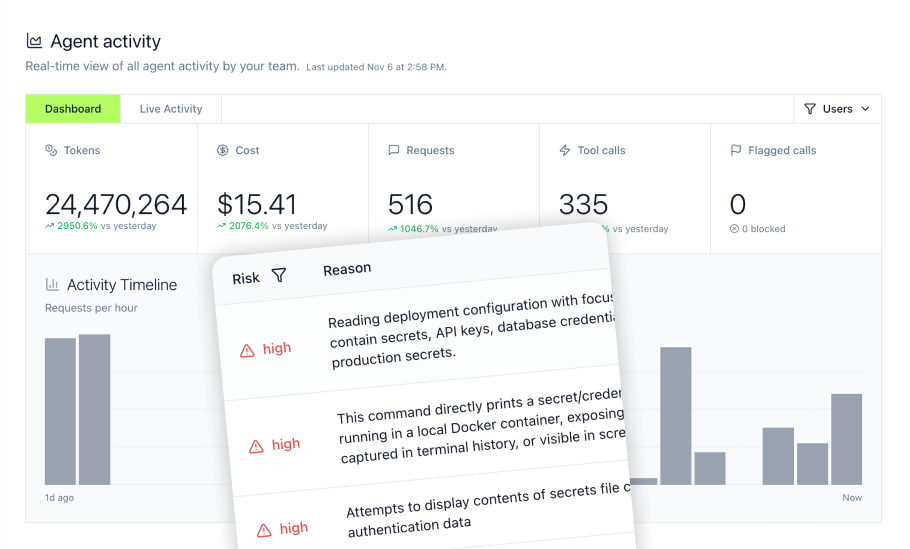
Agent Monitor addresses this visibility gap by tracking agent activity across the organization, including MCP calls made outside the gateway. This detection capability identifies off-gateway usage, local tool invocations, and unmanaged agent deployments. MDM integration enables enforcement mode configuration pushed to developer machines.
Implementing Advanced Guardrails
CISA AI resources emphasize securing AI systems through layered governance, risk management, and operational controls. Prompt injection represents a fundamental challenge for AI agent security. Defense layers include:
- Input validation: Pattern matching and content analysis on incoming prompts
- Output inspection: Scanning agent responses for sensitive data before delivery
- Behavioral analysis: Detecting unusual sequences of tool calls that suggest manipulation
- Custom guardrail policies: Organization-specific rules that reflect your threat model
The MCP data risk framework provides guidance on identifying and categorizing threats specific to your MCP deployment.
Data Protection Strategies for Model Context Protocol Operations
AI agents accessing enterprise data create data protection challenges that differ from traditional application access patterns.
Data Protection Requirements
- Encryption in transit: TLS for all MCP communication, including internal traffic between gateway and servers
- Encryption at rest: Data stored in logs, caches, or agent memory protected against unauthorized access
- Data residency options: Deployment and storage choices that should be reviewed against jurisdictional requirements
- Tokenization and masking: Sensitive fields replaced with tokens before agent processing
- Input/output inspection: Examining data flows to detect policy violations in real time
Integrating Enterprise DLP
Organizations with existing Data Loss Prevention investments should extend those capabilities to MCP traffic rather than building parallel systems.
MintMCP supports custom policy code execution on every tool call, enabling inline DLP integration with enterprise security platforms:
- AWS Bedrock Guardrails: Content filtering and sensitive data detection integrated at the gateway layer
- GCP DLP: Google's data protection APIs applied to MCP request and response content
- Microsoft Purview: Information protection policies enforced on agent data access
- Nightfall: AI-native sensitive data detection for unstructured content
- Skyflow: Data privacy vault integration for tokenization workflows
Data Residency Considerations
Multinational organizations face data residency requirements that constrain where AI agent processing can occur:
- Deployment location review: Confirm where gateway infrastructure, logs, and managed connectors run
- Data handling review: Validate how sensitive data is processed, stored, and exported
- Logging location review: Confirm whether audit trails meet internal retention and residency requirements
- Vendor documentation review: Match MintMCP's data residency options against your specific regulatory obligations
MintMCP offers data residency options for enterprise deployments, but teams with multi-region compliance requirements should validate exact deployment, processing, and logging boundaries during vendor review.
Building Network Security for MCP Infrastructure
MCP infrastructure introduces new network traffic patterns that existing security controls may not adequately address.
Network Security Considerations
- Firewall rule updates: MCP traffic paths through network security controls
- Network segmentation: Isolating MCP infrastructure from general corporate networks
- API security gateway integration: Leveraging existing API management for MCP endpoints
- DDoS protection: Ensuring gateway availability under load or attack conditions
Securing Gateway Deployments
Gateway placement affects both security and performance:
- DMZ deployment: Gateway as the only externally accessible MCP endpoint, with internal servers isolated
- VPC integration: Private connectivity between gateway and backend MCP servers
- SSL/TLS termination: Encryption management at appropriate network boundaries
For organizations requiring maximum control, MintMCP offers VPC and self-hosted deployment options on request, enabling security teams to evaluate MCP infrastructure within their preferred operating model.
Leveraging Sandbox Environments
MCP servers may execute code from various sources, including community-developed connectors. Sandboxed execution contains potential risks:
- Containerized isolation: Each MCP server runs in its own container with limited system access
- Input/output inspection: All data entering and leaving sandboxes subject to security review
- Resource limits: CPU, memory, and network constraints preventing resource exhaustion attacks
Developing a Cybersecurity Checklist for MCP Adoption
Systematic assessment ensures MCP deployments meet security requirements before production use.
Pre-Deployment Security Checklist
Before deploying MCP infrastructure:
- Identity provider integration tested with SSO and SCIM
- Network security rules updated for MCP traffic patterns
- Logging destinations configured and verified
- DLP integration validated for sensitive data detection
- Access policies defined for all user roles and agent types
- Incident response procedures documented for MCP scenarios
- Vendor security documentation reviewed and accepted
- Compliance requirements mapped to MCP controls
Post-Deployment Monitoring Checklist
Ongoing security operations:
- Daily review of security alerts and anomalies
- Weekly audit of access pattern changes
- Monthly policy review and updates
- Quarterly penetration testing of MCP infrastructure
- Annual compliance audit with MCP scope included
- Continuous monitoring of shadow AI indicators
- Regular credential rotation verification
MintMCP maintains a Trust Center with security documentation supporting enterprise security review, including penetration testing information and compliance materials.
Implementing Risk Management for AI Agent Deployments
MCP risk management requires adapting traditional frameworks to address AI-specific threat vectors while maintaining compatibility with existing enterprise risk programs.
Risk Assessment Framework
- Impact analysis: Evaluating consequences of agent security failures by data sensitivity and system criticality
- Likelihood estimation: Assessing probability based on threat intelligence and exposure analysis
- Control effectiveness: Measuring how well existing controls mitigate identified risks
- Residual risk acceptance: Documenting organizational acceptance of risks that cannot be fully mitigated
The agent security risks resource provides frameworks for categorizing and prioritizing MCP-specific threats.
Developing Incident Response Plans
MCP incidents require specialized response procedures:
- Detection triggers: Alerts indicating potential MCP security events
- Containment actions: Immediate steps to limit damage, including agent isolation and credential revocation
- Investigation procedures: Analyzing audit trails to understand incident scope and impact
- Recovery steps: Restoring normal operations with enhanced controls
Per-agent credential scoping enables rapid containment: when each agent has independent credentials, compromise of one agent does not expose credentials for others.
Securing AI Agents: Credential Hygiene and Scoping
Credential management for AI agents differs fundamentally from human user credentials. Agents operate continuously, access multiple systems, and cannot respond to authentication challenges the way humans can.
Credential Hygiene Best Practices
- Per-agent credentials: Each deployed agent receives its own rotatable credentials independent of creator access
- Scoped permissions: Credentials grant only the specific tool access each agent requires
- Automatic rotation: Regular credential refresh without manual intervention or service disruption
- Revocation capability: Immediate invalidation when agents are decommissioned or compromised
Automating Credential Rotation
Manual credential rotation does not scale across enterprise agent deployments. Automation requirements include scheduled rotation, zero-downtime updates, rotation verification, and emergency rotation capability.
Agent Bundles in MintMCP provide bearer API keys plus OAuth 2.0 client-credentials per agent, with rotation and revocation independent of human users.
Implementing Fine-Grained Permissions
Tool-level access control prevents agents from exceeding their intended scope through read vs. write separation, resource-specific access, action-level controls, and time-based restrictions.
Ensuring Compliance and Regulatory Adherence
Regulated industries face specific requirements for AI agent deployments that general security practices may not fully address.
Compliance Framework Mapping
| Framework | MCP Relevance | Key Requirements |
|---|---|---|
| SOC 2 | Access controls, logging, availability | Audit trails, access management, security monitoring |
| HIPAA | Protected health information handling | BAA requirements, encryption, access logging |
| GDPR | Personal data processing | Consent, data minimization, right to erasure |
| ISO 27001 | Information security management | Risk assessment, policy controls, continuous improvement |
Mapping SOC 2 Controls to MCP
SOC 2 Type II audits require evidence that controls operate effectively over time. MCP-specific considerations include access control evidence, logging completeness, change management procedures, and documented incident response.
The SOC 2 compliance whitepaper provides detailed guidance on mapping SOC 2 requirements to MCP controls.
Navigating HIPAA Requirements
Healthcare organizations deploying AI agents face HIPAA-specific requirements including Business Associate Agreements, minimum necessary access, audit controls, and encryption requirements.
MintMCP is compliant with HIPAA standards and signs BAAs for customers handling protected health information. Contact MintMCP for HIPAA documentation and compliance support.
Managing the MCP Ecosystem
MCP deployments typically involve multiple connectors accessing various enterprise systems. Managing this ecosystem requires balancing functionality with security.
Securing Third-Party Connectors
Third-party connectors introduce supply chain risk through vendor security assessment, code review, dependency analysis, and update management requirements.
MintMCP provides access to pre-configured MCP connectors with managed runtime, enabling organizations to leverage connectors including Salesforce, GitHub, Slack, HubSpot, Notion, Linear, Gmail, and Stripe without managing individual connector security.
Hosting Custom Servers
Custom MCP servers require secure development lifecycle, input validation, output encoding, authentication enforcement, and logging implementation.
STDIO server support automatically converts locally-run MCP servers to hosted, production-ready services with OAuth wrapping, eliminating code changes while adding enterprise authentication.
Why MintMCP Gateway is Essential for Enterprise MCP Security
Enterprise MCP security requires a comprehensive approach that integrates governance, logging, threat detection, data protection, and compliance into a unified control plane. Organizations cannot address these requirements through piecemeal solutions or manual processes at scale.
MintMCP Gateway provides a purpose-built MCP security platform for addressing these challenges holistically. The platform's Bundle architecture eliminates configuration complexity by packaging tool access, policy enforcement, and audit logging into single governance units. Per-agent identity with OAuth 2.0 and bearer token support enables credential rotation and audit attribution independent of human users. Custom policy code execution on every tool call allows inline DLP integration with existing enterprise security investments including AWS Bedrock Guardrails, GCP DLP, Microsoft Purview, Nightfall, and Skyflow.
Conversation-level logging captures the complete chain from prompt through tool calls to response with per-user attribution, feeding directly into Sentinel, Splunk, or S3 for unified security monitoring. Agent Monitor extends visibility beyond the gateway to detect shadow AI in developer tools, closing the visibility gap that gateway-only solutions miss. Enterprise SSO, SCIM synchronization, tool-level RBAC, and VPC deployment options provide the access control and network architecture flexibility security teams require.
MintMCP is SOC 2 Type II audited and compliant with HIPAA standards, with BAAs available for healthcare customers. The Trust Center provides security documentation, penetration testing information, and compliance materials supporting enterprise procurement review.
Frequently Asked Questions
What is the difference between MCP Gateway security and traditional API gateway security?
MCP gateways address AI-specific security requirements that traditional API gateways cannot handle. While both manage authentication and rate limiting, MCP gateways must inspect conversation context, enforce tool-level permissions within a single endpoint, detect prompt injection attempts, and maintain audit trails that capture the full chain from user prompt through multiple tool invocations to final response. Traditional API gateways see individual requests in isolation, missing the conversational context that determines whether agent behavior is appropriate.
How does credential management for AI agents differ from service account management?
Traditional service accounts provide static credentials shared across application instances, making it impossible to attribute specific actions to specific deployments. AI agent credential management requires per-agent identity with independently rotatable credentials, enabling security teams to revoke access for a single compromised agent without disrupting others. Agents also require scoped credentials that grant only the specific tool access each agent needs, not broad service account permissions. The credential rotation challenge is more acute because agents operate continuously without human availability to respond to authentication challenges.
What audit trail detail is required for regulatory compliance with MCP deployments?
Regulatory compliance typically requires audit trails that demonstrate who accessed what data, when, and for what purpose. For MCP deployments, this means capturing the full conversation context: the prompt that initiated agent action, each tool call the agent made in response, the parameters sent to each tool, the data returned from each tool, and the final response delivered to the user. Per-user attribution must tie this entire chain to an authenticated identity, not just log that "an agent" performed an action. Retention requirements vary by regulation, contract, auditor expectations, data type, and internal policy, so teams should define MCP log retention with legal, compliance, and security stakeholders before production deployment.
How can organizations detect AI agents operating outside managed infrastructure?
Shadow AI detection requires visibility into developer environments where AI coding assistants operate locally without routing through centralized gateways. Agent Monitor hooks into AI tools like Cursor and Claude Code to detect MCP calls made outside the gateway, file system access patterns, bash command execution, and prompt submissions. MDM integration enables pushing detection or enforcement configurations to developer machines, ensuring consistent policy application across the organization.
What is the relationship between MCP Gateway and Agent Gateway?
MCP Gateway provides governed data and tool connections for AI systems organizations already run, including Claude, Cursor, ChatGPT, Gemini, and Copilot. This covers authentication, access control, and audit for how agents connect to enterprise systems and data. Agent Gateway builds on this foundation to provide identities, permissions, memory, and monitoring for agents that work alongside users as persistent team members. While MCP Gateway governs what agents can access, Agent Gateway governs who agents are and how they operate over time.