LLM proxies like LiteLLM have helped thousands of teams unify API calls across multiple model providers. But as organizations move from experimentation to production AI deployments, the gap between routing requests and governing agents becomes impossible to ignore. With AI adoption reaching 78% in 2024, up from 55% the prior year, the infrastructure that got you started is rarely the infrastructure that scales. This article examines when teams outgrow simple LLM proxies, what a dedicated MCP gateway provides that proxies cannot, and how Agent Gateway capabilities extend that foundation with agent identities, permissions, memory, and monitoring.
Key Takeaways
- LLM proxies excel at API routing, cost monitoring, and model switching, but lack the governance layer enterprises require for production AI agent deployments
- The Model Context Protocol (MCP) enables AI agents to connect with enterprise data sources, creating new security and compliance requirements that proxies were not designed to handle
- Self-hosted LLM proxy deployments can create significant first-year operating costs when infrastructure, DevOps, and compliance build-out are included
- Many enterprises still lack comprehensive security frameworks for AI agents, making governance a critical gap in production deployments
- MCP gateways provide tool-level access control, credential management, and audit logging that standard proxies cannot deliver
- Shadow AI detection addresses the reality that unintended agent actions can occur in production environments
- Bundle-based governance simplifies enterprise permissions by packaging tool access, policy enforcement, and audit trails into single deployment units
What is an LLM Proxy and Why You Might Start There
An LLM proxy sits between your applications and model providers, abstracting away the differences between APIs from OpenAI, Anthropic, Google, and dozens of other vendors. LiteLLM supports over 100 LLM providers through a unified interface for model API calls.
The Role of LLM Proxies in Early AI Adoption
Teams typically adopt LLM proxies to solve immediate operational challenges:
- Model abstraction: Switch between GPT-4, Claude, and Gemini without rewriting application code
- Cost monitoring: Track spending across providers with centralized dashboards
- Rate limiting: Prevent runaway costs from misconfigured applications
- Load balancing: Distribute requests across multiple API keys or providers
- Basic logging: Capture request and response data for debugging
These capabilities make LLM proxies essential for teams experimenting with multiple models or managing costs during initial deployments.
Common Features of LLM Proxies
LiteLLM and similar tools provide a Python SDK and proxy server that standardizes the OpenAI API format across providers. Key features include virtual keys for budget management, fallback routing when providers experience outages, and integration with observability tools like Langfuse and Arize Phoenix.
For prototyping and small-scale deployments, these features are often sufficient. The challenge emerges when teams move beyond simple request routing to deploying AI agents that interact with enterprise data sources.
Beyond Basic Routing: The Emergence of the Model Context Protocol (MCP)
The Model Context Protocol represents a fundamental shift in how AI agents interact with external systems. Rather than agents making raw API calls to databases, CRMs, and development tools, MCP provides a standardized interface for tool access that major AI platforms are increasingly adopting.
Understanding MCP's Role in Agentic AI
MCP defines how AI agents request and receive context from external systems. When Claude queries your Snowflake data warehouse or Cursor accesses your GitHub repositories, those interactions flow through MCP servers that expose specific tools and resources.
This standardization has accelerated as major AI platforms adopted MCP. The protocol has since been donated to the Agentic AI Foundation under the Linux Foundation, and the MCP ecosystem has reached 97 million monthly SDK downloads.
Why MCP Matters for Enterprise AI
The shift from LLM API routing to MCP-based agent interactions introduces requirements that proxies were never designed to handle:
- Tool-level permissions: Controlling which tools an agent can invoke, not just which models it can access
- Credential management: Handling OAuth flows and API keys for dozens of enterprise systems
- Data governance: Ensuring agents cannot access sensitive information outside their authorized scope
- Audit trails: Logging not just prompts and responses, but every tool invocation and data access
A comprehensive MCP data risk framework becomes essential when agents can query production databases, send emails, and modify project management systems.
From LLM Proxy to Dedicated Gateway: Bridging the Enterprise AI Gap
The transition from LLM proxy to dedicated MCP gateway parallels the earlier evolution from simple reverse proxies to full API management platforms. The same pattern applies: what starts as request routing eventually requires authentication, authorization, rate limiting, transformation, and comprehensive observability.
The Limitations of Simple Proxies for Agents
LLM proxies operate at the model API layer. They see prompts and completions, but have no visibility into what happens when an agent uses tools to interact with external systems. This creates several gaps:
- Server-level access only: LiteLLM's MCP support filters at the namespace level, not the individual tool level
- No hosted runtime: Teams must deploy and manage their own MCP servers
- No OAuth brokering: OAuth flows for enterprise connectors require custom implementation
- Limited compliance infrastructure: Evidence for SOC 2, HIPAA, and other compliance standards usually depends on the team's own deployment, logging, access control, and operational controls
Core Requirements for Enterprise AI Infrastructure
Production AI deployments require infrastructure that addresses governance alongside connectivity. As teams move from experimentation to production, demand is shifting from simple model routing toward purpose-built AI infrastructure with authentication, authorization, policy enforcement, and observability.
A dedicated MCP gateway provides centralized authentication, tool-level access control, credential management, policy enforcement, and audit logging for every agent interaction with enterprise systems.
Advanced Governance for Large Language Models: Access, Policies, and Bundles
Enterprise AI governance requires more than access control lists. Teams need to manage permissions across roles, departments, and use cases while maintaining auditability for compliance.
Simplifying Complex Permissions with Bundles
The Bundle architecture packages tool access, policy rules, and audit trails into single governance units tied to identity provider groups. When an employee joins the Sales team in Okta, they automatically receive access to the Salesforce, Gmail, and Calendar connectors bundled for that role.
Bundle capabilities include:
- SCIM-driven group membership that syncs automatically with Okta and Azure AD
- Curated tool lists that expose only approved capabilities per role
- Per-Bundle access policies that cascade from organization to team level
- Isolated audit trails for compliance investigations
Ensuring Granular Control over LLM Interactions
Tool-level access control means the difference between allowing database reads but blocking writes, or enabling email viewing but preventing sending. This granularity is essential for least-privilege security models where agents should never have more access than their specific task requires.
Virtual MCP Bundles abstract multiple MCP servers into single endpoints with role-based tool access. Non-technical users can configure agent permissions without understanding the underlying connector architecture.
Custom Policy Enforcement and Data Loss Prevention (DLP) for AI Agents
Governance requires enforcement at the point of interaction. Policies that only generate alerts after the fact cannot prevent sensitive data from leaving the organization through agent actions.
Integrating Security at the Tool Call Level
Custom policy code execution on every tool call enables inline DLP integration. Pre- and post-phase hooks can transform, mask, or block requests before they reach external systems or return sensitive data to agents.
Documented DLP and guardrail integrations can include:
- AWS Bedrock Guardrails for content filtering and PII masking
- Google Cloud DLP for sensitive data detection
- Microsoft Purview for information protection
- Nightfall and Skyflow for specialized data security
Runtime policy enforcement is becoming more important as agents gain access to production systems, sensitive data, and enterprise tools.
Meeting Compliance with Advanced AI Gateways
Enterprises in regulated industries require infrastructure that meets specific compliance standards. SOC 2 Type II audited platforms provide evidence that security controls are designed and operating effectively over time. Platforms that are compliant with HIPAA standards and offer Business Associate Agreements can support healthcare organizations handling protected health information.
Penetration-tested infrastructure, data encryption in transit and at rest, and available deployment options help address security requirements that self-hosted solutions must assemble and operate themselves.
Shadow AI Detection and Observability: Guarding Against Unsanctioned Agent Use
Gateway-only solutions have a blind spot: they cannot see agent activity that bypasses the gateway entirely. When developers install MCP servers locally in Cursor or Claude Code, those interactions happen outside any centralized governance.
Identifying and Mitigating Risks from Off-Gateway Activity
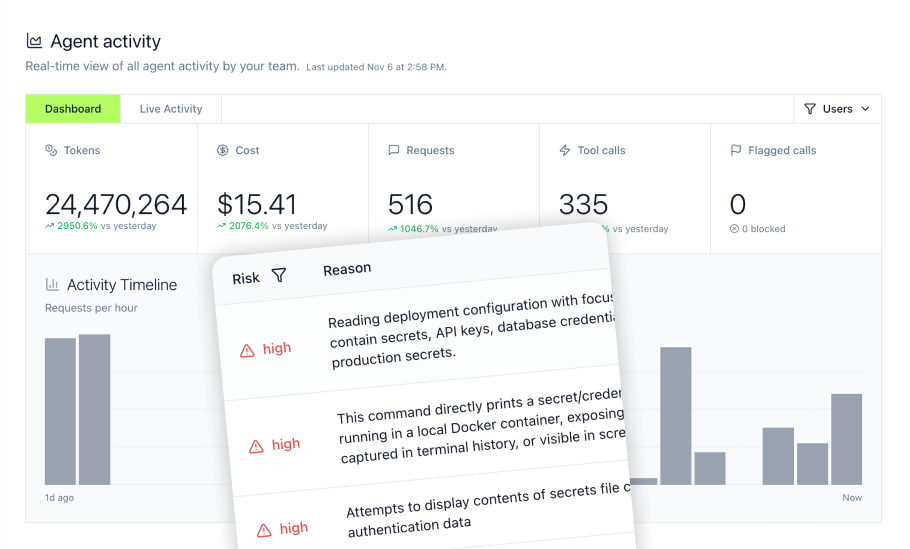
Agent Monitor tracks supported agent activity in real time, including MCP calls, file access, and command execution captured through development-tool hooks. This shadow AI detection addresses a critical gap in the standard MCP specification, which provides no visibility into off-gateway usage patterns.
Detection capabilities include:
- PII exposure in prompts and responses
- Credential leakage including API keys and tokens
- Risky bash commands that could modify or delete files
- Prompt injection attempts targeting agent behavior
MDM integration enables push of detect-only or enforce-mode configurations to developer machines for consistent policy application across the organization.
Real-time Monitoring for AI Agent Security
Recent MCP security research paints a concerning picture: agent tool access introduces risks around unauthorized access, prompt injection, privilege escalation, and auditability. Real-time monitoring with custom guardrail policies and block/flag/alert actions addresses these risks before they become incidents.
Org-level analytics on gateway-mediated MCP adoption, usage patterns by team and tool, latency monitoring, and error tracking provide the visibility security teams need to manage AI infrastructure effectively.
API Gateway vs LLM Gateway: Why Specialization Matters for AI
Traditional API gateways manage REST APIs, handling authentication, rate limiting, and routing for microservices architectures. LLM gateways serve a different purpose: managing the unique requirements of AI model interactions and agent tool calls.
Distinguishing Between General-Purpose and AI-Specific Gateways
API gateways optimize for request-response patterns with predictable payloads. LLM interactions involve streaming responses, conversation context, and tool orchestration that requires specialized handling.
Key differences include:
- Context awareness: LLM gateways must track conversation state across multiple interactions
- Tool orchestration: Managing agent tool calls requires understanding MCP semantics, not just HTTP verbs
- Semantic routing: Directing requests based on intent, not just URL paths
- Data provenance: Tracking what information informed an agent's response for audit purposes
- Per-user attribution: Logging at the conversation level with user identity for compliance
The Evolving Requirements of Agent-Centric Architectures
As AI moves from chat interfaces to autonomous agents, the infrastructure layer must evolve accordingly. Agent Gateway capabilities build on MCP Gateway foundations, adding identities, permissions, memory, and monitoring for agents that work alongside employees.
Coworker agents that live in Slack, hold memory across sessions, and continue work across days require infrastructure that treats agents as first-class principals with their own credentials and permission scopes.
Deploying Enterprise AI: Self-Hosted vs. Managed LLM Gateway Solutions
Deployment model significantly impacts total cost of ownership, time to production, and ongoing operational burden.
Evaluating Deployment Options for Your LLM Gateway
Self-hosted solutions like LiteLLM require teams to provision infrastructure, manage dependencies, configure deployments, and maintain ongoing operations. First-year costs can rise when infrastructure, DevOps setup, compliance work, and ongoing maintenance are included.
Managed SaaS solutions reduce infrastructure burden but may not meet every requirement for teams that need air-gapped deployments, custom hosting, or strict regional architecture constraints. Some platforms offer VPC or self-hosted options on request.
Transforming Local MCP Servers into Production Services
STDIO server support helps teams move locally run MCP servers into hosted, production-ready services with OAuth wrapping, reducing the code and infrastructure work required. This reduces the operational challenge of every developer running their own MCP server with personal credentials.
Hosted MCP connectors run in isolated, sandboxed execution environments with auto-scaling. Teams access pre-built connectors for Snowflake, Elasticsearch, Gmail, Notion, Linear, and other enterprise systems without managing container infrastructure.
Why Your Organization Will Outgrow a Simple LLM Proxy
The trajectory from LLM proxy to dedicated gateway is not optional for organizations serious about production AI deployments. The gap between routing API calls and governing agent behavior widens as deployments scale.
The Inevitable Trajectory Towards Sophisticated AI Governance
Several signals indicate when teams are ready to move beyond simple proxies:
- Compliance requirements emerge: SOC 2, HIPAA, or internal audit requirements that demand comprehensive logging and access controls
- Credential sprawl becomes unmanageable: Too many API keys and OAuth tokens distributed across too many systems
- Shadow AI appears: Developers running MCP servers outside any centralized visibility
- Audit requests arrive: Legal or compliance teams asking for evidence of what data agents accessed
- Scale demands governance: Moving from dozens to hundreds of users with different permission requirements
Predicting Your Enterprise AI Needs
Organizations typically reach the transition point when AI agents begin interacting with production data sources rather than just generating text. The moment an agent can query customer data, access financial systems, or modify project management tools, the governance requirements exceed what LLM proxies provide.
Centralizing agent security policies becomes essential when multiple teams deploy agents across different AI platforms. A unified governance layer ensures consistent policy enforcement regardless of whether agents run in Claude, Cursor, ChatGPT, Gemini, or Copilot.
Why MintMCP is Built for This Moment
The evolution from LLM proxy to enterprise AI infrastructure is not theoretical. Organizations deploying agents at scale need a platform purpose-built for the governance, security, and operational challenges that emerge when AI systems interact with production data and business-critical tools.
MintMCP provides the complete infrastructure stack for production AI agent deployments. The platform combines MCP Gateway for tool-level access control, credential management, and policy enforcement with Agent Gateway capabilities that extend governance to agent identities, memory, and monitoring. This unified architecture eliminates the gap between model routing and agent governance that proxies cannot bridge.
The platform addresses the specific challenges enterprises face: Bundle-based permissions simplify role management across identity providers, hosted MCP connectors reduce operational overhead, and Agent Monitor provides visibility into shadow AI activity that occurs outside gateway control. Documented integrations with AWS Bedrock Guardrails, Google Cloud DLP, and Microsoft Purview enable inline data loss prevention at the tool-call level.
For teams that have outgrown simple LLM proxies, MintMCP delivers the governance infrastructure production deployments require. SOC 2 Type II audited controls, compliance with HIPAA standards, and Business Associate Agreements support regulated industries. STDIO server support helps teams move local development servers into production-ready hosted services with OAuth wrapping and less infrastructure work.
The platform's architecture reflects the reality that enterprise AI infrastructure must serve both current chat-based applications and future autonomous agent deployments. When your organization reaches the point where governance becomes non-negotiable, MintMCP provides the foundation that scales from initial deployment through enterprise-wide adoption.
Frequently Asked Questions
What is the fundamental difference between LiteLLM and a dedicated MCP gateway like MintMCP?
LiteLLM operates as an LLM proxy that standardizes API calls across model providers. It handles model routing, cost tracking, and basic logging for LLM interactions. A dedicated MCP gateway operates at a different layer, managing how AI agents interact with enterprise data sources and tools. While LiteLLM sees prompts and completions, an MCP gateway controls tool-level permissions, manages credentials for external systems, enforces data loss prevention policies, and provides comprehensive audit trails for compliance. The distinction is between routing model API calls and governing agent behavior across enterprise systems.
How do per-agent credentials differ from shared service accounts for AI deployments?
Traditional approaches use shared service accounts where all agents authenticate to external systems using the same credentials. Per-agent credentials assign each deployed agent its own identity with independently rotatable tokens and scoped permissions. This approach enables precise audit attribution since every action traces to a specific agent identity. It also improves security hygiene by allowing credential rotation for individual agents without affecting others. When security incidents occur, per-agent credentials limit blast radius and simplify investigation. Agent Bundles extend this model with M2M authentication using OAuth 2.0 client credentials per agent.
Can organizations migrate incrementally from an LLM proxy to a full MCP gateway?
Yes, migration typically follows a phased approach. Organizations often begin by running both systems in parallel, routing non-critical traffic through the MCP gateway while maintaining the LLM proxy for production workloads. The second phase involves migrating MCP server deployments to the hosted platform, testing OAuth flows and tool-level access controls. Final cutover increases traffic to 100% while monitoring performance and compliance logging. For LLM routing specifically, migration requires changing endpoint configurations. The more substantial work involves deploying governed MCP connectors and configuring Bundle-based permissions to replace ad-hoc access patterns.
What governance capabilities does an MCP gateway provide that cannot be retrofitted onto an LLM proxy?
Several capabilities require architectural foundations that proxies lack. Tool-level access control requires understanding MCP semantics rather than just HTTP requests. OAuth brokering for STDIO servers works around redirect URI limitations that hosted containers introduce. Virtual MCP Bundles with SCIM-driven membership require integration with identity providers at a level beyond API key management. Shadow AI detection through agent monitoring hooks requires instrumentation in development tools that operate outside any proxy path. Custom middleware execution with DLP integration requires a request processing pipeline designed for policy enforcement. These capabilities cannot be added to a system designed primarily for API routing.
How does enterprise agent memory differ from standard LLM context windows?
Enterprise agent memory extends beyond the conversation context that LLMs maintain during a session. Production agents require private, team, organization, and customer memory scopes that persist across interactions and respect access boundaries. This memory should be company-owned, versioned, reviewable, auditable, and portable rather than locked in vendor-controlled storage. Git-like memory principles apply: changes should be tracked, reviewable by authorized personnel, and exportable for compliance or vendor migration. Coworker agents that operate alongside employees need memory that continues work across days while remaining under organizational governance rather than disappearing when sessions end.