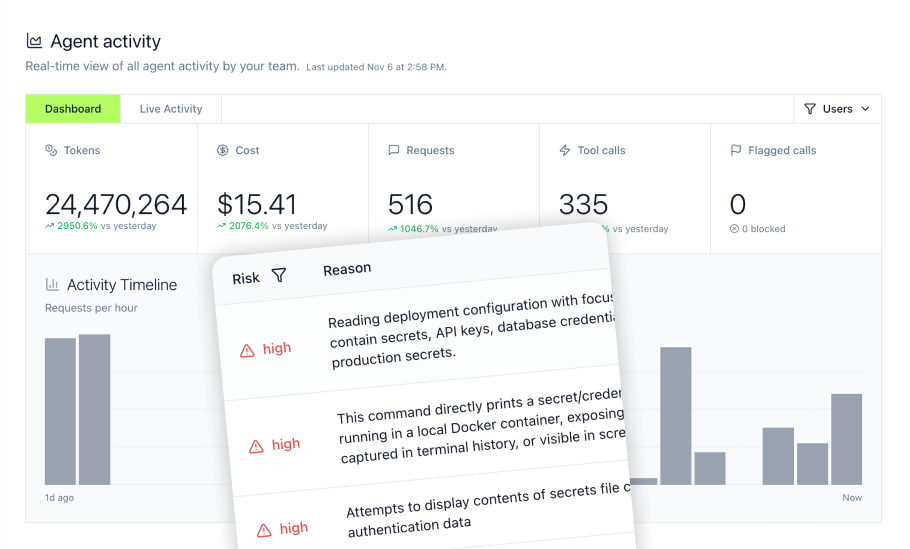
AI agents are rapidly becoming core enterprise infrastructure, connecting to databases, CRMs, code repositories, and internal tools. But without centralized governance, each agent creates ungoverned point-to-point connections with scattered credentials, no audit trails, and expanding attack surfaces. An Agent Gateway solves this by providing the control layer for agent identities, permissions, memory, and monitoring. For organizations deploying Claude, Cursor, ChatGPT, Gemini, or Copilot across teams, MintMCP's MCP Gateway provides the foundation for governed AI agent infrastructure, enabling secure tool access while maintaining centralized visibility into governed agent activity.
This article explains what an Agent Gateway is, why enterprises need one, and how to implement governed AI agent infrastructure that scales with your organization.
Key Takeaways
- An Agent Gateway is a centralized control layer that handles authentication, routing, policy enforcement, and observability for all AI agent communications with tools and data sources
- Agent Gateways solve the M×N integration problem where each agent needs separate integrations to multiple tools, creating credential sprawl and governance gaps
- Centralized Agent Gateways can reduce integration sprawl by standardizing routing, credential handling, policy enforcement, and audit logging across agent-to-tool connections
- The Model Context Protocol (MCP) has become a common standard for AI agent tool connections, with growing support across major AI ecosystems
- Per-agent identity with scoped credentials enables independent rotation and audit attribution, critical for compliance in regulated industries
- Shadow AI detection through agent monitoring hooks identifies ungoverned agent activity in developer tools like Cursor and Claude Code
- MintMCP's Bundle architecture packages tool access, policy enforcement, and audit logging into single governance units per team or role
Understanding AI Agents and the Need for Governance
AI agents operate autonomously to complete tasks by interacting with external tools and data sources. Unlike simple chatbots that respond to queries, agents take actions: querying databases, creating tickets, modifying code, sending emails, and accessing sensitive business systems.
Common enterprise agent types include:
- Coding assistants that access GitHub, run terminal commands, and modify file systems
- Data analysis agents that query Snowflake, BigQuery, and internal data warehouses
- Customer support agents that access CRM systems, ticketing platforms, and knowledge bases
- Development workflow agents that connect to Jira, Linear, CI/CD pipelines, and monitoring tools
The challenge emerges at scale. When 50 agents need access to 30 different tools, you face 1,500 potential integration points. Each connection requires its own credentials, access controls, and audit mechanisms. Without centralization, security teams lose visibility, credentials proliferate across systems, and authentication and access-control failures become harder to detect and resolve.
Organizations running AI agents without governance infrastructure face specific risks:
- Credential sprawl: Shared service accounts with broad permissions across multiple agents
- No audit attribution: Inability to trace which agent performed which action
- Silent capability expansion: Upstream MCP servers adding new tools without admin approval
- Shadow AI: Developers running unmonitored agents through local tools
The solution requires a layer that sits between agents and everything they interact with, centralizing authentication, policy enforcement, and observability. This is the Agent Gateway.
The Agent Gateway: Your Central Hub for AI Agent Infrastructure
An Agent Gateway is a centralized control layer that manages all communication between AI agents and their tools, data sources, and other agents. It handles authentication, routing, policy enforcement, and observability for every request, providing unified governance across multi-agent systems.
The concept parallels how API gateways transformed microservices architecture. Before API gateways, each service managed its own authentication, rate limiting, and logging. API gateways centralized these concerns, enabling consistent security and observability across all service communication. Agent Gateways do the same for AI agent infrastructure.
An Agent Gateway provides:
- LLM Gateway capabilities: Route traffic to OpenAI, Anthropic, Gemini, and other providers with unified APIs, cost tracking, and failover
- MCP Gateway capabilities: Connect agents to tools and data sources via Model Context Protocol with OAuth, tool discovery, and access control
- Agent-to-Agent communication: Enable secure multi-agent workflows across different frameworks
- Security and observability: JWT and API key authentication, RBAC, rate limiting, OpenTelemetry tracing, and real-time metrics
MintMCP approaches this through two connected product categories. The MCP Gateway provides governed data and tool connections for AI systems including Claude, Cursor, ChatGPT, Gemini, and Copilot. Built on this foundation, the Agent Gateway layer adds identities, permissions, memory, and monitoring for agents that work alongside employees.
This solves what MintMCP calls the "last mile problem" in enterprise AI: giving agents secure, governed access to internal systems without requiring extensive engineering overhead for each integration.
Core Capabilities: Unifying Authentication, Authorization, and Access for AI Agents
Effective agent governance requires controlling who or what can access which tools, with what permissions, and under what conditions. Agent Gateways centralize these decisions rather than scattering them across individual agent configurations.
Authentication and identity
Agent Gateways support standard enterprise authentication including OAuth 2.0 and SAML integration with identity providers like Okta and Azure AD. Each AI agent receives its own persistent identity with scoped credentials that can be rotated independently of human user credentials.
This per-agent identity model addresses a critical security gap. Traditional approaches share service account credentials across multiple agents, making it impossible to attribute actions or rotate credentials without disrupting all agents. Per-agent credentials enable:
- Independent rotation schedules based on risk profile
- Precise audit attribution for compliance investigations
- Credential revocation for specific agents without broad impact
- Scoped permissions that follow least-privilege principles
MintMCP implements this through Agent Bundles, which give each deployed agent its own rotatable credentials and permission scope independent of its creator's access level.
Authorization and access control
Beyond authentication, Agent Gateways enforce granular tool-level access controls. Organizations can:
- Enable database read operations while blocking writes
- Allow Slack message posting but restrict channel creation
- Permit GitHub pull request reviews but prevent direct commits
- Grant CRM record access while blocking bulk exports
Rate limiting per user, team, or agent prevents runaway automation from overwhelming downstream systems. Policy rules can require admin approval before agents access sensitive tools or perform high-risk operations.
Credential management
Managing credentials across dozens of tool integrations creates operational burden. Agent Gateways centralize credential storage with:
- Automatic rotation policies
- Centralized secrets handling for governed connector access
- OAuth token refresh handling
- Credential health monitoring
This reduces the credential management burden that scales linearly with each new tool integration. Centralizing credential management becomes increasingly important as teams add more MCP servers, agents, and tool integrations.
Advanced Governance: Real-time Monitoring and Policy Enforcement
Authentication and authorization establish baseline controls. Advanced governance requires real-time visibility into agent behavior and the ability to enforce policies at runtime.
Real-time agent monitoring
MintMCP's Agent Monitor tracks agent activity across the organization, including MCP calls made outside the gateway through hooks in Cursor and Claude Code. This addresses a critical gap: agents running locally on developer machines often bypass centralized infrastructure entirely.
Agent Monitor detects:
- PII exposure in agent inputs and outputs
- Credential leakage including API keys and tokens
- Risky bash commands that could modify systems
- Prompt injection attempts targeting agent behavior
Each detection can trigger block, flag, or alert actions based on organizational policy. MDM integration enables push of detect-only or enforce-mode configurations to developer machines for consistent policy application.
Shadow AI detection
One of the largest governance gaps involves shadow AI where developers run agents through local tools without organizational oversight. These ungoverned agents may access production systems, store credentials insecurely, or process sensitive data without audit trails.
Agent Monitor hooks identify off-gateway MCP usage in developer tools, providing visibility into agent activity that would otherwise remain invisible to security teams. This capability is particularly important as AI coding assistants become standard developer tools.
Policy enforcement
Beyond detection, Agent Gateways enable inline policy enforcement. MintMCP supports custom policy code execution on every tool call, enabling:
- Integration with DLP platforms including Bedrock Guardrails, GCP DLP, Microsoft Purview, Nightfall, and Skyflow
- Custom guardrail policies written in JavaScript
- Token masking for sensitive data in transit
- Jailbreak detection and blocking
These policies execute in a JS sandbox with allowed-domains fetch, secret injection, and built-in templates for common security patterns. Organizations with existing DLP investments can integrate their current security tooling rather than replacing it.
Ensuring Compliance and Auditability for AI Agent Workflows
Regulated industries require reliable audit trails for governed agent actions. Agent Gateways provide the logging and compliance infrastructure that individual agent deployments lack.
Comprehensive audit logging
Agent Gateways capture structured audit logs for governed agent activity, including user or agent attribution, tool calls, policy decisions, and relevant request metadata. Logs include:
- Timestamp and duration for every request
- Agent identity and user attribution
- Tool name and parameters
- Response status and relevant metadata
- Policy decisions such as allowed, blocked, or flagged
Configurable retention policies support compliance requirements ranging from 90 days to 7 years. Export capabilities integrate with SIEM platforms including Microsoft Sentinel, Splunk, and S3 for centralized security monitoring.
Security and compliance posture
Enterprise Agent Gateway platforms can centralize security controls, audit trails, and compliance documentation that are difficult to maintain across scattered agent deployments. MintMCP is SOC 2 Type II audited with continuous compliance monitoring via Drata. The platform is compliant with HIPAA standards, with BAA available for healthcare customers handling protected health information.
Additional security measures include:
- Penetration tested infrastructure
- Data encrypted in transit and at rest
- Data residency options
- Uptime SLA for production workloads
For detailed security documentation, visit the MintMCP Trust Center or contact security@mintmcp.com.
Audit trail capabilities
Agent Gateways provide centralized audit records that support forensic analysis, incident review, and regulatory inquiries. Provenance tracking across multi-step agent workflows shows the chain of actions from initial request to final output.
Organizations evaluating MCP data risk can use these audit capabilities to demonstrate controlled access to sensitive systems.
Streamlining AI Agent Deployment with One-Click Connectors and Custom Integrations
Agent Gateways reduce integration friction by providing pre-built connectors and simplifying custom tool development.
Pre-configured connectors
MintMCP offers one-click activation for pre-configured connectors, including Salesforce, GitHub, Slack, HubSpot, Notion, Linear, Gmail, and Stripe. Each connector includes:
- OAuth configuration and token management
- Default permission scopes based on common use cases
- Rate limiting appropriate for the target API
- Audit logging for all operations
These connectors reduce time-to-production for common integrations from weeks to minutes.
Custom MCP server hosting
Beyond pre-built connectors, MintMCP hosts custom STDIO-based MCP servers from the community ecosystem. STDIO server support automatically converts locally run MCP servers to hosted, production-ready services with OAuth wrapping and no code changes required.
MintMCP operates these connector instances with auto-scaling and isolated execution per connector. Organizations do not manage Kubernetes pods, runtimes, or scaling for the connector layer.
Virtual MCPs for role-based access
Virtual MCPs bundle multiple servers with role-based tool access. Instead of configuring access for each tool individually, administrators create bundles that match organizational roles:
- Engineering team bundle: GitHub, Linear, Datadog, PagerDuty
- Sales team bundle: Salesforce, HubSpot, Gong, Zoom
- Finance team bundle: QuickBooks, Ramp, Stripe, Mercury
SCIM group membership automatically grants appropriate bundles to new team members.
Overcoming the Challenges of Agent Tool Sprawl with the Bundle Model
As organizations scale agent deployments, managing individual tool permissions becomes untenable. The Bundle architecture addresses this by packaging governance into reusable units.
Bundle architecture
Each Bundle ties together:
- SCIM group membership determining who has access
- Curated MCP server list defining available tools
- Custom policy rules for the bundle
- Isolated audit trail for compliance
Unlike approaches requiring manual configuration of separate plugin, access rule, and credential objects, Bundles package these into single governance units. When a new employee joins a team, their IdP group membership automatically grants appropriate Bundle access.
Agent Bundles for non-human identities
Agent Bundles extend the model to AI agents themselves. Each deployed agent receives:
- Its own persistent identity
- Rotatable credentials independent of human users
- Permission scope specific to the agent's purpose
- M2M authentication via OAuth 2.0 client credentials
This model reduces reliance on shared, overprivileged service accounts by giving each agent a distinct identity, credential lifecycle, and permission boundary.
Tool update governance
MCP servers evolve over time, adding new tools and capabilities. Without governance, these additions silently expand what agents can do. MintMCP's tool-update policy allows organizations to:
- Auto-enable new upstream tools for trusted servers
- Require admin approval before new tools activate
- Review capability changes before deployment
This addresses silent capability expansion that can introduce unexpected risk.
The Future of AI Agent Governance: MintMCP's Role in a Maturing Ecosystem
The AI agent infrastructure market is consolidating rapidly around standard protocols and enterprise governance requirements.
Protocol standardization
The Model Context Protocol has become a common standard for AI agent tool connections. OpenAI documents MCP support for remote servers and connectors, and MCP moved under the Linux Foundation's Agentic AI Foundation in December 2025 with support from major ecosystem participants.
Additional protocols emerging include:
- Agent-to-Agent (A2A): Cross-framework agent communication
- Agent Communication Protocol (ACP): Alternative protocol implementations
Agent Gateways provide protocol-level compatibility across these standards, insulating organizations from protocol fragmentation.
Market trajectory
Agent Gateway platforms are positioned as infrastructure layers for the standardization wave, analogous to how API gateways emerged as essential infrastructure during the microservices transition. Research firms identify AI gateways as part of the governance layer for AI applications and agents, helping manage provider cost risk and protect private data in AI traffic.
Organizations investing in agent governance now benefit from:
- Established security and compliance infrastructure as agent adoption accelerates
- Flexibility to adopt new agent frameworks without rebuilding governance
- Vendor-neutral positioning as the AI landscape evolves
Coworker agents
The next evolution involves long-running agents that work alongside employees. These coworker agents live in Slack, hold persistent memory, continue work across days, and operate as semi-autonomous team members. Governing these agents requires the same identity, permission, and monitoring infrastructure that Agent Gateways provide.
MintMCP's approach treats coworker agents as first-class participants in organizational governance, with scoped tool access via Virtual MCP Bundles, auditable memory, and Slack-native interaction surfaces. For organizations building AI-native operations, the security team guide outlines how to maintain governance as agent capabilities expand.
Why MintMCP Fits Enterprise Agent Gateway Requirements
MintMCP is purpose-built for organizations that need production-grade AI agent governance without sacrificing deployment velocity. Unlike general-purpose API gateways adapted for AI workloads, MintMCP focuses on the requirements of agent-to-tool communication: protocol diversity, credential sprawl, shadow AI detection, and per-agent identity management.
The platform's Bundle architecture addresses a core enterprise challenge: packaging tool access, policy rules, and audit logging into reusable governance units. Most gateway platforms require administrators to configure authentication, tool access, and policy rules separately for each agent-tool pair. MintMCP's Bundles package these governance elements into reusable units tied to organizational structure through SCIM group membership. When a new developer joins the engineering team, they automatically receive the appropriate tool access, policy guardrails, and audit logging without manual configuration.
MintMCP's Agent Monitor capability addresses the shadow AI problem that bypasses traditional gateway architectures entirely. By instrumenting developer tools like Cursor and Claude Code with detection hooks, MintMCP provides visibility into agent activity that runs outside centralized infrastructure. This closed-loop approach gives security teams visibility into governed gateway traffic and monitored local agent activity, not just the subset that routes through official channels.
For organizations navigating compliance requirements in healthcare, finance, and government sectors, MintMCP provides audit trails, policy enforcement, and security controls for regulated AI deployment workflows. The platform is SOC 2 Type II audited and compliant with HIPAA standards, with BAA available for covered entities. Combined with comprehensive logging, policy enforcement hooks, and integration with existing DLP platforms, MintMCP enables organizations to deploy agents with governance requirements built into the operating model.
The result is an agent infrastructure platform that reduces integration overhead, closes shadow AI gaps, and provides the governance foundation required for enterprise-scale AI agent deployment.
Frequently Asked Questions
What is the Model Context Protocol (MCP) and how does an Agent Gateway use it?
The Model Context Protocol is an open standard that enables AI agents to connect with external tools and data sources. It defines how agents discover available tools, request actions, and receive responses. An Agent Gateway sits at the MCP layer, intercepting all protocol messages to enforce authentication, authorization, and policy rules. This allows organizations to govern MCP traffic across all agents from a central point rather than configuring security in each agent individually. MintMCP's gateway supports stdio, Streamable HTTP, and legacy SSE upstream transports, while normalizing authentication across OAuth, bearer tokens, and headers.
Can an Agent Gateway manage AI agents built with different LLMs or custom code?
Yes. Agent Gateways operate at the protocol layer rather than the model layer. Whether an agent runs on GPT-4, Claude, Gemini, or open-source models, it connects to tools through the same MCP protocol. The gateway governs these connections regardless of the underlying model. This also applies to agent frameworks: organizations using LangGraph, CrewAI, AutoGen, or custom agent code all benefit from centralized governance. MintMCP supports Claude, Cursor, ChatGPT, Gemini, Copilot, and other MCP-compatible clients through a unified governance layer.
What are the main benefits of using a centralized Agent Gateway over point-to-point integrations?
Point-to-point integrations require each agent to manage its own credentials, access controls, and logging. At scale, this creates credential sprawl, inconsistent security policies, and fragmented audit trails. Centralized Agent Gateways provide single sign-on integration, unified credential management with automatic rotation, consistent policy enforcement across all agents, centralized audit trails with user attribution, and lower integration overhead and fewer authentication gaps compared with scattered point-to-point configurations.
How does enterprise agent memory work within an Agent Gateway architecture?
Enterprise agent memory stores context that agents use across sessions and workflows. Within an Agent Gateway architecture, memory becomes governed infrastructure rather than opaque vendor storage. MintMCP supports scoped memory at private, team, org, and customer levels, with memory owned by the organization, versioned, reviewable, auditable, and portable. This contrasts with vendor-controlled memory stores where organizations cannot inspect, export, or audit what agents remember. Git-like memory principles ensure memory changes are tracked and reviewable, supporting compliance requirements for regulated industries.
What setup time and resources are required to implement an Agent Gateway?
Implementation timelines vary based on scope. Basic deployments connecting a few agents to common tools can be operational in a relatively short pilot window. Full enterprise deployments with SSO integration, custom policies, and multi-team rollout depend on the number of teams, connectors, and policy requirements involved. MintMCP's managed service approach reduces infrastructure requirements since MintMCP hosts and operates MCP connectors, handles scaling, and provides pre-built integrations. Organizations do not need to provision Kubernetes clusters or manage connector infrastructure. The primary resource requirement is defining access policies and tool mappings that align with organizational structure.