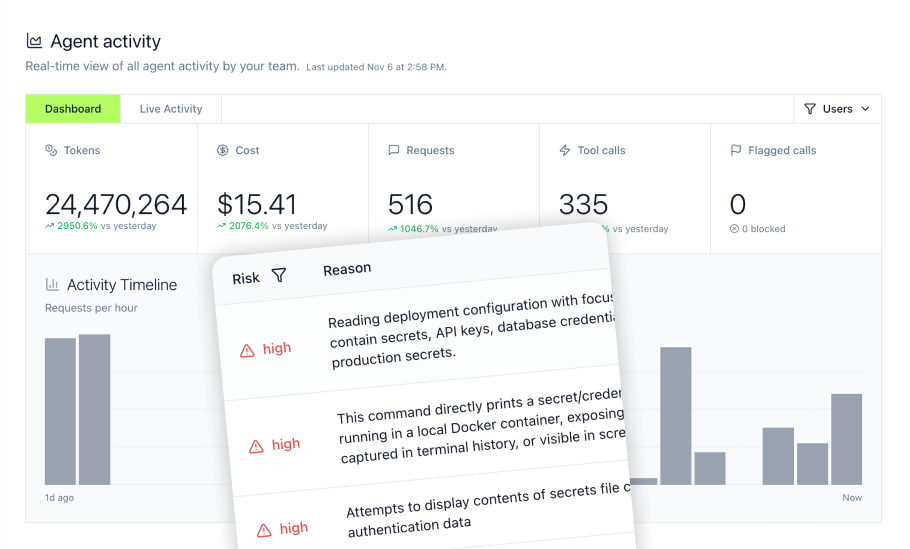
Selecting an MCP gateway for a SOC 2 compliant organization requires evaluating more than features. It demands verified security infrastructure, clear access controls, and audit evidence that security teams can review. As AI agents access customer data, production databases, and internal systems, the gateway deployed becomes a critical control point for compliance posture.
The challenge is stark: AI agents need governed access to internal tools, but many MCP deployments still depend on scattered credentials, local servers, and limited auditability. SOC 2 auditors examine how AI tools access sensitive data, who authorized that access, and whether complete audit trails exist. Without gateway controls, organizations can face custom development work, fragmented evidence collection, or delayed audit readiness.
MCP gateways address this by providing centralized authentication, authorization, credential management, policy enforcement, and monitoring. For SOC 2 compliant organizations, the goal is not just to connect agents to tools. It is to turn shadow AI into sanctioned AI with visibility, least-privilege access, and auditable control.
This guide evaluates five leading MCP gateways for SOC 2 compliant organizations in 2026, analyzing their compliance capabilities, implementation requirements, and enterprise readiness.
Key Takeaways
- MintMCP is a data-permissions-first MCP gateway with SOC 2 Type II audited controls, complete audit trails, and enterprise SSO built into the platform
- SOC 2-oriented MCP deployments should prioritize SSO, SCIM-driven RBAC, tool-level allowlisting, credential management, and audit logs over connector count alone
- Building equivalent MCP governance internally can require significant engineering, security, and audit documentation work
- Static credentials, shared service accounts, and unmanaged local MCP servers create access-control gaps that regulated organizations need to close
- For healthcare and regulated teams, MintMCP is compliant with HIPAA standards, signs BAAs, and provides compliance documentation through its Trust Center
1. MintMCP: SOC 2 Type II Audited MCP Gateway
MintMCP has established itself as a data-permissions-first MCP gateway for organizations that need governed AI access across internal tools, employees, and agents. MintMCP is SOC 2 Type II audited, with continuous compliance monitoring via Drata, enterprise SSO, complete audit trails, PII detection, and role-based access control built into the platform. Security teams can review the full security posture in the Trust Center, and customers handling protected health information can request HIPAA documentation and BAAs.
What Makes MintMCP Different
MintMCP transforms local STDIO-based MCP servers into governed services with centralized authentication, credential management, policy enforcement, and auditability. The platform supports OAuth brokering for stdio and hosted MCP servers, helping teams move away from unmanaged static credentials. Complete audit trails log MCP interactions, access requests, and configuration changes, which are the kinds of evidence SOC 2 auditors examine.
MintMCP is also structured around data permissions before agents. SSO, SCIM-driven RBAC, IdP groups, Virtual MCP Bundles, tool-level policy, and audit logs form the governance layer first. Agents are then enabled on top of that permission model.
Compliance Capabilities
- SOC 2 Type II audited, with continuous compliance monitoring via Drata and enterprise-available compliance documentation
- Compliant with HIPAA standards, with HIPAA documentation and BAAs available for customers handling protected health information
- Complete audit logs that support SOC 2 control evidence and accountability requirements
- OAuth 2.0, SAML, SSO, and SCIM-driven RBAC with enterprise identity providers
- Tool-level allowlisting and rule-based policy, not just server-level permissions
- Credential management, automatic credential revocation, and access control enforcement
- Virtual MCP Bundles for per-use-case endpoints with SCIM-driven membership
- Agent Bundles with M2M authentication and “act as agent” flow
- Centralized observability and integration points for external DLP and guardrails
Enterprise Outcomes
MintMCP helps regulated teams reduce the custom engineering and security review work required to govern MCP access. Instead of building separate authentication, policy, audit logging, credential management, and connector runtime layers internally, teams can use MintMCP as a managed SaaS-first gateway with compliance documentation available through its Trust Center.
Pre-Built Connectors
- Elasticsearch for semantic search and knowledge bases
- Snowflake for data warehouse queries with permissions
- Gmail for email access with approval workflows
- GitHub, Slack, Google Calendar integrations
- Hosted MCP connectors run by MintMCP, with connector runtime operations handled by the platform
Implementation Timeline
Deployment timing depends on the number of MCP servers, identity-provider complexity, connector scope, and audit requirements. For SOC 2 compliant organizations, teams should plan for identity integration, tool-level policy design, audit log validation, and security review rather than treating gateway rollout as a simple connector installation.
Best For: Healthcare, financial services, and regulated organizations where SOC 2 Type II audited controls, Trust Center documentation, SSO, SCIM-driven RBAC, audit logs, and tool-level governance are mandatory. Organizations can request compliance documentation directly for auditor review.
For teams managing coding agents in secure environments, MintMCP's LLM Proxy provides additional monitoring, tracking tool calls, bash commands, and file access from AI assistants.
2. TrueFoundry
TrueFoundry offers AI gateway capabilities for platform engineering and ML platform teams. TrueFoundry is a hybrid platform with managed SaaS and self-hosted control-plane options, making it relevant for organizations that want broader AI gateway and MCP governance capabilities across internal employee and agent workflows. Regulated teams should validate the scope of any SOC 2 Type II audit, the system boundary, and whether it covers their intended MCP deployment model.
Where TrueFoundry Fits Best
The platform provides unified LLM and MCP gateway management with self-hosted deployment options for teams that need infrastructure control. TrueFoundry is typically a better fit for platform teams that can operate custom infrastructure and integrate gateway capabilities into an existing AI platform stack.
Core Features
- AI gateway and MCP gateway management
- Self-hosted control-plane options
- Cost analytics and usage tracking
- Multi-tenant architecture for platform teams
Tradeoffs to consider
TrueFoundry can fit teams that want hybrid deployment and platform-level AI infrastructure control, but regulated organizations should evaluate how much MCP-specific governance they need out of the box. MintMCP focuses more directly on IT, Security, and AI Operations workflows such as SSO, SCIM-driven RBAC, tool-level allowlisting, Virtual MCP Bundles, Agent Bundles, credential management, and centralized audit logs.
Best For: Organizations prioritizing platform control where engineering teams can invest in custom MCP server development and compliance teams can validate the relevant audit scope.
3. Composio
Composio focuses on developer and AI engineering teams building agentic applications, with broad integration coverage for product and engineering use cases. Composio publicly positions itself with SOC 2 Type II coverage, but regulated teams should validate the report scope, system boundaries, and whether the controls cover the MCP deployment model they plan to use.
Where Composio Fits Best
The platform offers broad integration coverage with developer-friendly APIs and documentation. Organizations using Composio should verify that their MCP infrastructure, connector usage, identity model, and audit evidence meet their compliance requirements before relying on it for SOC 2 programs.
Core Features
- Broad managed integration coverage across enterprise tools
- Fast setup for developer-led deployments
- Developer-friendly APIs and documentation
- Broad ecosystem support
Tradeoffs to consider
Composio is often a better fit for developer-led agentic applications than for IT-led internal employee and internal-agent governance. Teams that need SCIM-driven RBAC, per-use-case Virtual MCP Bundles, Agent Bundles, centralized observability, and rule-based tool policy should compare that model with MintMCP’s data-permissions-first architecture.
Best For: Startups and product-led organizations prioritizing developer velocity and integration breadth where teams can validate compliance scope independently.
4. Lasso Security
Lasso Security takes a security-focused approach to AI and MCP usage, including threat detection, prompt-injection defenses, and data protection controls. For SOC 2 compliant organizations, the key question is whether its deployment model, audit scope, and evidence collection process satisfy the organization’s control requirements.
Where Lasso Security Fits Best
The platform provides security scanning and data-protection capabilities for teams focused on AI threat detection. Organizations should test policy coverage, deployment model, and performance impact in their own environment before production deployment.
Core Features
- Prompt-injection detection
- PII redaction capabilities
- Bring-your-own-server architecture
- Self-hosted deployment options
Tradeoffs to consider
A security-focused gateway can help with threat detection, but SOC 2-oriented MCP governance also requires identity, access control, auditability, credential lifecycle management, and policy administration. Teams should evaluate whether Lasso Security covers SCIM-driven RBAC, per-use-case tool bundles, agent identity governance, and centralized MCP audit evidence in the same way MintMCP does.
Best For: High-security environments where threat detection takes priority and teams have the expertise to self-host and independently validate deployment controls.
5. Lunar.dev MCPX
Lunar.dev MCPX provides MCP governance features including RBAC, audit trails, and policy enforcement. Lunar positions MCPX for enterprise MCP governance, but regulated teams should confirm whether relevant SOC 2 Type II audit coverage applies to the managed service, control plane, and deployment boundary used in production.
Where Lunar.dev MCPX Fits Best
The platform offers policy enforcement automation with self-hosted and managed deployment options. Organizations should include MCP infrastructure in their broader audit scope and confirm which control evidence is covered by vendor documentation versus customer-operated infrastructure.
Core Features
- Granular role-based access control
- Comprehensive audit logging
- Policy enforcement automation
- Enterprise SLA support
Tradeoffs to consider
Lunar.dev MCPX can be relevant for teams seeking MCP governance controls, but buyers should compare its model against MintMCP’s data-permissions-first primitives, including Virtual MCP Bundles, Agent Bundles with M2M auth, OAuth brokering for stdio and hosted MCP servers, hosted MCP connectors, credential management, and Gateway + Agent Monitor two-layer governance.
Best For: Enterprises with existing governance frameworks seeking granular RBAC and audit trails where teams can validate the relevant MCP-specific audit scope.
Why SOC 2 Compliance Matters for MCP Deployments
SOC 2 compliance centers on five Trust Services Criteria: Security, Availability, Processing Integrity, Confidentiality, and Privacy. For organizations deploying AI agents through MCP servers, these criteria translate into specific technical requirements that auditors evaluate.
Type I vs Type II: Type I assessments evaluate whether controls are suitably designed at a point in time. Type II audits evaluate whether controls operate effectively over a review period. For MCP gateways, Type II audit coverage is more useful because it shows sustained operation of access controls, monitoring, and change management processes.
Critical Control Areas: When AI agents access customer databases, CRM systems, or financial records, auditors examine specific control areas:
- CC6.1-6.3 (Access Control): Who can use which MCP tools? How are permissions assigned and revoked?
- CC7.1-7.3 (Monitoring): What visibility exists into AI agent activities? How are anomalies detected?
- CC8.1 (Change Management): How are MCP server configurations tracked and approved?
Organizations relying on gateways without relevant audit documentation must prove each control independently, including authentication design, permission enforcement, logging completeness, and change-management procedures.
The Current Security State: Static API keys and shared credentials create problems for MCP governance. Credentials can be hardcoded, shared across teams, or difficult to revoke without redeploying servers. For SOC 2 compliant organizations, that creates avoidable access-control risk.
Business Impact: Enterprise customers increasingly require SOC 2 reports from vendors. If AI agent infrastructure cannot produce reliable access-control evidence, audit logs, and change-management records, security teams may slow or block production deployment.
Implementing SOC 2 Compliant Gateways: Practical Timeline
Deploying an MCP gateway in a regulated environment follows a phased approach. The exact timeline depends on the organization’s identity provider, number of MCP servers, connector scope, audit requirements, and change-management process.
Phase 1: Assessment (Weeks 1-2) - Document existing MCP servers and authentication mechanisms. Map current user roles to the gateway RBAC model. Review SOC 2 Type II audit documentation with auditors if available.
Phase 2: SSO Integration (Weeks 3-4) - Connect corporate identity provider such as Okta, Microsoft Entra ID, or Auth0. Configure SAML, OAuth 2.0, or SSO flows. Test authentication with a pilot user group and confirm SCIM-driven membership where supported.
Phase 3: MCP Server Deployment (Weeks 5-6) - Deploy or connect MCP servers. Configure hosted MCP connectors where available. Establish tool-level permissions, Virtual MCP Bundles, and monitoring.
Phase 4: Compliance Configuration (Weeks 7-8) - Configure audit log retention policies. Integrate with existing SIEM or monitoring workflows where needed. Document control mappings for auditors and conduct end-to-end testing.
Phase 5: Validation (Weeks 9-10) - Verify audit trail completeness. Test RBAC enforcement with edge cases. Communicate migration timelines to users and decommission legacy unmanaged access paths.
Organizations can reduce implementation risk by selecting gateways that already include SSO, SCIM-driven RBAC, credential management, tool-level policy, and audit logging rather than assembling those controls from separate internal systems.
Key Features Required for SOC 2 Compliance
When evaluating MCP gateways for regulated environments, specific features directly map to SOC 2 Trust Services Criteria:
Access Controls (CC6.1-6.3): OAuth 2.0 and SAML integration with enterprise identity providers. SCIM-driven RBAC and role-based access control at the tool level, not just server level. Automatic credential revocation when employees depart. Support for both shared service accounts and per-user authentication where appropriate.
Monitoring and Logging (CC7.1-7.3): Complete audit trails of every MCP interaction. Real-time dashboards for usage patterns and security alerts. SIEM integration for centralized monitoring. Anomaly detection for unusual access patterns.
Change Management (CC8.1): Configuration change logging with user attribution. Approval workflows for production deployments. Version control or approval policy for MCP server configurations and tool updates.
For detailed implementation guidance, the enterprise MCP deployment guide provides step-by-step instructions for engineering teams.
Aligning with Broader Compliance Frameworks
SOC 2 compliance intersects with other regulatory frameworks for multinational organizations. Beyond SOC 2, organizations should consider GDPR for EU operations and emerging AI-specific regulations.
GDPR Alignment: Article 30 requirements for Records of Processing Activities align with MCP audit trail capabilities. Complete logs of which AI agents accessed which data, when, and under whose authorization support documentation requirements.
AI-Specific Regulations: The EU AI Act and the NIST AI Risk Management Framework establish requirements for AI system documentation and risk assessment. MCP gateways with comprehensive audit trails can support documentation requirements across multiple frameworks.
Shadow AI Problem: As teams adopt AI agents across departments, unmanaged tool usage can make it difficult to enforce purpose limitations and access policies. MCP gateways address this by providing visibility into which tools teams use, which identities invoke them, and which policies apply.
Total Cost of Ownership Considerations
Understanding true deployment costs requires looking beyond subscription fees for a 50-user team in Year 1:
Direct Costs: AI client licenses such as Cursor and Claude. Gateway subscription. Custom MCP server development. Training and onboarding.
Avoided Costs with Governed Gateways: Custom compliance infrastructure development, audit preparation, policy engineering, credential management, connector hosting, and internal maintenance can all increase the real cost of building MCP governance from scratch.
Break-Even Analysis: For regulated organizations, the business case often depends on avoided engineering work, faster security review, reduced audit preparation, and lower operational burden. For non-regulated organizations without SOC 2 requirements, open-source alternatives may provide better TCO if the team can operate and audit them independently.
Deploy Enterprise-Grade MCP Infrastructure
The Model Context Protocol has fundamentally changed how enterprises connect AI assistants to their data and tools. But deploying MCP at scale requires more than protocol support. It demands enterprise-grade security, governance, and monitoring that transforms experimental AI into production-ready infrastructure.
MintMCP Gateway provides a practical path from pilot to production, with managed SaaS-first deployment, hosted MCP connectors, SSO, SCIM-driven RBAC, tool-level policy, credential management, Virtual MCP Bundles, Agent Bundles, and comprehensive audit logging. MintMCP is SOC 2 Type II audited, compliant with HIPAA standards, penetration tested, and every agent action is audited. Security teams can review the full security posture in the Trust Center.
Whether securing access to Snowflake data warehouses, Elasticsearch knowledge bases, or custom enterprise tools, MintMCP provides infrastructure that makes AI deployment practical, governed, and secure.
For deeper understanding of MCP gateway architecture, see the guide on understanding MCP gateways.
Ready to transform AI infrastructure? Visit mintmcp.com to schedule a demo and see how MintMCP Gateway can accelerate enterprise AI deployment.
Frequently Asked Questions
What does SOC 2 Type II audited mean for MCP gateways?
SOC 2 Type II audited means an independent auditor has evaluated whether the relevant controls operated effectively over a review period. For MCP gateways, this matters because access controls, monitoring, logging, and change-management processes need to work consistently across AI agent operations. Organizations should review the vendor’s audit documentation and confirm the system boundary matches their intended deployment.
How do MCP gateways prevent unauthorized AI agent access?
Gateways like MintMCP provide granular tool-level RBAC that restricts which MCP tools each role can invoke. OAuth 2.0, SAML, SSO, and SCIM integration connect to enterprise identity providers, enabling automatic credential revocation when employees depart. Complete audit trails log access attempts and tool calls, creating the accountability SOC 2 auditors require.
What audit logs satisfy SOC 2 compliance requirements?
SOC 2 auditors examine logs demonstrating access control, monitoring, and change management across CC6, CC7, and CC8 criteria. For MCP gateways, this includes user authentication events, tool invocation records, configuration changes with user attribution, failed access attempts, and policy changes. Complete logs with user identity, timestamp, and action details support audit requirements.
How long does deployment take with governed gateways?
Deployment timing depends on identity-provider setup, connector complexity, MCP server scope, and internal security review. A governed gateway can reduce the need to build authentication, policy, credential management, and audit infrastructure from scratch, but teams should still plan for SSO integration, RBAC design, audit validation, and user migration.
What compliance standards beyond SOC 2 matter for enterprise AI?
Organizations should consider GDPR for EU operations, emerging AI-specific regulations like the EU AI Act, and the NIST AI Risk Management Framework. MCP gateways with comprehensive audit trails, identity controls, and policy enforcement can support documentation requirements across multiple frameworks.