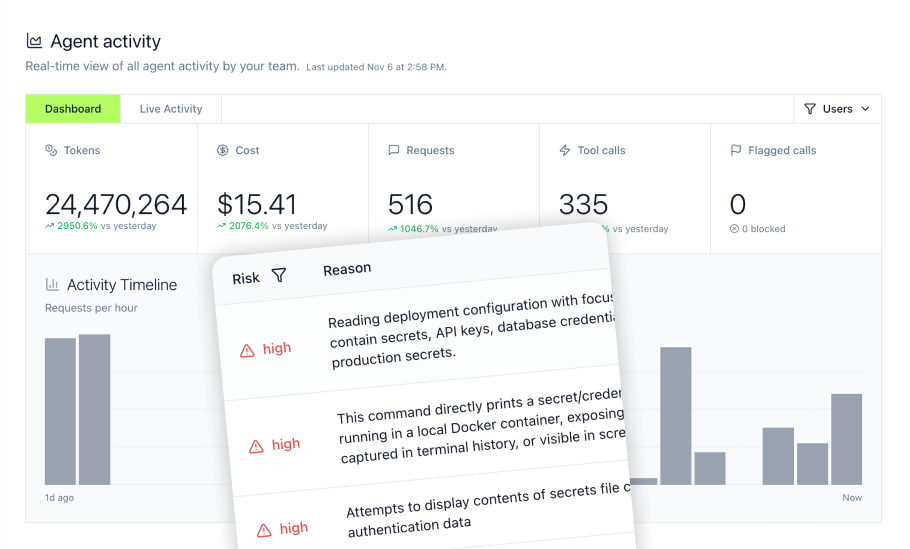
As enterprise AI adoption accelerates, the Model Context Protocol (MCP) is rapidly becoming an industry standard for connecting AI agents to internal tools and data, with support across Anthropic, OpenAI, Google, and Microsoft. However, deploying MCP at scale introduces critical challenges around rate limiting, access control, and governance that require purpose-built infrastructure.
An MCP gateway sits between AI clients and MCP servers, providing centralized control over authentication, rate limiting, and audit logging. For engineering leaders evaluating these solutions, the right gateway transforms shadow AI into sanctioned, governed infrastructure without slowing development teams.
This guide analyzes 13 MCP gateway solutions based on rate limiting granularity, access control sophistication, performance impact, and enterprise readiness. Whether organizations need SOC 2 Type II audited controls, microsecond-level gateway overhead, or advanced threat detection, options exist for diverse requirements.
Key Takeaways
- MCP gateways have become essential infrastructure for enterprises deploying AI agents, with rate limiting and access control emerging as primary evaluation criteria for production deployments.
- SOC 2 Type II audited posture remains a strong enterprise signal for regulated industries, and a small set of gateways, including MintMCP, highlight SOC 2 Type II programs as part of their security posture.
- Performance varies significantly across solutions, from microsecond-level gateway overhead in narrow published benchmarks to higher overhead for security-first platforms that perform deeper inspection.
- Access control sophistication ranges from basic RBAC to advanced task-based access control, with granular tool-level permissions becoming the enterprise standard.
- Deployment flexibility matters. Organizations can choose from managed SaaS, self-hosted open-source, or hybrid models depending on their compliance requirements and operating model.
1. MintMCP Gateway: Enterprise-Grade Compliance and Governance
MintMCP Gateway stands out as a governance-forward platform for enterprises requiring verified security controls and rapid deployment. As a SOC 2 Type II audited MCP platform, MintMCP provides the trust posture that regulated industries expect.
What Makes MintMCP Different:
MintMCP transforms local STDIO-based MCP servers into production-ready services through managed deployment, hosted MCP connectors, and OAuth brokering for stdio and hosted MCP servers. The platform's Virtual MCP Bundles expose curated tool sets per role, team, or use case with SCIM-driven membership, ensuring users access only the capabilities they need. A confirmed Cursor partnership reflects MintMCP's role in MCP governance and visibility for enterprise AI development workflows.
Rate Limiting Capabilities:
- Tool-level usage controls with customizable policies
- Team-based quota enforcement
- Real-time monitoring dashboards for usage tracking
Access Control Features:
- OAuth 2.0, SAML, SSO, and SCIM-driven RBAC
- Granular tool governance, including tool-level allowlisting and rule-based policy
- Credential management and OAuth brokering for stdio and hosted MCP servers
- Virtual MCP Bundles for per-use-case endpoints with SCIM-driven membership
- Agent Bundles with M2M auth and an “act as agent” flow
- Audit trails for MCP tool calls and gateway-observed activity, with exportable logs for security review workflows
- JavaScript Gateway Middleware in a JS sandbox with external DLP and guardrails integrations
Key Stats:
- Compliance: SOC 2 Type II audited, compliant with HIPAA standards, penetration tested
- Deployment: Managed SaaS-first, with VPC/self-hosted deployment available on request
- Pricing: Contact for enterprise pricing
Best For: Regulated industries and enterprise teams requiring audited security posture, data-permissions-first governance, and rapid deployment without operating gateway infrastructure themselves.
2. Bifrost by Maxim AI
Bifrost targets performance-sensitive teams with low gateway overhead and an Apache 2.0 open-source model. For teams prioritizing speed and self-hosted control, Bifrost offers a developer and platform-engineering-oriented approach.
Where Bifrost Fits Best:
The platform publishes performance benchmarks around 11µs gateway overhead at 5,000 RPS. This should be treated as gateway overhead in a benchmarked profile, not full end-to-end tool-call latency.
Rate Limiting Capabilities:
- In-memory rate limiting for low gateway overhead
- Per-tool, per-user rate limit configuration
- Stateless architecture enabling horizontal scaling
Access Control Features:
- Request-level filtering with mcp-include-clients
- Granular tool filtering with wildcard support
- Explicit execution model for tool-call control
Key Stats:
- Latency: Approximately 11µs gateway overhead in a published benchmark
- Overhead: ~11µs added gateway overhead per request at sustained 5,000 RPS in a published benchmark
- Pricing: Free open-source; enterprise edition available
Best For: High-volume, latency-sensitive applications where gateway overhead matters and teams are comfortable operating self-hosted infrastructure.
Tradeoffs to consider
Bifrost's OSS-first, self-hosted-first model can fit platform teams that want direct infrastructure control. Teams that prefer managed SaaS-first deployment, hosted MCP connectors, SCIM-driven RBAC, Virtual MCP Bundles, Agent Bundles, and centralized audit workflows may find MintMCP better aligned to IT, security, and AI operations requirements.
3. TrueFoundry MCP Gateway
TrueFoundry provides a unified platform managing both LLM traffic and MCP tool access through a single control plane. The architecture targets single-digit millisecond gateway overhead in published performance claims by handling authentication and rate limiting in-memory rather than through database queries.
Core Capabilities:
The platform's MCP Server Groups enable logical team isolation while maintaining unified billing and observability across AI infrastructure. This approach simplifies operations for organizations running multiple AI workloads.
Rate Limiting Capabilities:
- In-memory rate limiting with low gateway overhead in published claims
- Per-server group rate limits
- Unified rate limiting across LLM and MCP traffic
Access Control Features:
- OAuth 2.0 Identity Injection
- On-Behalf-Of (OBO) authentication
- Gateway-level access control with team isolation
Key Stats:
- Latency: Single-digit millisecond gateway overhead in published claims, depending on load and profile
- Throughput: 350+ RPS on single vCPU in published benchmark material
- Pricing: Contact for commercial pricing
Best For: Organizations seeking unified LLM and MCP management with high-throughput requirements.
Tradeoffs to consider
TrueFoundry is a strong fit for platform and ML teams that want LLM gateway and MCP gateway management together. Teams prioritizing data-permissions-first governance for internal employees and agents should also evaluate whether they need MintMCP capabilities such as Virtual MCP Bundles, Agent Bundles with M2M auth, hosted MCP connectors, and SCIM-driven membership tied to curated tool endpoints.
4. Lunar.dev MCPX
Lunar.dev MCPX offers access control implementation with granular ACLs at global, service, and tool levels.
Primary Focus:
Beyond standard RBAC, Lunar.dev enables tool customization by rewriting descriptions or locking parameters, providing control that goes beyond simple allow/deny policies. Immutable audit trails with Prometheus-compatible metrics support compliance reporting and operational visibility.
Rate Limiting Capabilities:
- Role-based rate limits enforced via consumer tags
- Budget constraints per agent/team
- Real-time metrics via Prometheus
Access Control Features:
- Three-tier ACLs (global, service, tool)
- API key and OAuth authentication
- SSO and IAM integration for enterprise
- Per-agent policy enforcement
Key Stats:
- Latency: Benchmark under expected traffic, since enforcement depth and deployment model can affect p95/p99 latency
- Deployment: On-premises, cloud, and hybrid options
- Pricing: Free tier plus commercial plans
Best For: Complex access control requirements where tool-level customization and multi-tier governance matter.
Tradeoffs to consider
Lunar.dev MCPX emphasizes ACLs, rate limits, metrics, and tool customization. Buyers should compare that model with MintMCP's data-permissions-first architecture, especially if they need SCIM-driven Virtual MCP Bundles, Agent Bundles, OAuth brokering for stdio and hosted MCP servers, and centralized governance across Claude, Cursor, ChatGPT, Gemini, and Copilot workflows.
5. Kong AI Gateway
Kong AI Gateway extends API gateway infrastructure with MCP capabilities. Organizations already running Kong can leverage existing infrastructure investments.
Kong's Approach:
Kong can expose existing services to AI agents through gateway-managed policies and authentication. Its plugin ecosystem allows teams to apply rate limiting, authentication, and policy enforcement patterns already used for API traffic.
Rate Limiting Capabilities:
- Rate limiting via Kong plugins
- Per-route, per-consumer rate limits
- Distributed rate limiting across Kong nodes
Access Control Features:
- Centralized OAuth plugin patterns
- Kong's authentication plugin ecosystem
- RBAC via Kong Enterprise
- Policy-based access control
Key Stats:
- Maturity: Established API gateway infrastructure
- Integration: API gateway approach for exposing existing services to MCP-enabled workflows
- Pricing: Enterprise pricing depends on Kong deployment and licensing
Best For: Organizations with existing Kong infrastructure wanting unified API and MCP management.
Tradeoffs to consider
Kong is a natural fit for API platform teams already standardized on Kong. Teams should evaluate whether an API gateway extension provides the MCP-specific primitives they need, such as Virtual MCP Bundles, Agent Bundles, tool-update policy, stdio and hosted-server OAuth brokering, hosted MCP connectors, and Gateway plus Agent Monitor governance.
6. Traefik Hub MCP Gateway
Traefik Hub brings reverse proxy and Kubernetes-native infrastructure patterns to MCP with a layered security approach across AI, MCP, and API layers.
Security Architecture:
The platform introduces Task-Based Access Control (TBAC) as an alternative to traditional RBAC, enabling dynamic authorization based on the specific task an agent is performing. OAuth 2.0 token exchange for On-Behalf-Of (OBO) authentication supports identity propagation.
Rate Limiting Capabilities:
- Traefik middleware-based rate limiting
- Kubernetes-native rate limit enforcement
- OpenTelemetry metrics for MCP operations
Access Control Features:
- On-Behalf-Of (OBO) authentication with OAuth 2.0
- Task-Based Access Control (TBAC)
- Dynamic agent authorization
- Integration with existing Traefik middleware
Key Stats:
- Architecture: Layered security pattern for AI, MCP, and API traffic
- Deployment: Kubernetes-native
- Pricing: Commercial Traefik Hub subscription
Best For: Kubernetes-native teams wanting defense-in-depth security with familiar Traefik tooling.
Tradeoffs to consider
Traefik Hub can fit teams already operating Traefik and Kubernetes-native infrastructure. Teams that want managed SaaS-first deployment, hosted MCP connectors, SCIM-driven RBAC, Virtual MCP Bundles, and Agent Bundles may prefer MintMCP's data-permissions-first approach.
7. Lasso Security MCP Gateway
Lasso Security provides a security-focused approach to MCP infrastructure with prompt injection detection and MCP server reputation analysis. The platform implements layered security patterns spanning AI, MCP, and API layers.
Security-First Design:
Lasso tracks and scores MCP servers based on behavior, providing reputation analysis that can identify risky tools before they cause incidents. Tool reputation analysis and plugin-based controls support custom security workflows.
Rate Limiting Capabilities:
- Security-aware rate limiting
- Threat-based dynamic rate adjustments
- Per-tool security quotas
Access Control Features:
- Real-time security scanning
- Token masking
- AI safety guardrails
- Modular plugin architecture for custom controls
Key Stats:
- Latency: Deployment-dependent; deep inspection can add overhead versus lightweight proxies, so benchmark p95/p99 under expected traffic
- Architecture: Layered security pattern
- Pricing: Open-source (Apache 2.0) with commercial platform
Best For: High-risk environments requiring threat detection at the gateway level.
Tradeoffs to consider
Lasso emphasizes MCP security inspection, server reputation, and threat controls. Security teams should also evaluate whether they need MintMCP capabilities such as SSO and SCIM-driven RBAC, per-use-case Virtual MCP Bundles, Agent Bundles, tool-update policy, centralized observability, and external DLP and guardrails integrations.
8. Microsoft Azure MCP Solutions
Microsoft supports MCP server management patterns through Azure API Management and open-source gateway approaches for Kubernetes-style deployments including Entra ID, offering dual deployment options: open-source Kubernetes or managed Azure API Management.
Azure Integration:
For organizations committed to the Azure ecosystem, native Entra ID integration can reduce authentication complexity. Azure Monitor and App Insights provide observability through existing Azure tooling.
Rate Limiting Capabilities:
- Azure API Management rate limiting policies
- Cloud-native scaling with Azure resources
- Policy enforcement through APIM
Access Control Features:
- Native Entra ID/Azure AD authentication
- OAuth 2.0 flows with Azure identity
- Kubernetes RBAC for deployment
- Azure Policy integration
Key Stats:
- Latency: Deployment-dependent; cloud routing and policy evaluation can add measurable overhead, so benchmark in your environment
- Deployment: Open-source Kubernetes or managed APIM
- Pricing: Depends on Azure services used
Best For: Azure-committed organizations wanting native identity integration and comprehensive cloud services.
Tradeoffs to consider
Azure-based MCP patterns fit organizations already standardized on Azure identity, APIM, and observability. Teams should evaluate whether they also need MintMCP's MCP-specific governance layer, including Virtual MCP Bundles, Agent Bundles, OAuth brokering for stdio and hosted MCP servers, hosted MCP connectors, and a managed SaaS-first operating model.
9. Docker MCP Gateway
Docker MCP Gateway leverages container isolation for security, providing familiar tooling for teams already using Docker infrastructure. Cryptographically signed container images help support supply chain integrity.
Container-Based Security:
Container-based isolation prevents MCP servers from accessing host filesystems by default, creating a security boundary through containerization. Access to Docker's MCP Catalog enables rapid deployment of pre-built integrations. This approach aligns with NIST AI security recommendations around isolation and containment.
Rate Limiting Capabilities:
- Container-level resource limits (CPU, memory)
- Rate limiting through container orchestration
- Resource quotas per container
Access Control Features:
- Container-based isolation model
- No host filesystem access by default
- Process-level security through containers
- Per-container resource limits
Key Stats:
- Latency: Deployment-dependent; container isolation and orchestration can add overhead, so benchmark for interactive workloads
- Security: Cryptographically signed images
- Pricing: Free with Docker Desktop
Best For: Container-first organizations wanting familiar tooling with isolation-based security.
Tradeoffs to consider
Docker MCP Gateway can be useful for container-first teams and developer environments. Organizations that need centrally managed SaaS deployment, SCIM-driven RBAC, audit logs, OAuth brokering, hosted MCP connectors, and Agent Bundles may need a governance layer such as MintMCP around or beyond containerized MCP runtime management.
10. Peta (Agent Vault)
Peta positions itself as a zero-trust credential management solution for AI agents, addressing the critical vulnerability of credential exposure. The three-component architecture (Core, Console, Desk) is designed to prevent agents from seeing raw API keys.
Zero-Trust Credentials:
Server-side encrypted vaults issue scoped, time-limited tokens rather than exposing credentials directly. Human-in-the-loop approval workflows through Slack and Teams integration add oversight for high-risk operations.
Rate Limiting Capabilities:
- Policy-based rate limiting through Peta Console
- Per-agent rate limits
- Per-tool invocation quotas
Access Control Features:
- Zero-trust credential model
- Human approval for high-risk actions
- Fine-grained per-agent, per-tool policies
- Time-limited token issuance
Key Stats:
- Architecture: Three-component (Core, Console, Desk)
- Integration: Slack/Teams for approvals
- Pricing: Contact for pricing
Best For: Organizations prioritizing credential security with zero-trust models and human-in-the-loop controls.
Tradeoffs to consider
Peta's focus is credential security and approval workflows. Teams evaluating broader MCP governance should compare that with MintMCP's combined gateway layer, hosted MCP connectors, tool-level allowlisting, SCIM-driven RBAC, Virtual MCP Bundles, Agent Bundles, audit logs, and centralized observability.
11. Operant AI MCP Gateway
Operant AI combines MCP gateway functionality with runtime defense and security research. The platform's 3D Runtime Defense model focuses on discovery, detection, and defense for emerging agent and MCP risks.
Security Research Focus:
Operant AI publishes research on AI and MCP attack patterns. That research informs the platform's threat detection capabilities and helps security teams evaluate emerging risks around agentic systems.
Rate Limiting Capabilities:
- Rate limiting and encryption enforcement
- Dynamic control based on threat detection
- Governance framework for enterprise policies
Access Control Features:
- MCP trust zones with live blocking
- Least privilege execution controls
- Granular access permissions for tool usage
- Centralized governance framework
Key Stats:
- Architecture: 3D Runtime Defense
- Pricing: Enterprise platform with contact-based pricing
Best For: Security-conscious organizations wanting threat intelligence integrated into gateway infrastructure.
Tradeoffs to consider
Operant AI emphasizes runtime defense and threat research. Teams should also evaluate MCP governance fundamentals such as SCIM-driven RBAC, curated per-use-case tool endpoints, OAuth brokering for stdio and hosted MCP servers, hosted connector operations, and agent identity governance through Agent Bundles.
12. IBM ContextForge
IBM ContextForge represents an architecturally ambitious approach with multi-gateway federation and auto-discovery for distributed enterprises.
Federation Architecture:
Virtual MCP servers combine multiple backends into unified interfaces, while protocol bridging converts REST and gRPC services to MCP without code changes. Multi-database support (PostgreSQL, MySQL, SQLite) enables flexible state management.
Rate Limiting Capabilities:
- Configurable rate limiting per gateway instance
- Federation-aware rate limiting across multiple gateways
- Redis-backed state sharing for distributed rate limits
Access Control Features:
- JWT Bearer token authentication
- AES-encrypted credentials
- Custom authentication headers
- Per-server access policies
Key Stats:
- License: Open-source (Apache 2.0)
- Architecture: Multi-gateway federation and protocol bridging
- Status: Open-source project
Important Note: ContextForge is best evaluated against current project documentation, release notes, and support expectations before production use.
Best For: Distributed enterprises requiring multi-gateway coordination with federation architecture.
Tradeoffs to consider
ContextForge may appeal to teams that need open-source federation and protocol bridging. Organizations looking for managed SaaS-first deployment, hosted MCP connectors, SCIM-driven RBAC, Virtual MCP Bundles, Agent Bundles, audit logs, and centralized operational ownership may prefer MintMCP.
13. Obot Platform
Obot combines gateway functionality with MCP catalog management and agent orchestration in a single Kubernetes-native platform.
Unified Platform:
The built-in MCP Catalog with discovery reduces the need for separate registry solutions. The Nanobot framework enables AI agent orchestration while enterprise IdP support such as Okta and Microsoft Entra can simplify identity management.
Rate Limiting Capabilities:
- Platform-wide rate limiting policies
- Per-agent rate limits
- Kubernetes-native resource quotas
Access Control Features:
- Enterprise IdP integration
- Central policy management
- Kubernetes RBAC integration
- Catalog-level access controls
Key Stats:
- Platform: Gateway, catalog, and agent orchestration
- Deployment: Self-hosted Kubernetes
- Pricing: Enterprise with support
Best For: Teams wanting catalog management, gateway, and orchestration in a single self-hosted platform.
Tradeoffs to consider
Obot is OSS-first and self-hosted, which can fit Kubernetes-fluent platform teams. Organizations that want managed SaaS-first deployment, hosted MCP connectors, SCIM-driven membership, Virtual MCP Bundles, Agent Bundles, and centralized audit workflows may find MintMCP better aligned to IT and security-led MCP governance.
Accelerate Enterprise AI with MintMCP Gateway
Selecting the right MCP gateway determines whether AI initiatives scale beyond pilot programs into production infrastructure. While numerous solutions exist across the spectrum from open-source projects to enterprise platforms, deployment speed, access control, and audited security posture remain critical barriers for regulated industries.
MintMCP Gateway removes these barriers through managed deployment that transforms local MCP servers into production-ready services with OAuth protection, tool-level allowlisting, rule-based policy, credential management, audit logging, and real-time monitoring. MintMCP's hosted MCP connectors reduce the need for customers to operate connector runtimes, while Virtual MCP Bundles and Agent Bundles help teams govern both employee and internal-agent access from the same permissions-first foundation.
MintMCP is SOC 2 Type II audited, compliant with HIPAA standards, penetration tested, and every agent action is audited. Security teams can review MintMCP's security posture in the Trust Center.
For organizations ready to move from AI experimentation to governed production deployment, MintMCP provides the infrastructure foundation for practical, secure enterprise AI adoption.
Ready to transform AI infrastructure? Visit mintmcp.com to schedule a demo and see how MintMCP Gateway can accelerate enterprise AI deployment.
Frequently Asked Questions
What is the primary function of an MCP Gateway in 2026?
An MCP gateway sits between AI clients such as Claude, ChatGPT, Cursor, Gemini, and Copilot and MCP servers, providing centralized authentication, rate limiting, and audit logging. The gateway transforms local MCP deployments into production-grade infrastructure with enterprise security controls and governance capabilities.
How does rate limiting protect enterprise AI systems?
Rate limiting prevents resource exhaustion, controls costs, and ensures fair usage across teams. Advanced gateways can implement per-tool, per-user, and per-team limits with low-overhead enforcement. Without rate limiting, a single runaway AI agent could consume excessive resources or trigger API overage charges.
What compliance standards should an enterprise look for in an MCP Gateway?
SOC 2 Type II audited posture provides strong third-party validation of security controls. For healthcare and EU environments, prioritize gateways with audit trails, role-based access control, encryption, enterprise SSO, and documented compliance support. MintMCP is SOC 2 Type II audited, compliant with HIPAA standards, and signs BAAs for customers handling protected health information.
Can MCP Gateways integrate with existing enterprise security infrastructure?
Most enterprise-grade gateways support OAuth 2.0, SAML, and SSO integration with identity providers like Okta, Microsoft Entra (Azure AD), and Ping Identity. Solutions that extend existing API gateway infrastructure preserve security investments while adding MCP governance capabilities.
How do MCP Gateways address the 'shadow AI' challenge?
Without governance, teams deploy AI tools that operate as black boxes with significant security risks: zero telemetry, no request history, and uncontrolled access. MCP gateways provide centralized visibility and policy enforcement, turning shadow AI into sanctioned AI without disrupting developer workflows.