Connecting AI agents to Slack without proper governance creates security blind spots that most IT teams cannot afford. As 86% of enterprises require tech stack upgrades to properly deploy AI agents, the right agent gateway transforms scattered experiments into production-ready infrastructure where every AI interaction flows through visible, controlled channels.
An agent gateway solves the fundamental N×M integration problem. Without one, connecting 10 AI agents to 20 tools requires 200 individual integrations. A gateway reduces this to 30 connections through a unified control plane that handles authentication, routes tool calls, enforces security policies, and maintains complete audit trails for every AI interaction with your Slack workspace.
Key Takeaways
- MintMCP: Agent Gateway with MCP Gateway foundation providing agent identities, permissions, memory, and monitoring plus data-permissions-first MCP architecture with Virtual MCP Bundles, Agent Bundles, hosted connectors, and support for Claude, Cursor, ChatGPT, Gemini, and Copilot
- Portkey: Unified LLM and MCP gateway with observability for teams consolidating AI traffic monitoring
- Composio: Developer-focused platform with 1,000+ integrations for rapid agentic application development
- TrueFoundry: Unified AI infrastructure combining MCP gateway with model serving and LLMOps capabilities
- Docker MCP Gateway: Container-native approach for teams with existing Docker orchestration
1. MintMCP: MCP Gateway and Agent Gateway for Slack
MintMCP combines an MCP Gateway for governed Slack data and tool connections with an Agent Gateway for the identities, permissions, memory, and monitoring needed to run long-running agents safely. Its data-permissions-first architecture starts with SSO, SCIM-driven RBAC, IdP groups, Virtual MCP Bundles, tool-level policy, and audit logs, then enables agents on top of that governed foundation.
Unlike traditional approaches requiring weeks of infrastructure setup, MintMCP helps teams turn MCP servers and hosted connectors into governed production services with centralized observability and enterprise authentication while giving agents the identity and permission controls they need to operate alongside users.
What makes MintMCP different
MintMCP solves the fundamental problem that 42% of enterprises face when needing access to 8 or more data sources for AI agent deployment. The platform wraps stdio, hosted, HTTP-streamable, and SSE MCP servers behind SSO-fronted remote MCP endpoints with OAuth brokering, SCIM-driven membership, and rule-based policy.
For Slack integration specifically, MintMCP provides one-click activation of Slack MCP connectivity with enterprise authentication already configured. This eliminates the fragmented security policies and visibility gaps that create operational chaos when managing point-to-point connections between AI agents and Slack workspaces.
The Agent Gateway layer extends this foundation by giving each agent its own identity through Agent Bundles with M2M authentication, scoped tool access, independent credential rotation, and real-time monitoring. This transforms agents from shared-account automation scripts into governed participants with clear permissions and audit trails.
Core capabilities for Slack integration
MCP Gateway foundation:
- Hosted MCP Connectors: MintMCP runs connector instances including Slack on the customer's behalf with auto-scaling and sandboxed execution per connector, reducing infrastructure overhead
- OAuth Brokering: Add enterprise authentication to Slack MCP servers including OAuth 2.x, bearer tokens, headers, and SSO-fronted access without rebuilding
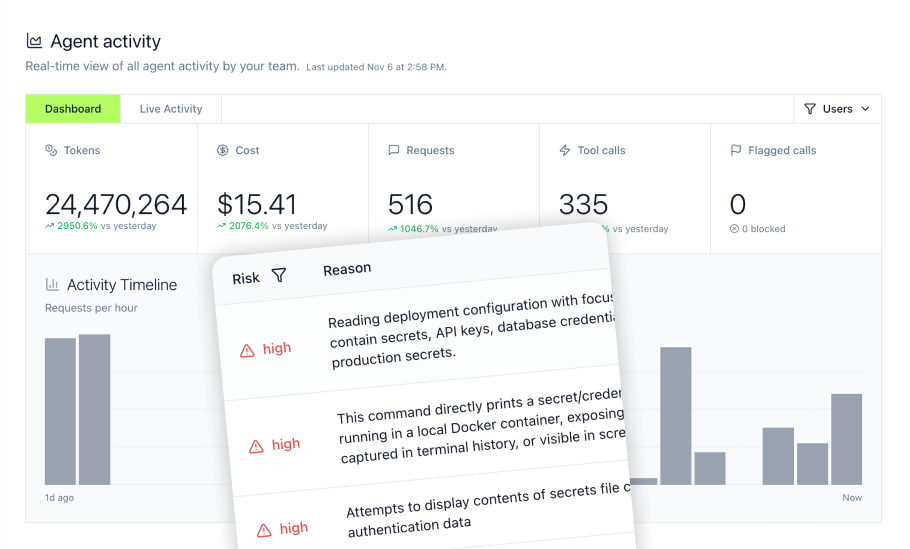
- Real-Time Monitoring: Live dashboards showing Slack tool calls, usage patterns, and security alerts across all MCP connections
- Granular Access Control: Configure Slack tool access by role with read-only operations for analysts while restricting write tools to authorized administrators
- Virtual MCP Bundles: Create team-specific endpoints that expose only minimum required Slack tools with SCIM-driven membership and curated tool lists
Agent Gateway capabilities:
- Agent Bundles: Give internal agents first-class identities with M2M auth, scoped Slack tools, independent rotation and revocation
- Agent Monitor: Track agent activity in real-time across the organization, including MCP calls made outside the gateway through hooks in Cursor and Claude Code
- Custom Gateway Middleware: Runs customer-authored middleware in a JS sandbox with external DLP and guardrails integrations for masking, blocking, and policy enforcement
Security architecture
MintMCP implements defense-in-depth security through centralized governance, SSO enforcement, SCIM-driven RBAC, tool-level policy, credential management, and observability controls. The platform provides visibility into which teams and agents use which Slack tools, when they access data, and how frequently.
Agent Monitor extends governance beyond the gateway by tracking agent activity in real-time, including MCP calls made outside the gateway through hooks in Cursor and Claude Code. This two-layer approach addresses shadow AI concerns where developers run local MCP servers that bypass centralized controls.
Enterprise integrations beyond Slack
- Snowflake data warehouse access with natural language queries
- Elasticsearch knowledge base search for documentation and log analysis
- Gmail integration for AI-driven communication automation
- GitHub, Salesforce, HubSpot, and 50+ pre-configured connectors
- Claude, Cursor, ChatGPT, Gemini, and Copilot governance through centralized gateway
Deployment and compliance
Deploy quickly with managed SaaS-first delivery, US and EU availability, hosted MCP connectors, and self-service access for developers. VPC and self-hosted deployment are available on request.
MintMCP is SOC 2 Type II audited, compliant with HIPAA standards, and penetration tested. Customers handling protected health information can request HIPAA documentation, and MintMCP signs BAAs. Visit the Trust Center for compliance documentation.
Pricing
Contact for enterprise demonstration and pricing
Getting started
Visit mintmcp.com/mcp-gateway for the deployment guide
2. Portkey
Portkey provides a unified LLM and MCP gateway that consolidates AI traffic observability in one dashboard. The platform focuses on combining language model routing with MCP server management for teams that want unified monitoring across both layers.
Where Portkey fits
- Integration with existing LLM routing and observability workflows
- Unified dashboard for both LLM and MCP traffic monitoring
- OpenTelemetry metrics and traces for MCP operations
Slack integration approach
Portkey supports Slack MCP server connections through its gateway with OAuth configuration options. The platform provides step-by-step setup documentation for connecting Slack workspaces and configuring required scopes.
Tradeoffs to consider
Teams should evaluate whether Portkey provides MCP-specific governance primitives such as SCIM-driven Virtual MCP Bundles, Agent Bundles with M2M auth, tool-update policy, and hosted connector operations. Organizations requiring per-agent identity governance or custom DLP middleware may need to assess feature parity with their requirements.
- Deployment: Hybrid with managed SaaS and self-hosted options
- Focus: Unified LLM and MCP observability
3. Composio
Composio provides a developer-focused platform with 1,000+ integrations designed for rapid agentic application development. The platform emphasizes speed of integration development for teams building customer-facing AI products.
Where Composio fits
- 1,000+ pre-built SaaS tool connectors with managed OAuth
- Developer SDK for programmatic integration development
- Free tier available for experimentation and smaller deployments
Slack integration approach
Composio offers Slack as one of its pre-built connectors with managed OAuth handling. The platform focuses on reducing time-to-integration for developers building applications that need Slack connectivity.
Tradeoffs to consider
Teams prioritizing enterprise governance, SSO/SCIM integration, and audit-ready compliance may need to evaluate whether Composio's developer-first approach provides sufficient controls for regulated industries. Agent Bundles for per-agent identity governance and Virtual MCP Bundles for team-scoped tool access are not standard features.
- Deployment: Managed SaaS-first with VPC options on Enterprise tier
- Focus: Developer experience and rapid integration development
4. TrueFoundry
TrueFoundry offers unified AI infrastructure that combines MCP gateway capabilities with model serving, fine-tuning, and LLMOps in one platform. The solution targets platform engineering teams managing end-to-end AI infrastructure.
Where TrueFoundry fits
- Unified platform combining MCP gateway with model serving infrastructure
- Platform engineering teams managing multiple AI infrastructure components
- Organizations wanting consolidated AI operations tooling
Slack integration approach
TrueFoundry supports MCP server connections including Slack through its gateway layer. The platform integrates Slack connectivity within its broader AI infrastructure management approach.
Tradeoffs to consider
Organizations primarily focused on MCP governance rather than full AI infrastructure may find TrueFoundry's broader scope exceeds their immediate requirements. Teams should evaluate whether they need the complete AI platform or would benefit from a focused MCP gateway with Virtual MCP Bundles and Agent Bundles for governance.
- Deployment: Hybrid with managed SaaS and self-hosted control plane options
- Focus: Unified AI infrastructure and LLMOps
5. Docker MCP Gateway
Docker's MCP Gateway brings container orchestration expertise to MCP server management, providing a Docker-native approach to run and manage MCP servers with Docker Desktop, CLI, and Docker Compose. The solution focuses on containerized hosting and lifecycle management.
Where Docker MCP Gateway fits
- Container isolation for MCP server deployments including Slack connectors
- Docker Desktop, Docker Engine, and Docker Compose integration for orchestration
- Standard container security practices and image management
- Organizations with existing Docker environments seeking infrastructure control
Slack integration approach
Docker MCP Gateway can run containerized MCP servers, but Docker's catalog entry for the Slack MCP server is archived. Teams should validate a maintained Slack MCP implementation or use Slack's official remote MCP server through a separately supported integration path.
Tradeoffs to consider
A container-native gateway can give teams infrastructure control, but customers remain responsible for the container runtime, server lifecycle, credentials, scaling, and operational maintenance. Teams should evaluate how much authentication, SCIM-driven RBAC, tool-level policy, audit logging, OAuth brokering, and agent identity governance they need beyond container lifecycle management.
- Deployment: Docker Desktop or self-hosted with Docker Engine, with Docker Compose available for multi-container workflows
- Pricing: Open-source with infrastructure costs variable
Choosing the right gateway for Slack integration
Deployment speed vs. control
Purpose-built gateways like MintMCP provide fast managed SaaS-first deployment with hosted MCP connectors and pre-configured governance controls, while self-hosted open-source options require infrastructure setup but offer full control. Consider whether you need production deployment quickly or can invest weeks building custom infrastructure.
Security and compliance requirements
Organizations in regulated industries face security concerns as the top challenge at 53-62% of respondents. Audit logs, SSO, SCIM-driven RBAC, credential management, and tool-level access controls are important for healthcare, finance, and enterprises handling sensitive data. Evaluate whether your gateway provides these controls or requires you to implement them.
STDIO vs. remote server support
The critical question is whether your gateway handles STDIO-based MCP servers, which represent a large share of community-built servers but are difficult to deploy without proper infrastructure. Solutions supporting only remote HTTP or SSE servers limit ecosystem access and require rebuilding existing STDIO tools.
Authentication architecture
The MCP authorization specification defines OAuth-based authorization for HTTP transports, but implementation varies significantly across gateways. Some gateways broker OAuth and wrap stdio or hosted servers with enterprise SSO, while others require manual OAuth configuration per server. Consider whether you need shared service accounts, per-user authentication, per-agent identity, M2M auth, or an "act as agent" flow depending on your use cases.
Shadow AI detection
Developers often run local MCP servers in Cursor or Claude Code that bypass the gateway. If your gateway only sees traffic through its proxy, you have blind spots. MintMCP's Agent Monitor addresses this by hooking into local agent activity including bash commands, file operations, and off-gateway MCP calls.
Implementation roadmap for Slack integration
Phase 1: Pilot deployment (2-4 weeks)
Begin with limited scope deployment for 10-50 users accessing Slack plus 2-3 carefully selected MCP servers. Choose low-risk use cases like internal knowledge base search or development tool integration. This phase validates architecture, identifies integration challenges, and establishes baseline metrics without organization-wide risk.
Initial Slack MCP setup activities:
- Use MintMCP's one-click Slack app manifest or create an internal or Marketplace-published Slack app
- Enable Model Context Protocol under Agents & AI Apps
- Grant only the Slack MCP scopes required for the pilot, such as
search:read.public,channels:read,channels:history, andchat:write - Add private-channel, group-message, or direct-message scopes only when the use case requires them
- Register Slack's remote MCP server in MintMCP and complete the OAuth flow
Pilot governance activities:
- Create a Virtual MCP Bundle for the pilot team with a curated Slack tool list
- If the pilot also requires an @mentionable Slack-native agent, connect a separate Coworker Agent Slack app and invite that agent to the pilot channel
- Brief pilot users on approved tools, example prompts, and any configured write restrictions
Phase 2: Governance framework (4-8 weeks)
Establish policies for server vetting and approval, define role-based access controls aligned with organizational structure, implement monitoring and alerting for security events, and document operational procedures. Create a governance council including security, legal, and business stakeholders to approve new MCP server deployments.
Phase 3: Enterprise rollout (8-12 weeks)
Expand to additional teams and use cases based on pilot success metrics. Integrate with enterprise identity providers for SSO enforcement. Connect production data sources like data warehouses and enterprise search. Enable self-service access for developers while maintaining centralized governance.
Success metrics
Track deployment velocity, time from server request to production, security events detected and prevented, developer satisfaction with tooling access, compliance audit preparation time, and cost per AI interaction. Organizations may see meaningful reductions in time spent on authentication setup when centralized gateway infrastructure replaces one-off server-by-server configuration.
Business use cases for Slack-integrated AI agents
Incident triage and response
Engineering teams often spend valuable response time manually gathering context from Slack threads, GitHub commits, and monitoring logs. With a governed AI agent connected to Slack, GitHub, Datadog, and PagerDuty through an MCP gateway, teams can trigger context aggregation through an @incident-bot mention. The agent produces structured summaries including recent deployments, correlated errors, and recommended next steps, reducing manual context gathering during incident response.
Customer support context aggregation
Support engineers manually pull customer account data from Salesforce, recent email threads, product usage analytics, and support history before responding to escalations. An AI agent connected through governed channels compiles account overviews, recent interactions, usage patterns, and recommended responses when tickets are tagged "escalation" or when support agents mention the assistant in Slack.
Sales account research automation
Account executives often research CRM notes, email history, product usage, and support tickets across multiple tools before customer calls. A governed AI agent can deliver account summaries, recent touchpoints, usage trends, and talking points through Slack before scheduled calls.
Conclusion
For organizations serious about deploying AI agents in Slack with enterprise governance, MintMCP provides the Agent Gateway and MCP Gateway foundation that transforms scattered AI experiments into production-ready infrastructure.
The combination of Virtual MCP Bundles for team-scoped tool access, Agent Bundles for per-agent identity governance, hosted MCP connectors with auto-scaling, and Agent Monitor for shadow AI detection addresses the full spectrum of enterprise requirements. From one-click Slack MCP activation to custom JS middleware for DLP integration, MintMCP delivers the governance foundation that regulated industries demand while giving agents the identities, permissions, and monitoring they need to operate safely alongside users.
Teams can measure time savings on routine Slack workflows during a pilot using before-and-after baselines for response time, manual handoffs, and tool usage, while security teams gain visibility into which agents access which tools, when governed data flows occur, and how frequently. When each agent has its own credentials and scoped tools through Agent Bundles, organizations stop worrying about what could go wrong and start focusing on what they can build.
Start your free trial to deploy governed AI agents in Slack without slowing down engineering velocity.
Frequently asked questions
What is an agent gateway and why do I need one for Slack integration?
An agent gateway provides a centralized control plane that handles authentication, authorization, security policies, and observability for AI agents connecting to tools like Slack. Without a gateway, organizations face fragmented security policies across individual MCP servers, zero visibility into which agents access which tools, duplicated authentication logic, and inconsistent logging. The gateway transforms an exponentially complex N-to-N mesh into a manageable hub-and-spoke model where every AI interaction flows through governed channels.
How does MintMCP secure AI agent interactions within Slack?
MintMCP implements defense-in-depth security through centralized governance, SSO enforcement, SCIM-driven RBAC, tool-level policy, credential management, and observability controls. Virtual MCP Bundles expose only minimum required Slack tools per team with SCIM-driven membership. Agent Bundles give each AI agent its own credentials with independent rotation and revocation rather than shared service account keys. Agent Monitor extends governance by detecting off-gateway MCP usage in tools like Cursor and Claude Code.
Can MintMCP help automate existing Slack workflows and integrate with tools like Jira or GitHub?
Yes. MintMCP provides 50+ pre-configured connectors including GitHub, Jira, Salesforce, Snowflake, and Elasticsearch. AI agents connected through MintMCP can aggregate context from multiple systems into Slack responses, automate incident triage by combining Slack threads with monitoring data, and trigger workflows across connected tools while maintaining complete audit trails.
What is shadow AI detection and how does it relate to Slack usage with AI agents?
Shadow AI refers to AI agent activity that occurs outside governed infrastructure, typically through local MCP servers in developer tools like Cursor or Claude Code that bypass the gateway. Agent Monitor detects this off-gateway activity through hooks that identify MCP calls, bash commands, and file operations. This ensures security teams have visibility into agent behavior even when developers run agents locally rather than through the centralized Slack integration.
Is MintMCP compatible with various AI models like Claude and ChatGPT when integrating with Slack?
MintMCP supports Claude, Cursor, ChatGPT, Gemini, and Copilot through centralized gateway and Agent Monitor coverage. The platform provides governance across all major AI clients connecting to Slack, ensuring consistent authentication, access controls, and audit logging regardless of which AI model or client your teams use.