AI agents are accessing your production databases, CRM systems, and internal documentation right now. The question security teams must answer: can you prove what data those agents touched, who authorized it, and what they did with it? With 82% of organizations already using AI agents but only 44% having security policies in place, the gap between adoption and governance creates substantial compliance and security risk. MintMCP's Agent Gateway builds on its MCP Gateway foundation to provide identities, permissions, memory, monitoring, audit logging, and access controls for agents that work alongside users.
This article provides a practical guide to implementing agent gateway infrastructure with comprehensive audit logging and observability, covering architecture decisions, security requirements, implementation approaches, and ongoing governance for AI agent tool calls across your organization.
Key Takeaways
- Agent gateways serve as the critical control layer between AI assistants and enterprise systems, providing centralized authentication, authorization, and audit logging for every tool call
- Organizations using security AI and automation save approximately $1.88 million per breach compared to those without those capabilities
- Comprehensive audit logging must capture prompts, tool calls, responses, context, and per-user attribution with configurable retention and SIEM export capabilities
- Shadow AI detection requires monitoring beyond the gateway to identify off-gateway agent activity in developer tools like Cursor and Claude Code
- Bundle-based architectures simplify governance by packaging tool access, policy enforcement, and audit logging into single units tied to team roles
- Per-agent identity with scoped credentials enables credential rotation and access revocation independent of human user accounts
The Imperative for an Agent Gateway in Modern AI Deployments
Why Traditional API Gateways Fall Short for AI Agents
Traditional API gateways were designed for request-response patterns between applications, not for the conversational, context-dependent interactions that characterize AI agent workflows. When a developer uses Claude Code to query a production database, the agent makes multiple tool calls across a single conversation, maintains context between requests, and requires identity propagation that standard API gateways cannot provide.
The core limitations include:
- No conversation-level context: Standard gateways treat each request independently, losing the audit trail that connects related tool calls within a single agent session
- Missing identity forwarding: AI agents need to act on behalf of specific users with appropriate permission scopes, not as generic service accounts
- No semantic understanding: Traditional rate limiting and access controls operate at the endpoint level, not at the tool or capability level within MCP servers
- Absent policy hooks: Blocking a database write or masking PII before it reaches an agent requires inline policy execution that API gateways lack
Bridging the Last Mile Problem in Enterprise AI
The "last mile problem" in enterprise AI refers to the challenge of connecting AI assistants to internal systems and data sources securely. While foundation model providers handle inference, the integration layer between agents and enterprise tools remains the responsibility of each organization.
An agent gateway addresses this by providing:
- Centralized authentication: Single SSO integration for all agent-to-tool connections
- Unified audit logging: One stream of activity records across all MCP servers and AI clients
- Consistent access control: Role-based tool access enforced at the gateway, not configured per-server
- Credential management: Automatic rotation and secure storage without exposing secrets to agents or users
MintMCP Gateway functions as this control plane, managing and hosting MCP servers with enterprise authentication and access controls. The platform helps transform local MCP servers into production-ready, governed services through one-click deployment, reducing the engineering overhead of building this infrastructure for each integration.
Ensuring Accountability with Comprehensive Audit Logging
What Your AI Agent Audit Log Must Capture
Effective audit logging for AI agents extends beyond traditional application logging. Each log entry must preserve the full context of agent actions to support compliance investigations, security incident response, and operational troubleshooting.
Required audit fields for AI agent tool calls:
- User identity: The human user whose session initiated the agent request, not a generic service account
- Agent identity: For autonomous agents, the specific agent instance with its own credentials and permission scope
- Timestamp: Precise timing for correlation with other security events
- Tool called: The specific MCP tool invoked, such as
database.queryorslack.post_message - Input parameters: The full request payload sent to the tool
- Response content: The data returned from the tool to the agent
- Conversation context: The prompt and prior tool calls within the session
- Policy decisions: Any guardrails triggered, access denials, or content modifications
MintMCP Gateway provides full conversation-level logging that captures prompts, tool calls, responses, and context with per-user attribution. Logs support configurable retention periods and export to SIEM platforms including Microsoft Sentinel, Splunk, and S3 for integration with existing security operations workflows.
Meeting Regulatory Compliance with Detailed Agent Activity Records
Compliance frameworks increasingly require demonstrable control over automated systems accessing sensitive data. Agent audit logs support compliance by providing attribution, completeness, immutability, retention, and accessibility for audit review and legal discovery.
Organizations handling protected health information or financial data face particular scrutiny around AI system access. MintMCP is SOC 2 Type II audited with HIPAA documentation available for customers requiring Business Associate Agreements. For detailed guidance on managing data exposure through AI agents, the MCP data risk framework provides practical assessment approaches.
Achieving Granular API Security for AI Agent Tool Calls
Implementing a Zero-Trust Model for AI Agent Access
Zero-trust principles require that no agent, user, or system receives implicit trust based on network location or prior authentication. Every tool call must be authenticated and authorized independently, with access decisions based on identity, context, and policy.
Zero-trust implementation requires:
- Mandatory authentication: Every request includes valid credentials, no exceptions for internal traffic
- Per-request authorization: Tool access evaluated against current policy on each call
- Least privilege: Agents receive only the tool access required for their specific function
- Continuous verification: Session tokens validated against current revocation status
- Encrypted transport: All agent-to-gateway and gateway-to-tool communication over TLS
MintMCP Gateway provides OAuth 2.0 and SAML authentication with automatic credential rotation and rate limiting per user and team. Tool-level access control enables granular policies such as allowing database reads while blocking writes.
Protecting Sensitive Data: DLP at the Agent Tool Call Level
Data loss prevention for AI agents must operate inline at the point of tool interaction. When an agent queries a database and receives customer PII, the gateway must have the opportunity to mask or block that data before it reaches the agent's context window.
Effective DLP integration requires:
- Pre-call inspection: Evaluate request parameters before forwarding to tools
- Post-call filtering: Inspect and modify tool responses before returning to agents
- Pattern matching: Identify credit card numbers, SSNs, API keys, and other sensitive patterns
- Contextual blocking: Apply different rules based on user role, tool type, or data classification
- Integration with existing DLP: Connect to enterprise DLP platforms rather than replacing them
MintMCP supports custom policy code execution on every tool call, enabling inline integration with AWS Bedrock Guardrails, GCP DLP, Microsoft Purview, Nightfall, and Skyflow. Gateway middleware runs in a JS sandbox with allowed-domain fetch, secret injection, and built-in templates for common use cases including jailbreak detection and content moderation.
Unlocking Deep Insights with Comprehensive Observability Tools for Agent Actions
Monitoring Agent Behavior Beyond the Gateway
Gateway-level observability captures only agent traffic that routes through your controlled infrastructure. Developers using AI coding assistants like Cursor or Claude Code often configure local MCP servers that bypass centralized governance entirely.
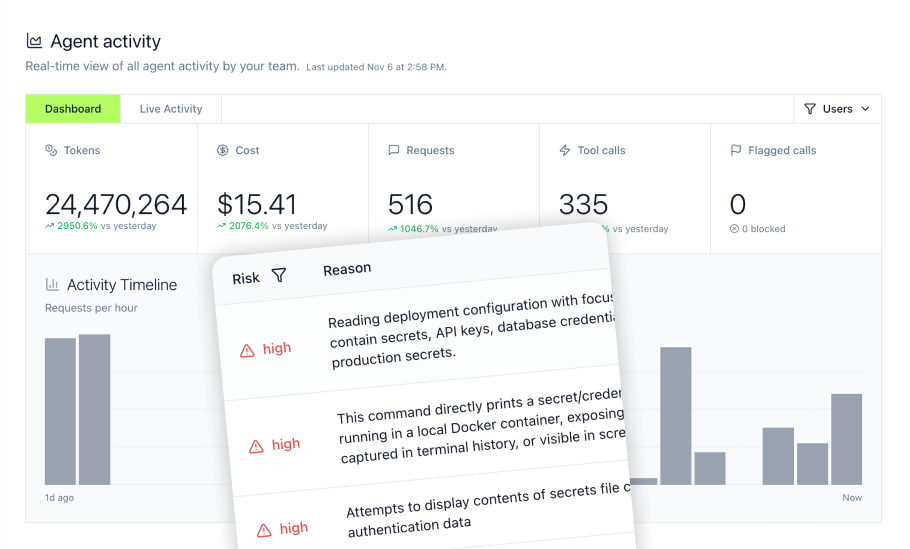
Comprehensive agent monitoring must address on-gateway activity, off-gateway detection, bash command execution, file system access, and prompt content. MintMCP Agent Monitor tracks agent activity in real-time across the organization, including MCP calls made outside the gateway through hooks in Cursor and Claude Code. MDM integration enables push of detect-only or enforce-mode configurations to developer machines for consistent policy application.
Leveraging Analytics for Performance and Security Posture
Beyond security event detection, observability data supports operational optimization and adoption tracking. Key analytics capabilities include usage patterns by team and tool, latency monitoring, error tracking, adoption metrics, and anomaly detection.
Centralized Governance and Control for Cloud Deployments
Integrating with Cloud Native Security Services
Enterprise AI deployments rarely exist in isolation. Integration with existing cloud identity providers, security tools, and compliance infrastructure determines whether an agent gateway fits into established workflows or creates additional operational burden.
Critical cloud integrations include:
- Identity providers: SSO through Okta, Azure AD, and Google Workspace with SCIM provisioning
- SIEM platforms: Event export to Sentinel, Splunk, and cloud-native logging services
- DLP services: Policy integration with cloud provider guardrails and third-party DLP platforms
- Secrets management: Connection to existing vault infrastructure for credential storage
MintMCP is managed SaaS-first, with VPC and self-hosted options available on request. For regional requirements, confirm current deployment and data residency options with MintMCP during security review.
Ensuring Compliance for Multi-Cloud AI Workloads
Organizations running AI workloads across AWS, Azure, and GCP face the challenge of maintaining consistent governance across heterogeneous infrastructure. An agent gateway provides the unifying control layer that applies identical policies regardless of where underlying services run.
Multi-cloud governance considerations include consistent identity, unified audit, policy portability, and regional requirements that should be confirmed during security review.
Advanced API Monitoring for Proactive Threat Detection
Detecting and Mitigating Prompt Injection Attacks
Prompt injection represents one of the most significant security risks for AI agents. Attackers embed malicious instructions in data that agents process, attempting to override system prompts and trigger unauthorized actions.
Prompt injection defense layers include input validation, response inspection, behavioral analysis, and output filtering. MintMCP Agent Monitor detects prompt injection attempts using built-in rules, with support for custom guardrail policies that can block, flag, or alert based on detected patterns.
Runtime Blocking of Risky Agent Behaviors
Detection alone is insufficient when agents can execute destructive operations in milliseconds. Runtime blocking requires inline policy enforcement that can halt dangerous actions before they complete.
Risk categories requiring runtime blocking include credential exposure, PII leakage, destructive commands, and unauthorized access. MintMCP Gateway provides isolated, sandboxed execution for hosted connectors, with input and output inspection. Custom policies with block, flag, or alert actions enable security teams to define organization-specific rules for their threat model.
Simplifying Agent Lifecycle Management with the Bundle Architecture
From Group Membership to Granular Agent Permissions
Managing tool access for hundreds of users across dozens of MCP servers quickly becomes unmanageable without abstraction. MintMCP's Bundle architecture addresses this complexity by packaging tool access, policy enforcement, and audit logging into single governance units per team or role.
Each Bundle ties SCIM group membership to a curated MCP server list, custom policy rules, and an isolated audit trail. When team membership changes in your identity provider, tool access updates automatically. Bundle governance capabilities include admin approval workflows, policy cascading, self-service access requests, and audit isolation.
Automating Policy Enforcement for AI Agent Fleets
Agent Bundles extend the Bundle model to non-human principals, giving each deployed agent its own persistent identity with scoped credentials that can be rotated independently of user accounts. Per-agent identity benefits include independent rotation, scoped permissions, audit attribution, and billing visibility.
Seamless Integration: Supporting the Full AI Agent Ecosystem
Connecting Your Agents to Critical Enterprise Tools
An agent gateway must support the AI clients your teams actually use without forcing standardization on a single platform. The Model Context Protocol provides the foundation, but implementation details vary across clients and server types.
MintMCP supports major AI platforms including Claude, Cursor, ChatGPT, Gemini, and Copilot. STDIO server support automatically converts locally-run MCP servers to hosted, production-ready services with OAuth wrapping, requiring no code changes. For teams building custom agents, the Claude skills guide provides practical implementation patterns.
Pre-built hosted connectors include integrations for Salesforce, GitHub, Slack, Snowflake, Gmail, Stripe, HubSpot, Notion, Linear, and dozens more. These connectors run managed by MintMCP with auto-scaling and isolated execution per connector.
Infrastructure-as-Code for AI Agent Management
Enterprise deployments require programmatic management that integrates with existing CI/CD pipelines and infrastructure-as-code workflows. Manual configuration through dashboards does not scale to organizations managing hundreds of MCP servers across multiple environments.
MintMCP provides REST APIs and SDKs for programmatic management, enabling teams to version control their agent governance configuration alongside application code. Admin MCP allows operating the platform from any MCP client, managing rules, deploying custom connectors, and pulling logs through conversational interaction with full audit logging.
Building Trust: Enterprise-Grade Security for Agent Gateways
Meeting Stringent Regulatory Requirements for AI
Enterprise adoption of AI agents requires security posture that satisfies audit requirements and risk committees. Point solutions without formal attestation create liability when regulators ask how you govern AI access to sensitive systems.
MintMCP is SOC 2 Type II audited with continuous compliance monitoring via Drata. Customers handling protected health information can request HIPAA documentation, and MintMCP signs Business Associate Agreements. The platform undergoes regular penetration testing with data encrypted in transit and at rest. Data residency options and uptime SLAs are available for production workloads.
For detailed security documentation, visit the Trust Center or contact security@mintmcp.com for compliance materials.
The Foundation of Secure AI Agent Operations
Security for AI agents extends beyond compliance checkboxes. The architecture must assume breach and limit blast radius when incidents occur. Immutable audit records support forensic investigation. Credential isolation prevents lateral movement. Policy enforcement at the tool call level stops data exfiltration before it succeeds.
An agentic AI governance framework provides the structure for ongoing security management, defining ownership, review cadences, and escalation paths for AI agent incidents.
Why MintMCP Agent Gateway Fits Enterprise AI Governance
Organizations deploying AI agents at scale require infrastructure that balances developer velocity with security and compliance requirements. MintMCP Agent Gateway delivers this balance through its comprehensive approach to identities, permissions, memory, and monitoring.
The platform's Bundle architecture simplifies governance by packaging tool access, policy enforcement, and audit logging into team-aligned units that update automatically with identity provider changes. Per-agent identity enables precise attribution and credential management independent of human accounts. Conversation-level audit logging captures the full context of agent actions with immutability and SIEM export for regulatory compliance.
Real-time monitoring extends beyond the gateway to detect shadow AI activity in developer tools, addressing the blind spot that traditional solutions miss. Custom policy execution enables inline DLP integration at the tool-call level, protecting sensitive data before it leaves your perimeter. One-click deployment helps turn local MCP servers into governed services without code changes.
With HIPAA documentation for healthcare customers, BAAs available, and integration with existing cloud identity and security tools, MintMCP provides the foundation security teams need for governed agent deployments. Pre-built connectors for dozens of enterprise systems accelerate time-to-value while maintaining consistent governance across your AI agent fleet.
Whether you're securing agent access to production databases, enforcing DLP policies on tool responses, or providing auditors with immutable records of AI actions, MintMCP Agent Gateway delivers the centralized control plane that bridges the gap between AI adoption and governance maturity.
Frequently Asked Questions
How does an agent gateway handle MCP servers that require user-specific OAuth tokens?
For MCP servers requiring per-user OAuth authorization, like Gmail or Google Calendar, the gateway must broker the OAuth flow and maintain token refresh on behalf of users. MintMCP handles this through OAuth brokering for hosted servers, working around redirect URI limitations in containerized environments. When a user first accesses a connector requiring OAuth, they complete the authorization flow once, and the gateway manages token storage and refresh thereafter.
What happens when an MCP server adds new tools after initial configuration?
MCP servers evolve over time, and new tool additions can expand an agent's capabilities beyond what was originally authorized. MintMCP's tool-update policy addresses this through configurable behavior: organizations can choose to auto-enable new upstream tools or require admin approval before they become available in Bundles. This prevents silent capability expansion where agents gain access to new tools without explicit authorization.
Can I migrate existing MCP server configurations to a managed gateway without rebuilding them?
Yes, STDIO-based MCP servers can be deployed to a managed gateway through one-click upload without code modifications. The gateway wraps the server with OAuth authentication, adds audit logging, and helps manage scaling. Your existing server code can run inside the managed environment. The migration path typically takes minutes to hours per server, not weeks of re-engineering.
How do I handle AI agents that need access to systems without MCP support?
Not every enterprise system offers MCP server implementations. For REST APIs without native MCP support, custom MCP servers can wrap existing APIs, or the gateway's API connector can expose endpoints as MCP tools. MintMCP provides templates and documentation for building custom connectors, and the hosted CLI enables deployment without managing infrastructure.
What metrics should I track to measure agent gateway ROI?
Key metrics for agent gateway ROI include compliance audit preparation time reduction, security incident investigation time, credential management overhead, and developer productivity impact. The $1.88 million average savings IBM reported for organizations using security AI and automation provides useful context for risk-adjusted ROI calculations, though actual impact depends on your threat model and regulatory environment.