As MCP adoption expands across enterprise AI workflows, Model Context Protocol has moved from experiment to enterprise infrastructure. But rapid adoption has created a critical governance gap: MCP ecosystem research has documented risks across hosts, registries, and servers, raising the question of how teams manage dozens of MCP servers while maintaining security, compliance, and auditability.
MCP Gateway solutions solve this by providing centralized catalogs, access control, and audit trails for AI agent tool usage. Organizations deploying Claude, Cursor, ChatGPT, Gemini, and Copilot need governed access to internal systems without the engineering overhead of building custom integrations for each tool.
This guide compares 15 MCP registry and gateway solutions across deployment flexibility, compliance posture, feature completeness, and enterprise readiness to help you choose the right infrastructure for your AI agent deployments.
Key takeaways
- MintMCP Gateway provides governed data and tool connections for Claude, Cursor, ChatGPT, Gemini, and Copilot through centralized authentication, tool-level access control, audit logs, and policy enforcement
- Registry and gateway needs differ: registries help teams discover and approve MCP servers, while gateways enforce runtime access, credentials, logging, and policy controls
- Enterprise MCP deployments require identity-aware governance, including SSO, SCIM-driven RBAC, OAuth brokering, per-agent identity, audit trails, and least-privilege tool access
- Deployment model matters: managed SaaS-first platforms reduce infrastructure overhead, while self-hosted options give teams more control but require runtime, scaling, security, and lifecycle management
- Agent governance is becoming a separate control layer: MintMCP's Agent Gateway builds on its MCP Gateway foundation with identities, permissions, memory, and monitoring for agents that work alongside users
1. MintMCP Gateway: enterprise MCP infrastructure in minutes
MintMCP Gateway provides enterprise governance for Model Context Protocol focused on authentication, tool-level access control, credential management, logging, rule-based policy, and agent governance. Its data-permissions-first architecture starts with SSO, SCIM-driven RBAC, IdP groups, Virtual MCP Bundles, tool-level policy, and audit logs, then enables agents on top.
Unlike traditional approaches requiring weeks of infrastructure setup, MintMCP helps teams turn MCP servers and hosted connectors into governed production services with centralized observability and enterprise authentication.
What makes MintMCP Gateway different
MintMCP solves the fundamental challenge of connecting AI agents to enterprise data sources while maintaining governance. The platform's architecture wraps stdio, hosted, HTTP-streamable, and SSE MCP servers behind SSO-fronted remote MCP endpoints with OAuth brokering, SCIM-driven membership, and rule-based policy.
Core capabilities
- Virtual MCP Bundles create team-specific, per-use-case endpoints that expose only the minimum required tools with SCIM-driven membership, curated tool lists, and fine-grained role-based access
- Agent Bundles give internal agents first-class identities with M2M auth, scoped tools, independent rotation and revocation, and an "act as agent" flow for connectors requiring per-agent OAuth
- Hosted MCP Connectors run on your behalf with auto-scaling and sandboxed execution per connector, reducing infrastructure overhead
- OAuth Brokering adds enterprise authentication to local and hosted MCP servers including OAuth 2.x, bearer tokens, headers, and SSO-fronted access without rebuilding each server
- Custom Gateway Middleware runs customer-authored middleware in a JS sandbox with external DLP and guardrails integrations for masking, blocking, and policy enforcement
Enterprise integrations
MintMCP provides pre-built connectors for Snowflake data warehouse access with natural language queries, Elasticsearch knowledge base search for HR documentation and support tickets, Gmail integration for AI-driven customer response automation, and custom MCP server deployment for internal tools. The platform supports Claude, Cursor, ChatGPT, Gemini, and Copilot governance through centralized gateway and Agent Monitor coverage. MintMCP's Agent Gateway builds on this MCP Gateway foundation by adding identities, permissions, memory, and monitoring for agents that work alongside users.
Security and compliance
MintMCP is SOC 2 Type II audited and compliant with HIPAA standards, with every agent action audited. The platform provides enterprise SSO, complete audit trails, PII detection, and role-based access control built into every layer. Customers handling protected health information can request HIPAA documentation, and MintMCP signs BAAs. Security teams can review MintMCP's full security posture in the Trust Center.
Deployment and pricing
Deploy quickly with managed SaaS-first delivery in US and EU availability zones, hosted MCP connectors, pre-configured policies, and self-service access for developers. VPC and self-hosted deployment available on request. Contact for enterprise demonstration and pricing.
2. Obot AI
Obot AI provides open-source MCP gateway capabilities with a built-in curated MCP catalog and self-service discovery. The MIT-licensed platform runs on Kubernetes or Docker with an optional managed service.
Primary focus
- Composite servers combine multiple MCP servers into single endpoints
- Multi-role RBAC with IdP integration for Okta and Entra
- GitOps-compatible admin model for infrastructure-as-code teams
Where Obot fits
Organizations seeking full infrastructure control with Kubernetes expertise who want to self-host their MCP gateway. Teams prioritizing open-source transparency and community-driven development.
Deployment considerations
Self-hosted on Docker for development or Kubernetes for production, with a hosted option also available. Self-hosted deployments still require teams to operate the runtime, Kubernetes deployment, scaling, connector lifecycle, and governance stack.
3. TrueFoundry MCP Gateway
TrueFoundry integrates MCP gateway capabilities into its MLOps platform, providing unified LLM and MCP management in a single control plane. The platform reports low-latency benchmark results in its own materials, though teams should validate latency under their own workload.
Primary focus
- VPC-native deployment for data residency compliance across AWS, GCP, Azure, and on-premises
- OAuth 2.0 Identity Injection with On-Behalf-Of authentication
- Virtual MCP Server abstraction for backend stability
Where TrueFoundry fits
Organizations wanting unified LLM routing and MCP governance in a single platform with performance-oriented architecture. Teams with existing MLOps investments looking to add MCP capabilities.
Deployment considerations
Hybrid deployment with managed SaaS and self-hosted control plane in customer's Kubernetes environment. Air-gapped deployment available via forward proxy.
4. Lunar.dev MCPX
Lunar.dev's MCPX provides an MCP gateway that centralizes policy enforcement, access control, and observability. The platform reports low-latency benchmark results in its own materials, with Tool Groups for per-team tool curation.
Primary focus
- Risk sandbox and tool customization including description rewriting and parameter locking
- Prometheus-compatible metrics with labels for tool, agent, and model
- Integration with Lunar AI Gateway for LLM and MCP unified visibility
Where Lunar MCPX fits
Platform and infrastructure teams deploying MCP to production who need centralized access control, observability, and policy enforcement. Organizations seeking centralized MCP policy enforcement, observability, and tool access control.
Deployment considerations
Self-hosted via Docker or Kubernetes with optional SaaS dashboards for telemetry and control plane visibility. Security and compliance documentation should be verified during procurement.
5. JFrog MCP Registry
JFrog MCP Registry treats MCP servers like software binaries within the JFrog Software Supply Chain Platform. It is most relevant for organizations already using JFrog to manage software artifacts, packages, and supply chain workflows.
Primary focus
- System of record for MCP servers, agent skills, models, and agentic assets
- Proactive approach blocking unauthorized servers before entering the organization
- Integration with existing JFrog artifact management workflows
Where JFrog fits
Organizations with existing JFrog investments who want to manage MCP servers alongside software packages and AI models. Enterprises with strict supply chain security requirements.
Deployment considerations
Enterprise pricing tied to JFrog platform. Requires JFrog infrastructure investment for full value realization.
6. MCP Manager (Usercentrics)
MCP Manager provides governance-first positioning from the consent management vendor, addressing MCP-specific threats including tool poisoning and rug-pull attacks.
Primary focus
- Rug-pull detection and anti-mimicry protection
- Centralized access control and governance for MCP usage
- Deployment support for remote, managed, and workstation MCP servers
Where MCP Manager fits
Organizations prioritizing MCP-specific threat detection alongside traditional governance controls. Teams concerned about emerging attack vectors in the MCP ecosystem.
Deployment considerations
Pricing and deployment details should be confirmed during vendor evaluation.
7. Composio
Composio provides a managed MCP gateway with a large catalog of pre-built SaaS connectors for common enterprise tools. The platform holds SOC 2 Type II attestation.
Primary focus
- Managed toolkits reducing custom development for common SaaS integrations
- BYOC, or Bring Your Own Cloud, option on Enterprise tier
- Pre-built connectors for rapid deployment
Where Composio fits
AI engineering teams building agentic applications who prioritize breadth of pre-built integrations over custom governance controls. Organizations seeking rapid integration deployment.
Deployment considerations
Managed SaaS-first with VPC and on-premises options on Enterprise tier only.
8. Bifrost (Maxim AI)
Bifrost provides a Go-based MCP gateway targeting latency-sensitive applications with minimal overhead. The Apache 2.0 licensed project focuses on raw performance.
Primary focus
- Dual MCP client and server architecture
- Minimal gateway overhead for performance-critical deployments
- Open-source foundation with enterprise tier
Where Bifrost fits
Organizations with stringent latency requirements where gateway overhead significantly impacts user experience. Teams with Go expertise seeking performant infrastructure.
Deployment considerations
Open-source self-hosted with enterprise tier available. No managed SaaS option surfaced in public documentation.
9. Microsoft MCP Gateway
Microsoft's open-source MCP Gateway provides native integration with the Azure ecosystem including Entra ID for identity and Azure Monitor for observability.
Primary focus
- Session-aware routing for multi-turn agent conversations
- Native Entra ID authentication and Azure Monitor integration
- Alignment with existing Azure identity, monitoring, and compliance workflows, depending on customer configuration
Where Microsoft Gateway fits
Azure-committed organizations seeking to leverage existing identity and monitoring investments. Teams standardized on Microsoft infrastructure.
Deployment considerations
Designed for Kubernetes-based deployment, including AKS environments. Teams should evaluate operating requirements, support model, and production readiness before adoption.
10. Docker MCP Gateway
Docker's MCP Gateway brings container orchestration expertise to MCP server management, providing a Docker-native approach to running and managing MCP servers with Docker Desktop, CLI, and Compose.
Primary focus
- Container isolation for MCP server deployments
- Docker Compose configurations for development environments
- Standard container security practices and image management
Where Docker Gateway fits
Developers running MCP servers locally and organizations with existing Docker environments seeking to run and manage MCP servers using familiar workflows.
Deployment considerations
Self-hosted on Docker or Kubernetes infrastructure. Open-source with infrastructure costs varying by deployment. Requires teams to operate connector runtimes, scaling, and Kubernetes infrastructure.
11. Kong AI Gateway for MCP
Kong AI Gateway extends existing Kong deployments with MCP protocol support, providing MCP-to-REST conversion and centralized OAuth management.
Primary focus
- MCP-to-REST conversion for legacy system integration
- LLM-as-a-Judge validation for response quality
- Unified API and MCP management through existing Kong infrastructure
Where Kong fits
Organizations already standardized on Kong for API gateway functionality who want to add MCP support without deploying separate infrastructure.
Deployment considerations
Hybrid deployment with Konnect SaaS control plane plus self-hosted data plane, or fully self-hosted. Commercial pricing tied to Kong license.
12. AWS Bedrock AgentCore Gateway
AWS Bedrock AgentCore provides AWS-native MCP gateway with IAM and Cognito integration for authentication and semantic search registry for MCP server discovery.
Primary focus
- IAM and Cognito integration for AWS-native authentication
- Semantic search registry for MCP server discovery
- Alignment with existing AWS identity, security, and compliance workflows, depending on customer configuration
Where AWS AgentCore fits
AWS-committed organizations seeking native integration with existing AWS identity and compliance posture. Teams building on Bedrock who want unified agent infrastructure.
Deployment considerations
AWS-managed with usage-based pricing. AWS-only deployment limits multi-cloud flexibility.
13. Portkey
Portkey adds MCP module capabilities to its mature LLM gateway infrastructure, providing a unified dashboard for LLM and MCP traffic management. The platform lists SOC 2 among its security and compliance standards.
Primary focus
- Existing LLM gateway features extended to MCP
- Read-only directory for MCP server discovery
- Unified observability across LLM and MCP traffic
Where Portkey fits
Organizations with existing Portkey LLM gateway investments who want to add MCP capabilities without deploying separate infrastructure.
Deployment considerations
Managed plus self-hosted options available. MCP functionality may be an add-on to core LLM gateway features.
14. IBM ContextForge
IBM ContextForge provides open-source MCP gateway with multi-cluster federation and protocol bridging for legacy systems. The Apache 2.0 licensed project includes over 40 plugins.
Primary focus
- Multi-region enterprise architecture with cluster federation
- REST and gRPC-to-MCP conversion for legacy system integration
- Over 40 plugins for extensibility
Where IBM ContextForge fits
Large enterprises with multi-region deployments requiring cluster federation. Organizations with significant legacy system investments needing protocol bridging.
Deployment considerations
Self-hosted on Kubernetes. Open-source deployments require teams to evaluate compliance controls, operational readiness, current development status, and support requirements.
15. Smithery
Smithery serves as a public discovery directory for MCP servers with thousands of listed tools and services, separate from the Official MCP Registry. The registry provides hosted and local CLI options with OAuth for hosted servers.
Primary focus
- Public directory for MCP server discovery
- Hosted and local CLI deployment options
- OAuth support for hosted servers
Where Smithery fits
Discovery and prototyping use cases. Teams evaluating what MCP servers exist in the ecosystem before selecting a governance solution.
Deployment considerations
Free community registry. Not designed for enterprise governance, access control, or audit requirements.
Choosing the right MCP registry tool
Selecting an MCP registry tool requires evaluating several critical factors against your organization's specific requirements.
Deployment model considerations
Purpose-built gateways like MintMCP provide managed SaaS-first deployment with hosted MCP connectors and pre-configured governance controls. Self-hosted open-source options offer full infrastructure control but require teams to operate runtimes, scaling, and governance stacks. Consider whether you need production deployment quickly or can invest weeks building custom infrastructure.
Security and compliance requirements
Organizations in regulated industries need SOC 2 Type II audited platforms, audit logs, SSO, SCIM-driven RBAC, credential management, and tool-level access controls. Evaluate whether your gateway provides these controls or requires you to implement them yourself. For healthcare organizations handling protected health information, verify compliance with HIPAA standards, documentation availability, and BAA support.
STDIO vs. remote server support
Many community-built MCP servers use STDIO transport but are difficult to deploy without proper infrastructure. Solutions that only support remote HTTP or SSE servers limit ecosystem access and require rebuilding existing STDIO tools. Look for gateways that broker OAuth and wrap stdio servers with enterprise SSO.
Authentication architecture
OAuth 2.1 support was added to the MCP authorization specification in 2025, but implementation varies. Some gateways broker OAuth and wrap stdio or hosted servers with enterprise SSO, while others require manual OAuth configuration per server. Consider whether you need shared service accounts, per-user authentication, per-agent identity, M2M auth, or an "act as agent" flow.
Observability and monitoring
Without comprehensive logging, organizations face a visibility gap where they cannot see which tools agents use or track data access. Essential metrics include tool call tracking, performance analytics, error rates, and cost allocation per team. Evaluate whether your gateway provides real-time dashboards and audit logs or requires separate monitoring infrastructure.
Deploy governed AI infrastructure with MintMCP
MintMCP provides the enterprise MCP governance layer that connects AI agents to your internal systems with centralized authentication, tool-level access control, and complete audit trails. The platform's data-permissions-first architecture ensures that every agent action flows through governed infrastructure before accessing sensitive data.
With Virtual MCP Bundles for team-specific endpoints, Agent Bundles for per-agent identity, hosted MCP connectors that auto-scale, and custom JS middleware for DLP integrations, MintMCP addresses the full spectrum of enterprise MCP governance requirements.
Organizations deploying AI agents in regulated industries benefit from MintMCP's SOC 2 Type II audited platform, compliance with HIPAA standards, and signed BAAs. The platform integrates with existing identity providers through SSO and SCIM, extends security monitoring through SIEM connections, and enforces data protection policies through DLP integrations. This allows security teams to govern AI agents using the same tools and workflows they already trust.
MintMCP's managed SaaS-first deployment eliminates weeks of infrastructure setup, auto-scales hosted connectors without operational overhead, and provides pre-configured policies that teams can customize. VPC and self-hosted options are available on request for teams with stricter deployment requirements, while the Trust Center provides transparent security documentation for procurement reviews.
Get started at mintmcp.com to deploy governed AI agents in minutes, not months.
Frequently asked questions
What is an MCP registry tool and why is it essential for enterprise AI deployments?
An MCP registry tool provides centralized management, discovery, and governance for Model Context Protocol servers that connect AI agents to enterprise data and tools. These tools address the governance gap that emerges when organizations deploy multiple AI agents accessing dozens of internal systems. Without centralized registry and gateway infrastructure, enterprises face fragmented security policies, inconsistent authentication, and zero visibility into which agents access which data.
How do MCP registry tools ensure compliance for AI agents accessing sensitive data?
Enterprise MCP registry tools implement defense-in-depth security through centralized authentication, tool-level access controls, and immutable audit trails. Features like SSO integration, SCIM-driven RBAC, OAuth brokering, and per-agent identity enable organizations to enforce least-privilege access. Complete audit logs capture every tool call with user attribution, supporting compliance investigations and regulatory requirements.
What are the key differences between MintMCP's Bundle architecture and traditional MCP gateway configurations?
MintMCP's Bundle architecture packages tool access, policy enforcement, and audit logging into single governance units per team or use case. Virtual MCP Bundles create dedicated endpoints with SCIM-driven membership and curated tool lists. Agent Bundles extend this model to non-human principals, giving each AI agent its own rotatable credentials and permission scope. This differs from traditional approaches requiring separate configuration of plugin, access rule, and credential objects for each integration.
How does shadow AI detection work for coding agents like Cursor and Claude Code?
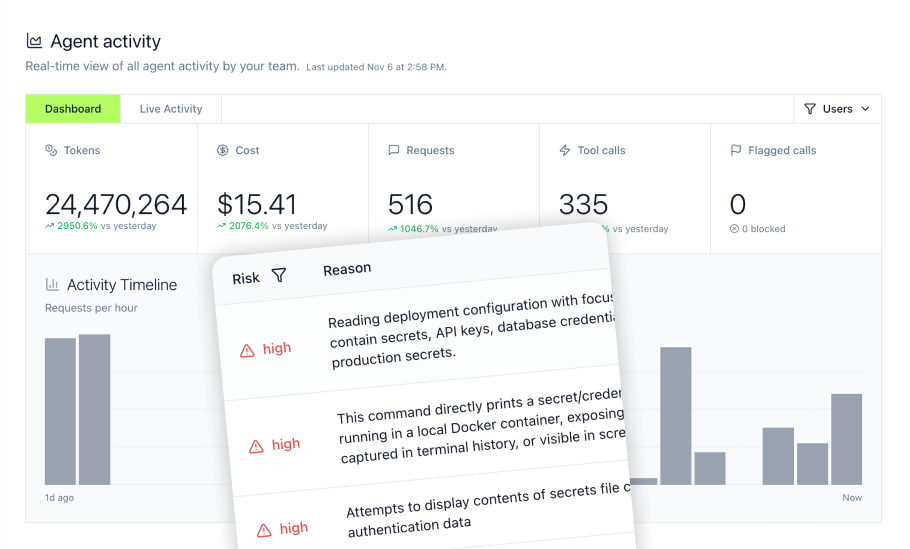
Shadow AI detection identifies AI agent activity occurring outside governed infrastructure. MintMCP's Agent Monitor tracks agent activity including MCP calls made outside the gateway through hooks in Cursor and Claude Code. The system detects PII exposure, credential leakage, risky commands, and prompt injection attempts using built-in rules with block, flag, or alert actions. This creates two-layer governance covering both MCP traffic and local non-MCP agent activity.
Can MCP registry tools integrate with existing enterprise security and identity management systems?
Enterprise MCP registry tools integrate with identity providers like Okta and Azure AD for SSO and SCIM-driven user provisioning. They connect to SIEM platforms including Microsoft Sentinel and Splunk for centralized security monitoring. DLP integrations with services like AWS Bedrock Guardrails, Google Cloud DLP, and Microsoft Purview enable inline data protection. These integrations allow organizations to extend existing security investments to AI agent infrastructure rather than building parallel governance systems.