The best TrueFoundry alternatives for enterprise MCP governance are MintMCP (purpose-built MCP gateway with Virtual MCPs, Agent Bundles, and Mint Guard), Runlayer (hybrid SaaS plus self-hosted MCP and agent governance), Prisma AIRS AI Gateway, formerly Portkey (AI gateway with LLM, MCP, observability, and guardrail capabilities), and LiteLLM (open-source AI gateway with LLM and MCP gateway capabilities). MintMCP is a strong fit for organizations that need governed internal employee and agent access to enterprise tools, with SOC 2 Type II audited infrastructure, SCIM-driven RBAC, and per-agent identity.
Key Takeaways
- MintMCP stands out as a strong TrueFoundry alternative for MCP gateway deployments with SOC 2 Type II audited, compliant with HIPAA standards (BAA available), data-permissions-first architecture, SSO and SCIM-driven RBAC, tool-level policy, credential management, and audit logs
- MCP gateways serve as essential infrastructure providing security isolation, comprehensive observability, and centralized management for AI agent connections to data sources
- Security and compliance vary significantly: MintMCP offers centralized audit logs, SSO, SCIM-driven RBAC, tool-level allowlisting, and policy enforcement, while alternatives range from basic logging to broader platform governance
- Deployment complexity differs dramatically: MintMCP is managed SaaS-first with hosted MCP connectors, while some alternatives require teams to manage container runtimes, Kubernetes infrastructure, or self-hosted gateway operations
- Consider your primary use case: Choose MintMCP for secure enterprise MCP deployments and internal employee or internal-agent governance, TrueFoundry for a broader platform spanning LLM, MCP, agent, and model infrastructure, and specialized platforms for specific integration requirements
What Is TrueFoundry and Why Do Users Look for Alternatives
What is TrueFoundry? TrueFoundry is an enterprise AI infrastructure platform spanning AI Gateway, MCP Gateway, Agent Gateway, and model deployment and serving. It targets platform engineering and ML platform teams and supports private, VPC, on-prem, and air-gapped deployment patterns. Organizations specifically deploying MCP servers and governing internal employee and agent access often evaluate purpose-built MCP governance platforms alongside TrueFoundry.
The Model Context Protocol is an open protocol that enables standardized connections between AI applications and external data sources and tools. MCP provides a common way for AI systems to discover and invoke tools instead of relying on a separate integration format for every application.
MCP gateways can serve as centralized governance layers for AI models and agents. They can provide security isolation with comprehensive access controls, centralized management for MCP connections across environments, and policy enforcement across different model endpoints.
As AI systems evolve from simple question-answering tools into autonomous agents capable of reasoning, planning, and executing complex tasks, they require sophisticated infrastructure for orchestration, memory, and control. Organizations specifically deploying MCP servers may find a purpose-built MCP governance platform, with Virtual MCPs, Agent Bundles, Mint Guard, and tool-update policy, a better fit than a broader AI infrastructure platform.
TrueFoundry vs. MintMCP: Key Differences
| Capability | MintMCP | TrueFoundry |
|---|---|---|
| Primary use case | Internal employee and agent MCP governance | Unified LLM, MCP, agent, and model infrastructure |
| Deployment model | Managed SaaS-first; VPC/self-hosted on request (verify current regional availability at mintmcp.com) | Hybrid managed SaaS + self-hosted; VPC, on-prem, and air-gapped options |
| MCP-specific primitives | Virtual MCPs, Agent Bundles, tool-update policy | Dedicated MCP Gateway with server registry, OAuth2, RBAC, policy, audit, and observability |
| Agent identity | Per-agent identity, bearer keys, M2M OAuth tokens, workload identity federation | Agent Gateway with agent-level identity, access controls, policy, and auditability |
| Runtime guardrails | Mint Guard, Rules, Gateway Middleware (JS sandbox) | AI and Agent Gateway guardrails and policy controls |
| SCIM-driven RBAC | Yes, directory-group-driven Virtual MCP membership | Verify current SCIM support against TrueFoundry documentation |
| Compliance | SOC 2 Type II audited, compliant with HIPAA standards | Vendor states support for SOC 2, HIPAA, and GDPR standards |
| Target buyer | IT, Security, AI Operations, platform engineering | Platform Engineering, ML Platform teams |
See our full MintMCP vs. TrueFoundry comparison for a deeper breakdown.
When to Choose MintMCP Over TrueFoundry
- Your primary problem is governing internal employee and agent access to enterprise tools, not operating a broader LLM, model-serving, and agent infrastructure platform. MintMCP's Virtual MCPs, SCIM-driven RBAC, and tool-level policy are built for this use case.
- You need per-agent identity. Each autonomous agent gets its own credentials, bearer keys, M2M OAuth tokens, or workload identity federation, independently rotatable and revocable without touching human accounts.
- Runtime guardrails are non-negotiable. Mint Guard detects prompt injection, secrets, PII, and harmful content at runtime with Off, Monitoring, and Enforcing modes. Rules and Gateway Middleware add declarative and custom enforcement layers.
- You want managed SaaS-first deployment without operating Kubernetes infrastructure or connector runtimes yourself.
- You need a governance layer across Claude, Cursor, ChatGPT, Gemini, and Copilot, not just a single model provider or agent harness.
- Compliance requires SOC 2 Type II audited infrastructure, compliance with HIPAA standards, and centralized audit trails with SIEM export. Customers handling protected health information can request HIPAA documentation, and MintMCP signs BAAs.
1. MintMCP: A Strong Overall Alternative for Enterprise MCP Deployments
MintMCP is purpose-built for the Model Context Protocol. It provides the deployment and governance infrastructure MCP deployments need at enterprise scale, with managed SaaS-first rollout, hosted connectors, and a data-permissions-first architecture that governs access before granting it.
Key MintMCP Advantages
- Managed SaaS-first deployment for enterprise MCP gateway rollout
- OAuth brokering for STDIO and hosted MCP servers
- SOC 2 Type II audited and compliant with HIPAA standards. Customers handling protected health information can request HIPAA documentation, and MintMCP signs BAAs.
- Audit logs and centralized observability for MCP tool calls and agent activity
- Tool-level allowlisting and rule-based policy for governed MCP access
- SSO and SCIM-driven RBAC for entire organizations
- Virtual MCP Bundles for per-use-case endpoints with SCIM-driven membership, curated tools, and access policy
- Agent Bundles with bearer keys, M2M OAuth tokens, or workload identity federation, each agent independently rotatable and revocable
- Hosted MCP connectors run by MintMCP so teams do not need to manage connector runtimes
Enterprise Security Features
MintMCP's security architecture provides enterprise protection through multiple layers:
- Authentication and identity management with SSO, SCIM-driven RBAC, and IdP groups
- Tool governance with tool-level allowlisting and rule-based policy
- Runtime protection through three complementary layers: Mint Guard for managed detection of prompt injection, secrets, PII, and harmful content (with Off, Monitoring, and Enforcing modes); declarative Rules for tool-name, argument, and content matching with flag, block, mask, or notify actions; and Gateway Middleware for customer-authored JavaScript in a JS sandbox, including integrations with external DLP or classifier systems
- Audit and observability tracking MCP operations and policy decisions
- Tool-update policy to control whether new upstream tools are auto-enabled or require admin approval
Deployment Infrastructure
Unlike platforms requiring extensive Kubernetes expertise, MintMCP's quickstart supports a faster managed deployment path:
- Managed SaaS-first rollout with VPC or self-hosted deployment on request (verify current regional availability at mintmcp.com)
- Hosted MCP connectors run by MintMCP for managed connector runtime, scaling, and isolation
- Virtual MCP Bundles for per-role or per-use-case MCP endpoints
- Centralized credential management for API keys and tokens
- Database, API, and service connections for AI tools
- Admin MCP to manage rules, deploy custom connectors, pull logs, and operate the platform from MCP clients
Persistent Autonomous Agents with Company-Owned Memory
Beyond governing connections, MintMCP's Coworker Agents are long-running agents that work alongside employees through Slack, scheduled triggers, or manual runs. They retain company-owned memory that is scoped, versioned, reviewable, and auditable, not locked inside an opaque vendor system. Instructions, memory, and work history remain under organizational control, and agents operate with scoped tool access and governed credentials. For organizations evaluating TrueFoundry's agent workflow capabilities, Coworker Agents represent a governed alternative for persistent autonomous work.
Enterprise Governance and Operational Controls
MintMCP's Security and Enterprise layer provides the identity, audit, and operational foundation across the platform:
- Audit trails covering MCP tool calls, agent actions, and policy decisions, with tamper-evident access history where supported
- SIEM export for centralized security visibility across your existing security stack
- Kill switch via operational controls for org-wide or tool-level shutdown as needed
- Configuration as code for version-controlled governance policy, relevant for platform engineering teams already managing infrastructure declaratively
- Private network tunnel for connecting AI agents to data sources inside private networks without exposing them to the public internet
AI Agent Compatibility
MintMCP connects AI agents to data with support for:
- ChatGPT integration with custom GPT capabilities
- Claude web setup for browser-based access
- Gemini and Copilot connections for enterprise AI workflows
- Cursor governance through Gateway and Agent Monitor coverage
- Custom AI tool integration through flexible APIs
Monitoring and Observability
The audit and observability features provide comprehensive visibility:
- Track MCP tool calls across coding agents
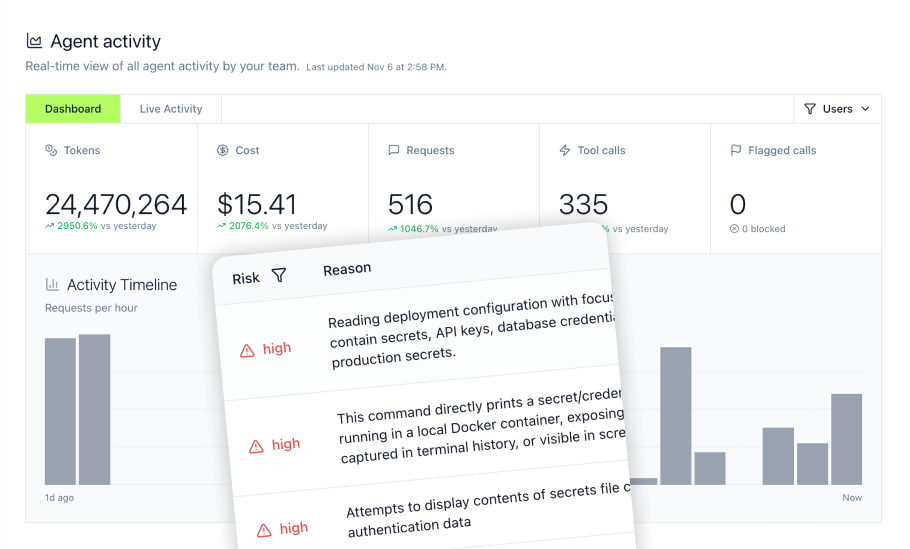
- Monitor local non-MCP agent activity through Agent Monitor coverage for bash commands, file reads and writes, and prompt submissions. Coverage varies by client and hook phase.
- See installed MCPs and usage patterns
- Measure response times and error rates
- Review centralized audit logs across teams and projects
- Apply rule-based blocking of risky operations
Connector Ecosystem
MintMCP's connector framework supports:
- Hosted connectors run by MintMCP for managed cloud services
- Remote connectors for distributed deployments
- Custom connectors for specific integrations
- Secure connector architecture with built-in protection
Pricing Model
MintMCP offers enterprise pricing with deployment options matching organizational needs. Contact their team for detailed pricing based on scale, governance, and compliance requirements.
2. Runlayer
Runlayer targets IT, Security, AIOps, and platform engineering teams with a focus on internal employee and agent governance. It offers hybrid deployment, combining managed SaaS with self-hosted options on customer infrastructure, making it a closely overlapping option for organizations evaluating MintMCP.
See the MintMCP vs. Runlayer comparison for a detailed breakdown.
Runlayer Strengths
- Hybrid deployment model combining managed SaaS with self-hosted options for teams that want infrastructure ownership
- Internal employee and agent governance focus, overlapping closely with MintMCP's target use case
- IT, Security, and AIOps buyer orientation, similar to MintMCP's primary audience
- Platform engineering appeal for teams comfortable managing their own infrastructure layer
Considerations When Comparing Runlayer to MintMCP
- MCP-specific primitives: MintMCP's Virtual MCP Bundles provide per-use-case endpoints with SCIM-driven membership, curated tools, and access policy. MintMCP's Agent Bundles provide per-agent identity with scoped tools, M2M authentication, and independent credential rotation and revocation. Evaluate whether Runlayer's current product covers equivalent primitives by reviewing their current documentation.
- Managed agent infrastructure: MintMCP's Coworker Agents are long-running hosted agents with company-owned memory and Slack-native operation. Verify Runlayer's current agent hosting capabilities against their documentation.
- Data-permissions-first architecture: MintMCP starts from governed data and tool access, then extends the same identity, permission, audit, and policy foundation to autonomous agents. Evaluate whether Runlayer's architecture follows the same sequence.
3. Prisma AIRS AI Gateway, Formerly Portkey
Portkey's AI gateway technology is now presented as Prisma AIRS AI Gateway following Palo Alto Networks' acquisition of Portkey. The current platform spans LLM, MCP, and agentic traffic governance rather than operating only as an LLM gateway. It combines routing and observability with MCP access controls, runtime security, governance, and agent identity capabilities.
See the MintMCP vs. Portkey comparison for a detailed breakdown of the earlier Portkey product footprint.
Prisma AIRS AI Gateway Core Capabilities
- Unified AI gateway across multiple model providers
- MCP Gateway for authentication, access control, server and tool governance, and observability
- Observability and tracing for AI requests, tool use, usage, latency, and cost
- Guardrails and runtime security controls for AI traffic
- Agent identity and governance for agentic interactions
- Enterprise governance capabilities for teams managing AI traffic at scale
Considerations When Comparing Prisma AIRS AI Gateway to MintMCP
- Product orientation: Prisma AIRS AI Gateway is a broader enterprise AI control plane spanning LLM, MCP, and agentic traffic. MintMCP's primary strength is internal MCP and agent governance, with Virtual MCPs, per-agent identity, hosted connectors, and SCIM-driven access as core primitives.
- MCP-specific governance: Prisma AIRS includes MCP authentication, access control, registry, policy, and observability capabilities. MintMCP's differentiation is its Virtual MCP Bundles and Agent Bundles model for per-use-case and per-agent governed access.
- Compliance baseline: MintMCP is SOC 2 Type II audited and compliant with HIPAA standards. Organizations evaluating Prisma AIRS should compare the compliance posture of the specific deployment and services they intend to use.
- Internal employee governance: MintMCP's data-permissions-first architecture, SCIM-driven RBAC, and hosted MCP connectors are built specifically for governing internal employees and agents across Claude, Cursor, ChatGPT, Gemini, and Copilot.
4. LiteLLM
LiteLLM is an open-source AI gateway that provides a unified interface for interacting with multiple LLM providers. In addition to multi-provider model routing, LiteLLM now includes a dedicated MCP Gateway for centralizing MCP servers and tools behind a fixed gateway endpoint.
LiteLLM Core Capabilities
- Unified API across multiple LLM providers
- Provider translation handling different API formats
- Cost tracking and usage monitoring
- Multi-provider routing, rate limits, and gateway controls through a single interface
- MCP Gateway for centralized MCP server and tool access
MCP Integration Features
- Centralized MCP Gateway endpoint for tools from multiple MCP servers
- MCP access control by API key, team, and organization
- Tool listing and invocation, plus MCP prompts and resources
- Streamable HTTP, SSE, and STDIO transport support
- OAuth and other MCP authentication flows through the gateway
- Shared control plane for LLM models, MCP servers, and agent-facing endpoints
Cost and Deployment
LiteLLM offers open-source deployment with self-hosting options, including CLI- and container-based deployment. Verify current enterprise hosting and deployment options against LiteLLM's documentation.
Considerations When Comparing LiteLLM to MintMCP
- Product focus: LiteLLM now provides both LLM gateway and MCP Gateway functionality. MintMCP's primary distinction is its internal employee and agent governance model built around Virtual MCP Bundles, first-class Agent Bundles, hosted connectors, and cross-platform monitoring and guardrails.
- Governance requirements: Organizations requiring SCIM-driven RBAC, tool-level policy, and agent identity governance should compare the exact access and identity primitives provided by each platform rather than treating LiteLLM as only an LLM proxy.
- Internal employee governance: MintMCP is purpose-built for governing internal employee and agent access to enterprise tools. LiteLLM provides an open-source control plane across LLM and MCP infrastructure.
- Best for: Teams that want an open-source, self-hosted gateway spanning multi-provider LLM routing and centralized MCP access.
Authentication and Security Features in MCP Gateway Solutions
Security architecture differentiates enterprise-ready platforms from basic implementations. MintMCP's security architecture sets out the full framework.
MintMCP Enterprise Authentication
- SSO integration with identity providers
- SCIM-driven RBAC for group-based access management
- Okta SSO configuration for enterprise identity
- OAuth brokering for STDIO and hosted MCP servers
- M2M authentication for Agent Bundles
Alternative Platform Authentication
- API key management for basic access control
- OAuth 2.0 for delegated authorization
- Token-based access with expiration policies
Access Control Models
MintMCP's RBAC provides:
- SSO and SCIM-driven RBAC for entire organizations
- Granular permissions per tool and data source
- Virtual MCP Bundles for team, role, and use-case-specific endpoints
- Team-based policies for collaborative environments
- Automated policy enforcement without manual intervention
Governance and Compliance
- SOC 2 Type II audited and compliant with HIPAA standards (BAA available). Organizations handling ePHI remain responsible for meeting applicable requirements under the HHS HIPAA Security Rule.
- Audit logs and centralized observability for security and compliance review
- Tool-level allowlisting and rule-based policy for least-privilege MCP access
- External DLP and guardrails integrations for sensitive data protection
- Gateway and Agent Monitor two-layer governance across MCP traffic and supported local agent activity
Developer Experience: SDKs, Deployment, and Documentation Quality
Developer experience impacts adoption speed and long-term success. MintMCP balances comprehensive capabilities with intuitive interfaces.
SDK Design and Capabilities
- SDK and developer APIs enabling programmatic management and MCP deployment workflows
- Streamlined deployment workflow to spin up new services with minimal configuration, without managing connector runtimes or Kubernetes infrastructure
- Team accessibility through Virtual MCP Bundles that scope tools and access by role, team, or use case
- Authentication and access control handled centrally through SSO, SCIM-driven RBAC, and the platform's management interface
Documentation Quality
MintMCP's documentation provides:
- Getting started guides for rapid onboarding
- Architectural overviews explaining system design
- Security documentation covering protection layers
- Integration tutorials for common scenarios
- Developer documentation covering APIs, deployment, and platform configuration
Developer Productivity
Organizations can reduce implementation overhead through:
- Self-serve access that reduces waiting for approvals
- Hosted MCP connectors that reduce custom runtime management
- Centralized security controls that reduce one-off policy implementation
- Clear documentation that minimizes support requests
Making the Right Choice for Your MCP Gateway Deployment
Selecting the right TrueFoundry alternative depends on specific requirements, security needs, and deployment timelines. MintMCP is a strong option for enterprise MCP deployments, combining managed SaaS-first deployment with security controls, audit logs, and MCP-specific governance.
Choose MintMCP when:
- Enterprise security is non-negotiable with compliance requirements
- Managed SaaS-first deployment matters for reducing operational overhead
- Governance across employees and internal agents is essential
- Audit logs and centralized observability are required
- Hosted MCP connectors reduce connector runtime and Kubernetes complexity
- Cross-platform AI governance across Claude, Cursor, ChatGPT, Gemini, Copilot, and custom tools is important
- MCP-specific primitives such as Virtual MCP Bundles, Agent Bundles, Mint Guard, OAuth brokering, and tool-update policy are required
The future of enterprise AI infrastructure requires secure, governed connections between AI agents and data sources. MintMCP supports this shift with purpose-built infrastructure that makes MCP deployment practical for enterprises. Get started with MintMCP today and deploy governed MCP infrastructure.
Frequently Asked Questions
What makes MintMCP different from TrueFoundry for MCP deployments?
MintMCP focuses specifically on Model Context Protocol infrastructure and internal employee and agent governance, with managed SaaS-first deployment, OAuth brokering, SSO and SCIM-driven RBAC, Virtual MCP Bundles, Agent Bundles, and tool-level policy. TrueFoundry now provides its own MCP Gateway and Agent Gateway alongside LLM gateway and model-serving infrastructure, with deployment options spanning private VPC, on-prem, and air-gapped environments. MintMCP is SOC 2 Type II audited and compliant with HIPAA standards (BAA available), and its governance model is a strong fit for organizations prioritizing centrally governed internal tool access and first-class agent identity.
What compliance credentials should I look for in an MCP gateway?
Enterprise MCP gateways should provide appropriate independent security assurance, HIPAA support and BAAs when healthcare workflows require them, and audit logs for security and compliance review. MintMCP's compliance framework includes centralized observability, audit logs, tamper-evident access history where supported, and policy controls. Look for platforms offering SSO, SCIM-driven RBAC, tool-level allowlisting, credential management, and automated policy enforcement for comprehensive governance.
How quickly can I deploy MCP servers compared to TrueFoundry?
MintMCP supports a managed deployment path for MCP servers with centralized security configuration, hosted MCP connectors, and SSO-fronted gateway access. TrueFoundry also provides a dedicated MCP Gateway and can be a strong fit for teams that want a broader platform spanning MCP, agent, model, and AI gateway infrastructure. Organizations focused specifically on MCP gateway rollout should compare the operational work required for connector runtime management, security configuration, deployment topology, and ongoing governance.
Which MCP gateway solution offers the best AI agent compatibility?
MintMCP provides AI agent support including ChatGPT, Claude, Cursor, Gemini, Copilot, and custom tools through flexible APIs. The platform's architecture supports AI agents requiring MCP connections to data sources. Organizations using multiple AI platforms can use MintMCP to apply a consistent governance layer across supported integrations while Agent Monitor coverage varies by client, agent, and hook phase.
What are the hidden costs when switching from TrueFoundry?
Hidden costs can include training time, migration effort for existing deployments, potential refactoring of custom integrations, and operational overhead differences. Evaluate total cost of ownership including compliance preparation time, security implementation effort, connector runtime management, and developer productivity during transition. MintMCP's managed SaaS-first deployment, hosted MCP connectors, SSO and SCIM-driven RBAC, and prebuilt governance controls can reduce many implementation costs.
Is MintMCP a TrueFoundry alternative for agent governance?
Yes. MintMCP is purpose-built for governing internal employee and agent access to enterprise tools through the Model Context Protocol. TrueFoundry now also provides MCP Gateway and Agent Gateway capabilities within a broader AI infrastructure platform. MintMCP provides Virtual MCPs, per-agent identity, runtime guardrails through Mint Guard, and SCIM-driven RBAC for organizations rolling out AI clients like Claude, Cursor, ChatGPT, Gemini, and Copilot.
What is the difference between an MCP gateway and an MLOps platform?
An MCP gateway governs connections between AI applications or agents and MCP servers, including tool discovery, authentication, access control, credentials, policy, and audit. An MLOps platform manages model development, deployment, serving, and related operational workflows. Some modern platforms, including TrueFoundry, now span both categories, while purpose-built MCP governance platforms focus more narrowly on governed tool and agent access. Some organizations need both.