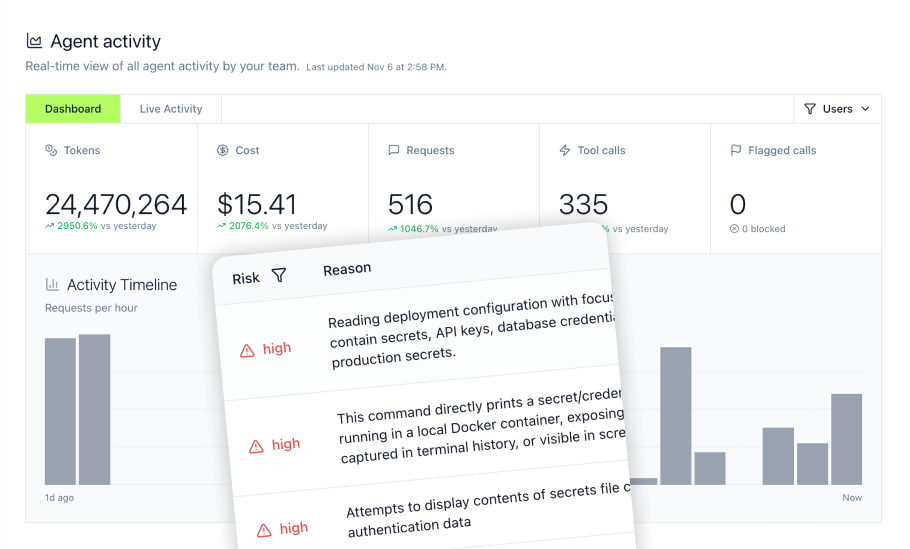
As AI agents become critical infrastructure across AWS, Azure, and GCP deployments, enterprises face a new challenge: governing tool access across distributed clouds without creating security silos. An MCP gateway centralizes authentication, audit logging, and access control for all MCP connections, transforming scattered AI tools into managed enterprise infrastructure.
This analysis covers purpose-built managed gateways, OSS and self-hosted options, and API gateway extensions, evaluated across deployment model, governance depth, agent identity support, and compliance baseline. The best choice depends on your multi-cloud architecture, operational model, and governance requirements.
Note: Capability descriptions for vendors outside MintMCP's primary competitive reference, including Lunar.dev MCPX, Microsoft Azure API Management, Lasso Security, IBM ContextForge, Docker MCP Gateway, Traefik Hub, and Operant AI, are based on publicly available information as of September 2026 and should be verified directly with each vendor before procurement decisions.
Key Takeaways
- Governance architecture matters more than raw throughput for IT, Security, and AI Operations teams. Evaluate Virtual MCP endpoints with SCIM-driven access policy, per-agent identity support, private network tunnel capability, and runtime guardrails before comparing latency benchmarks.
- Agent identity is the multi-cloud governance gap. Agents running across AWS, Azure, and GCP typically inherit whichever service account or API key is available in that environment. Purpose-built agent identity with independent credential rotation and revocation closes that gap.
- Private network tunnel capability determines whether a gateway can reach workloads in private VPCs without requiring public exposure. This is a hard requirement for many multi-cloud enterprise deployments.
- Performance varies significantly. Gateway overhead, tool-call latency, and end-to-end latency are different metrics. Teams should compare them separately and verify benchmarks directly with vendors rather than relying on best-case published figures.
- Multi-cloud is standard. Multi-cloud adoption continues to rise, making cloud-agnostic gateways important for unified governance.
- Open-source options exist. Several solutions, including Bifrost, IBM ContextForge, Docker, and Obot, offer open-source deployment paths for teams requiring infrastructure sovereignty.
- SOC 2 Type II audited status is a compliance baseline for enterprise procurement, not a differentiator on its own. Verify each vendor's current Trust Center and compliance documentation during evaluation.
What Is an MCP Gateway?
The following describes how a governed MCP gateway functions; specific capabilities vary by vendor. An MCP gateway is a control plane that sits between AI agents and the MCP servers that expose enterprise tools and data. Instead of each agent connecting directly to every server, agents connect once to the gateway. The gateway handles authentication, credential injection, tool-level access control, audit logging, and policy enforcement for every connection that flows through it.
Without a centrally governed gateway, each MCP server typically requires its own authentication setup, which can create fragmented credential stores, access policies, and audit trails. In a multi-cloud environment, that fragmentation compounds: agents running in AWS, Azure, and GCP each accumulate their own credential sets, and no single team has visibility across all of them. A gateway collapses that into one governed entrypoint. As multi-cloud adoption continues to rise, a gateway can provide a consistent governance layer across clouds.
How to Choose an MCP Gateway for Multi-Cloud Environments
Before evaluating vendors, establish your requirements across these eight criteria.
1. Deployment model. Does the vendor offer managed SaaS, self-hosted, VPC deployment, or some combination? Which cloud regions are supported? A managed SaaS-first option reduces operational overhead. A self-hosted option gives infrastructure teams full control but requires ongoing maintenance.
2. Private network access. Can the gateway reach workloads running in private VPCs across AWS, Azure, and GCP without requiring those workloads to be publicly exposed? This is a hard requirement for most enterprise security teams.
3. Agent identity. Does the gateway support non-human agent identities with their own credentials, or do agents inherit human accounts or shared service accounts? Per-agent identity with independent credential rotation and revocation is the governance primitive that makes autonomous agents attributable and revocable.
4. Cross-cloud credential governance. Can credentials be scoped per agent, rotated independently, and revoked without affecting other agents or users? This matters when a coding agent in GCP and a pipeline agent in AWS need separate, independently managed access.
5. SCIM-driven access policy. Does directory group membership automatically drive which tools each user or agent can access? Manual access policy management does not scale across multi-cloud environments with dozens of teams and agents.
6. Runtime guardrails. What controls exist at the tool-call layer? Look for managed detection policies covering prompt injection, secrets, and PII; declarative rules for tool-level blocking and flagging; and the ability to run custom logic for DLP integrations.
7. Audit and SIEM export. Is every tool call logged with full attribution, including which agent or user initiated it, which tool was called, and what data flowed through? Can those logs export to your existing SIEM infrastructure?
8. Compliance baseline. SOC 2 Type II audited status provides assurance that security controls have been independently reviewed over time. HIPAA documentation availability matters for healthcare and adjacent industries. Verify each vendor's current Trust Center during evaluation.
Feature Comparison Table
| Gateway | Deployment | Agent identities | SCIM-driven access | Private network | Runtime guardrails | Audit/SIEM export | Compliance baseline |
|---|---|---|---|---|---|---|---|
| MintMCP | Managed SaaS (US/EU); VPC on request | Yes, per-agent, M2M auth; workload identity federation available on request | Yes | Yes | Mint Guard, Rules, Gateway Middleware | Yes | SOC 2 Type II audited; compliant with HIPAA standards |
| TrueFoundry | Managed SaaS, hybrid, VPC, air-gapped | Verify directly | Verify directly | Verify directly | Verify directly | Yes | Verify directly |
| Bifrost | Self-hosted (OSS); enterprise edition available | Verify directly | Verify directly | Verify directly | Verify directly | Verify directly | Verify directly |
| Lunar.dev MCPX | Managed, private cloud, on-premises | Verify directly | Verify directly | Verify directly | Verify directly | Yes | Verify directly |
| Azure API Management | Azure managed service; self-hosted gateway available | Verify directly | Verify directly | Verify directly | Verify directly | Yes | Verify directly |
| Kong AI Gateway | Self-hosted; Konnect managed | Verify directly | Verify directly | Verify directly | Verify directly | Yes | Verify directly |
| Lasso Security | Verify directly | Verify directly | Verify directly | Verify directly | Yes | Verify directly | Verify directly |
| IBM ContextForge | Self-hosted (OSS) | Verify directly | Verify directly | Verify directly | Verify directly | Verify directly | Verify directly |
| Docker MCP Gateway | Self-hosted (OSS) | Verify directly | Verify directly | Verify directly | Verify directly | Verify directly | Verify directly |
| Traefik Hub | Self-hosted; commercial | Verify directly | Verify directly | Verify directly | Verify directly | Verify directly | Verify directly |
| Operant AI | Commercial | Verify directly | Verify directly | Verify directly | Verify directly | Verify directly | Verify directly |
| Obot | Self-hosted (Docker/Kubernetes); managed cloud available | Verify directly | Verify directly | Verify directly | Verify directly | Verify directly | Verify directly |
1. MintMCP Gateway: Data-Permissions-First Governance Across Multi-Cloud Environments
MintMCP Gateway is a governance-focused MCP gateway for multi-cloud enterprises, providing a platform designed for governed employee and internal-agent access. The platform addresses the core challenge most organizations face: connecting AI agents to enterprise tools while preserving authentication, access control, credential management, observability, and audit.
MintMCP stands out for its data-permissions-first architecture, Virtual MCP Bundles with SCIM-driven access policy, and managed SaaS-first deployment across US and EU regions. SOC 2 Type II audited status provides the documentation baseline for enterprise security review.
What Makes MintMCP Different
MintMCP's core abstraction is the Virtual MCP (VMCP): per-use-case endpoints with SCIM-driven membership, curated tools, and access policy, enforced at runtime through Guardrails layers including Mint Guard for managed detection (prompt injection, secrets, PII) and Rules for declarative tool-level controls. Instead of configuring every MCP server separately on every user machine, organizations manage access centrally and let users connect through governed endpoints.
Hosted enterprise connectors for Snowflake, Elasticsearch, Gmail, and other enterprise data sources integrate governance directly into data access workflows. The private network tunnel capability lets MCP connections reach workloads in AWS, Azure, and GCP private networks without requiring public exposure.
Enterprise Capabilities
- SOC 2 Type II audited, with audit-ready controls for enterprise security review; compliant with HIPAA standards
- SSO and SCIM-driven RBAC with Virtual MCPs for per-use-case tool access
- Tool-level allowlisting, Mint Guard detection policies, Rules for declarative controls, and Gateway Middleware for customer-authored DLP and classifier integrations running in a JS sandbox
- Private network tunnel for MCP connections to workloads in AWS, Azure, and GCP private networks, no public exposure required
- Gateway and Agent Monitor governance across Claude, Cursor, ChatGPT, Gemini, and Copilot
- Managed SaaS-first deployment in the US and EU, with VPC or self-hosted deployment available on request
Agent Gateway for Autonomous Agents Across Multi-Cloud Environments
For organizations running autonomous agents across AWS, Azure, and GCP, MintMCP's Agent Gateway builds on the MCP Gateway foundation by giving each agent its own non-human identity, scoped MCP access, and independently rotatable credentials. Agents authenticate through bearer keys, machine-to-machine OAuth tokens, or workload identity federation, which is available on request, so a coding agent running in a GCP workload and a pipeline agent running in AWS each have separate, revocable identities rather than sharing a human employee's API key or a generic service account.
This is the Agent Bundle model: per-agent identity with scoped tools, independent credential rotation and revocation, and an attributable audit trail per agent. When an agent is decommissioned or compromised, its credentials are revoked independently without touching other agents or users.
Best For: IT, Security, and AI Operations teams governing internal employees and autonomous agents across multi-cloud environments, particularly organizations running Claude, Cursor, ChatGPT, Gemini, or Copilot alongside custom agents and needing consistent access control, credential governance, and audit across all of them.
Pricing: Contact for enterprise pricing
2. TrueFoundry MCP Gateway
TrueFoundry combines MCP gateway capabilities with unified AI infrastructure. The platform extends beyond MCP to include LLMOps, model serving, and tracing in one control plane. Public references often cite best-case low-millisecond overhead, while actual latency depends on deployment configuration, authentication path, workload, and infrastructure.
Capabilities
- Unified access to LLMs and MCP servers through a single interface
- VPC, on-premises, air-gapped, and multi-cloud deployment options
- Federated SSO supporting Okta and Azure AD with OAuth 2.0
- Audit logging and observability
Best For: High-volume AI workloads where latency directly impacts user experience or throughput requirements are central to platform design, particularly teams that also need LLMOps and model serving in the same control plane.
Pricing: Pricing: verify directly with TrueFoundry before procurement decisions.
3. Bifrost by Maxim AI
Bifrost is an OSS-first, self-hosted-first Go gateway designed for developer, platform engineering, and AI/ML teams. It is built as a drop-in replacement for OpenAI, Anthropic, Vercel AI SDK, and LangChain, with a built-in MCP gateway for unified tool management.
Performance Benchmarks
Bifrost publishes benchmark figures for gateway overhead in specific test configurations. Teams should verify current benchmarks directly with the vendor and distinguish gateway overhead, which Bifrost publishes benchmark figures for in specific controlled test configurations, from end-to-end tool-call latency; verify current benchmark figures directly with the vendor before drawing production conclusions.
Deployment Model
Apache 2.0 open-source licensing with an optional enterprise edition. Self-hosted architecture provides maximum control and reduces dependency on managed gateway infrastructure.
Best For: Teams requiring high-performance routing with full infrastructure control, or organizations with existing Kubernetes deployments seeking to avoid managed service costs.
Pricing: Open-source (Apache 2.0); enterprise edition available
4. IBM ContextForge
IBM ContextForge offers a federation architecture enabling multi-gateway coordination with automatic discovery. The project has visible open-source community activity, but teams should verify current repository activity and deployment maturity during evaluation.
Federation Features
- Multiple gateway instances auto-discover and share tool registries
- Protocol bridging described as converting REST and gRPC to MCP without rewrites (verify current capabilities directly with the IBM ContextForge project before procurement decisions)
- Multi-database support including PostgreSQL and SQLite (verify current capabilities directly with the IBM ContextForge project before procurement decisions)
- Full customization through open-source modification
Performance Consideration
Latency depends on configuration and federation topology; verify current performance characteristics directly with the IBM ContextForge project before making deployment decisions.
Best For: Large distributed enterprises requiring multi-gateway coordination across regions or business units with independent infrastructure.
Pricing: Free, open-source under Apache 2.0
5. Docker MCP Gateway
Docker MCP Gateway brings container isolation principles to MCP server management, providing CPU and memory limits per server with digitally signed Docker-built MCP Catalog images for supply chain security.
Container-Native Features
- Container isolation with resource limits per MCP server
- MCP Catalog with pre-built servers (verify current catalog contents directly with Docker before procurement decisions)
- Docker Compose integration for familiar workflows
- Digitally signed Docker-built MCP Catalog images for supply chain protection
Performance Range
Latency depends on container configuration and resource allocation; verify current performance characteristics directly with Docker before making deployment decisions.
Best For: Teams already using Docker for application deployment who want consistent container-based management for MCP servers.
Pricing: Free and open-source
6. Obot Platform
Obot delivers a complete open-source MCP platform including gateway, catalog, chat client, and orchestration through its Nanobot framework.
Platform Components
- Built-in MCP Catalog with auto-documentation and discovery
- Nanobot framework for advanced agent orchestration (verify current capabilities directly with Obot before procurement decisions)
- Enterprise IdP support described as including Okta and Microsoft Entra (verify current capabilities directly with Obot before procurement decisions)
- Central IT control plane for policy management
- Kubernetes-native deployment
Best For: Organizations that want to own and operate the full infrastructure stack. Obot supports both self-hosted deployment and a managed cloud option. Self-hosted production deployments can run on Kubernetes, with Docker also supported. Teams choosing the self-hosted path should plan for ongoing infrastructure operations before evaluating this path.
Pricing: Free, open-source self-hosted option; enterprise edition and managed cloud option available.
7. Kong AI Gateway
Kong AI Gateway extends Kong's API gateway infrastructure with MCP support, enabling automatic generation of MCP servers from existing REST APIs without code changes.
Integration Capabilities
- Auto-generate MCP servers from existing REST endpoints
- OAuth 2.1 implementation with centralized policy enforcement
- LLM-as-a-Judge policy validation for output quality control (verify current capabilities directly with Kong before procurement decisions)
- MCP traffic observability with granular tool usage tracking
- Prompt and completion size monitoring and cost visibility (verify current capabilities directly with Kong before procurement decisions)
Strategic Value
Organizations with existing Kong deployments can add MCP capabilities without introducing separate infrastructure, leveraging established API governance policies.
Best For: Enterprises already using Kong for API management who want unified governance across REST APIs and MCP tools.
Pricing: Enterprise licensing required
8. Microsoft Azure API Management
Azure API Management provides native MCP management capabilities within the Azure ecosystem, offering a managed Azure service plus a self-hosted gateway that can run in containerized environments such as Kubernetes.
Azure-Native Features
- Native Entra ID (Azure AD) integration for authentication
- Azure Monitor and Application Insights observability
- Session-aware routing for stateful MCP interactions (verify current capabilities directly with Microsoft Azure documentation before procurement decisions)
- Azure Key Vault integration for secrets management (verify current capabilities directly with Microsoft Azure documentation before procurement decisions)
- Multi-cloud extension via Azure Arc infrastructure (verify current capabilities directly with Microsoft Azure documentation before procurement decisions)
Performance Consideration
Latency depends on deployment topology, policy processing, network placement, and the self-hosted or managed gateway configuration; verify current performance characteristics directly with Azure documentation.
Best For: Azure-centric enterprises with existing Entra ID deployments seeking seamless integration rather than introducing new authentication systems.
Pricing: Based on Azure API Management pricing tiers
9. Traefik Hub MCP Gateway
Traefik Hub extends existing Traefik API gateway deployments with MCP support, providing enterprise AI infrastructure with MCP observability patterns for unified visibility across AI and traditional workloads.
Middleware Approach
- Extends existing Traefik deployments without separate infrastructure
- Security controls across AI, MCP, and API layers (verify current capabilities directly with Traefik before procurement decisions)
- Kubernetes-native architecture for cloud-native deployments
- OpenTelemetry integration for unified observability
Best For: Organizations already running Traefik in multi-cloud Kubernetes environments seeking to avoid infrastructure duplication.
Pricing: Commercial licensing
10. Lunar.dev MCPX
Lunar.dev MCPX provides production-grade access control with three-tier ACL: global, service-level, and tool-level permissions with consumer tags. The platform is described as enabling tool customization including description rewrites and parameter locking; verify current capabilities directly with Lunar.dev before procurement decisions.
Governance Features
- Global, service-level, and tool-level permissions
- Audit trails and Prometheus-compatible metrics (verify current capabilities directly with Lunar.dev before procurement decisions)
- Tool description customization for context-appropriate LLM interactions
- Deployment options: verify current deployment models directly with Lunar.dev before procurement decisions.
Best For: Organizations requiring granular tool-level permissions across teams, or those needing to customize how LLMs interact with specific tools.
Pricing: Pricing: verify directly with Lunar.dev before procurement decisions.
11. Lasso Security MCP Gateway
Lasso Security provides a security-first approach with controls across AI, MCP, and API layers.
Security Capabilities
- Real-time threat detection for prompt injection and data exfiltration
- MCP server reputation scoring with automatic blocking (verify current capabilities directly with Lasso Security before procurement decisions)
- PII masking and redaction via Presidio integration
- Threat intelligence integration for MCP security workflows (verify current capabilities directly with Lasso Security before procurement decisions)
Note: PII redaction and DLP integration are also available in MintMCP through Gateway Middleware, which runs customer-authored logic in a JS sandbox and supports external classifier and DLP integrations.
Performance Trade-off
Security processing may add overhead, resulting in higher latency than lightweight routing-focused gateways. That tradeoff may be acceptable for security-sensitive workloads where threat detection outweighs latency requirements.
Best For: Organizations handling sensitive data such as PII, financial records, or healthcare information that require real-time threat detection beyond standard access controls.
Pricing: Pricing and licensing: verify directly with Lasso Security before procurement decisions.
12. Operant AI MCP Gateway
Operant AI positions itself as a security-forward option for MCP deployments, with published research on emerging MCP attack vectors including Shadow Escape attack detection (verify current capabilities directly with Operant AI before procurement decisions) and a published 3D Runtime Defense approach covering discovery, detection, and defense (verify current capabilities directly with Operant AI before procurement decisions). Capabilities are based on publicly available information as of September 2026; verify directly with the vendor before procurement decisions.
Best For: Security teams requiring visibility into emerging threats and attack vectors, particularly those evaluating AI security architecture.
Pricing: Commercial; contact for pricing
Governing Autonomous Agents Across Multi-Cloud Environments
The governance challenge in multi-cloud environments is not just about routing MCP traffic. It is about what happens when autonomous agents run simultaneously in AWS, Azure, and GCP and each one needs access to enterprise tools.
In most organizations today, agents running in different clouds inherit whichever service account or API key is available in that environment. A pipeline agent in AWS might use a shared service account that also has access to production databases in GCP. A coding agent in Azure might run under a developer's personal OAuth session. When something goes wrong, there is no clean way to answer: which agent did this, what credentials did it use, and how do we revoke access without disrupting everything else?
Workload identity federation addresses part of this. It lets agents authenticate using the cloud provider's native identity mechanism (AWS IAM roles, Azure Managed Identity, GCP Workload Identity) rather than static API keys. But workload identity alone does not solve the tool-access governance problem. An agent with a valid cloud identity can still reach any MCP server that accepts that identity, unless something governs which tools that agent is allowed to call.
MintMCP's Agent Gateway addresses this through the Agent Bundle model. Each agent gets its own non-human identity, scoped MCP access, and independently rotatable credentials. Agents authenticate through bearer keys, M2M OAuth tokens, or workload identity federation, which is available on request. The scoped MCP access means an agent can only call the tools it has been explicitly granted, not everything the underlying cloud identity could theoretically reach.
The private network tunnel capability closes the remaining gap. Agents running in private VPCs can reach governed MCP connections without requiring those connections to be publicly exposed. This matters for enterprises that run data workloads in private subnets and cannot expose them to the public internet even for governed AI access.
For more on MCP gateways in enterprise engineering contexts, see MCP gateways for enterprise engineering teams.
Why Not Build Your Own MCP Gateway?
The surface area of an MCP gateway looks manageable at first. A reverse proxy that routes MCP traffic, injects credentials, and logs requests seems like a weekend project for a capable platform team.
What that framing misses is everything that makes a gateway production-ready for multi-cloud enterprise use. A routing layer does not handle per-agent identity. It does not manage credential lifecycle across AWS, Azure, and GCP workloads. It does not enforce SCIM-driven access policy when a team member changes roles. It does not run runtime guardrails for prompt injection or PII detection. It does not export structured audit logs to a SIEM. It does not provide a private network tunnel for workloads that cannot be publicly exposed.
Each of those capabilities requires its own implementation, its own maintenance burden, and its own security review. Upstream MCP server schema changes break custom parsers. Credential rotation logic needs to handle failure cases. Security patches need to be applied across every component. The ongoing cost of maintaining a DIY gateway can exceed the cost of a managed option once identity, policy, logging, patching, and operational ownership are included.
For organizations whose primary requirement is governing internal employees and autonomous agents, a purpose-built managed gateway is the faster path to production-ready governance.
Deploy Enterprise AI with Confidence
The Model Context Protocol has changed how enterprises connect AI assistants to their data and tools. Deploying MCP at scale requires security, governance, and monitoring that transforms experimental AI into production-ready infrastructure.
MintMCP Gateway provides a managed SaaS-first path from pilot to production, with hosted MCP connectors, Virtual MCPs with SCIM-driven access policy, per-agent identity through Agent Bundles, and runtime guardrails through Mint Guard, Rules, and Gateway Middleware. With SOC 2 Type II audited status, pre-built connectors for enterprise data sources, and a data-permissions-first governance model that spans Claude, Cursor, ChatGPT, Gemini, and Copilot, MintMCP helps reduce the technical barriers that slow AI deployment from pilot to production.
Whether securing access to Snowflake data warehouses, Elasticsearch knowledge bases, or custom enterprise tools, MintMCP provides the infrastructure that makes AI deployment practical, auditable, and secure.
For a deeper understanding of MCP gateway architecture, see the guide to understanding MCP gateways.
Ready to transform AI infrastructure? Visit mintmcp.com to schedule a demo and see how MintMCP Gateway can accelerate enterprise AI deployment.
Frequently Asked Questions
What is an MCP Gateway and why is it essential for multi-cloud enterprises in 2026?
An MCP gateway is a control plane that sits between AI agents and the MCP servers that expose enterprise tools and data. It centralizes authentication, credential injection, tool-level access control, audit logging, and policy enforcement for every MCP connection. As multi-cloud adoption continues to rise, gateways can prevent security fragmentation by providing unified governance across AWS, Azure, and GCP deployments. Without a gateway, each MCP server can require separate authentication, creating compliance gaps and operational overhead that compounds across clouds.
How do MCP Gateways help manage security and compliance across different cloud providers?
MCP Gateways enforce consistent policies across all connected MCP servers regardless of where they run. Features like complete audit trails track every tool invocation for security and compliance reviews. Role-based access control ensures teams access only approved tools, while OAuth and SSO integration connects to existing identity providers. Runtime guardrails add a second layer of control at the tool-call level, detecting and blocking prompt injection, PII exposure, and other risky actions before they execute. MintMCP's SOC 2 Type II audited status provides documentation for enterprise security review.
Can MCP Gateways integrate with existing enterprise data sources like Snowflake or Elasticsearch?
Most enterprise gateways include pre-built connectors or support custom integrations. MintMCP provides native Snowflake integration for data warehouse access and Elasticsearch integration for enterprise search, both with built-in governance controls. These connectors enable AI agents to query enterprise data through natural language while enforcing access policies and maintaining audit trails.
What compliance certifications should an enterprise look for in a multi-cloud MCP Gateway solution?
SOC 2 Type II audited status provides assurance for enterprise deployments by showing that security controls have been independently reviewed over time. HIPAA documentation availability matters for healthcare and adjacent industries. GDPR readiness, enterprise SSO, audit logs, encryption, and access-control evidence also matter for procurement and security review. MintMCP is SOC 2 Type II audited and compliant with HIPAA standards, but enterprises should verify each vendor's current Trust Center and compliance documentation during evaluation.
How does a robust MCP Gateway address the challenge of shadow AI in large organizations?
Shadow AI grows when employees adopt tools faster than IT can approve them. MCP Gateways provide visibility into which tools teams use, track access patterns, and enable policy enforcement without blocking productivity. MintMCP separates governance into two layers. MCP Gateway governs traffic through governed connections. Agent Monitor provides visibility into supported local agent activity, including tool calls, bash commands, file operations, and prompt submissions, beyond what routes through the gateway. Coverage varies by client and hook phase, but the distinction matters: Agent Monitor does not require all traffic to flow through a central gateway endpoint to provide visibility. Together, the two layers transform unmanaged AI usage into governed infrastructure with centralized audit trails for supported activity.
How do I govern autonomous agents running across multiple clouds simultaneously?
The core problem is that agents running in different clouds typically inherit whichever service account or API key is available in that environment. Without per-agent identities, a compromised agent in one cloud can use credentials that reach systems in another, and there is no clean way to revoke access for one agent without disrupting others. MintMCP's Agent Gateway addresses this through Agent Bundles: each agent gets its own non-human identity, scoped MCP access, and independently rotatable credentials. Agents authenticate through bearer keys, M2M OAuth tokens, or workload identity federation, which is available on request. The private network tunnel capability means agents in private VPCs can reach governed MCP connections without public exposure.