Connecting AI agents to Jira is straightforward in a demo environment. Running that connection at enterprise scale, with proper authentication, audit trails, and access controls, is where most teams hit a wall. An MCP Gateway sits between your AI clients and Jira, handling the complexity of token management, role-based permissions, and compliance logging that organizations require before IT signs off on production deployment.
The Model Context Protocol is an open protocol that's becoming the industry standard for connecting AI assistants to enterprise tools, with adoption and support across Anthropic, OpenAI, Google, and Microsoft. But MCP servers introduce new challenges around deployment, security, and governance. Without a gateway layer, organizations face ungoverned AI sprawl, with agents accessing Jira data without visibility into what they're reading, writing, or modifying.
This guide evaluates six MCP gateways that address these challenges for Jira integration, comparing their authentication handling, compliance capabilities, and deployment complexity.
Key Takeaways
- MCP gateways solve critical production problems including token lifecycle handling, access control, and response filtering that emerge when running AI agents at organizational scale
- Jira integrations require OAuth session and credential management in production deployments
- Enterprise teams need complete audit trails before IT approves AI-to-Jira integrations; gateways provide this visibility
- Without response filtering or scoping, full Jira responses can overwhelm AI context windows, increasing costs and degrading performance
- Setup time varies widely by product and environment, from quick managed SaaS setups to longer enterprise deployments with custom RBAC policies
1. MintMCP Gateway: From Local MCP to Enterprise Deployment, Fast
MintMCP Gateway provides the infrastructure enterprises need to deploy MCP servers at scale, transforming local tools into production-ready services with monitoring, logging, and compliance controls built in. The platform handles authentication, permissions, and audit trails, the complexity that typically blocks organizational AI adoption.
Core Capabilities for Jira Integration
MintMCP addresses the specific challenges teams face when connecting AI agents to Jira:
- SSO, SCIM-driven RBAC, and OAuth brokering wrap MCP endpoints with enterprise authentication and help centralize Jira credential management
- Complete audit trails log MCP interactions, access requests, and configuration changes for security reviews, compliance workflows, and internal audit requirements
- Granular tool access control lets administrators configure access by role, enabling read-only operations while restricting write tools
- Virtual MCP Bundles create per-use-case endpoints with SCIM-driven membership, curated Jira tool access, and policy controls
- Tool-update policy lets admins decide whether new upstream tools are automatically enabled or require approval before rollout
- Centralized observability provides visibility into server health, usage patterns, and security-relevant activity
- Managed SaaS-first deployment and hosted MCP connectors reduce the need to operate connector runtimes, scaling, or Kubernetes infrastructure directly
Security and Governance
MintMCP Gateway is SOC 2 Type II audited and provides the governance infrastructure enterprise IT teams require:
- Role-based access control at the project and tool level
- SSO enforcement and SCIM-driven access policies
- Centralized credential management for AI tool and MCP server access
- Policy enforcement that applies data access rules across governed MCP deployments
- Audit logs and centralized observability for security and compliance reviews
- External DLP and guardrails integrations through JavaScript Gateway Middleware running in a JS sandbox
- Compliance support for teams that require SOC 2 Type II audited controls, penetration testing, encryption in transit and at rest, uptime SLA, and HIPAA documentation on request
Business Applications
The platform enables multiple Jira-related workflows:
- Development teams can connect AI coding assistants to repositories, issue trackers, and CI/CD systems securely
- Support teams gain AI assistants that access CRM data, support tickets, and customer history through governed tool access
- Product teams enable AI-powered analytics and user behavior analysis from governed data sources
- Internal agents can use Agent Bundles with per-agent identity, M2M authentication, and scoped Jira tool access
Deployment Model
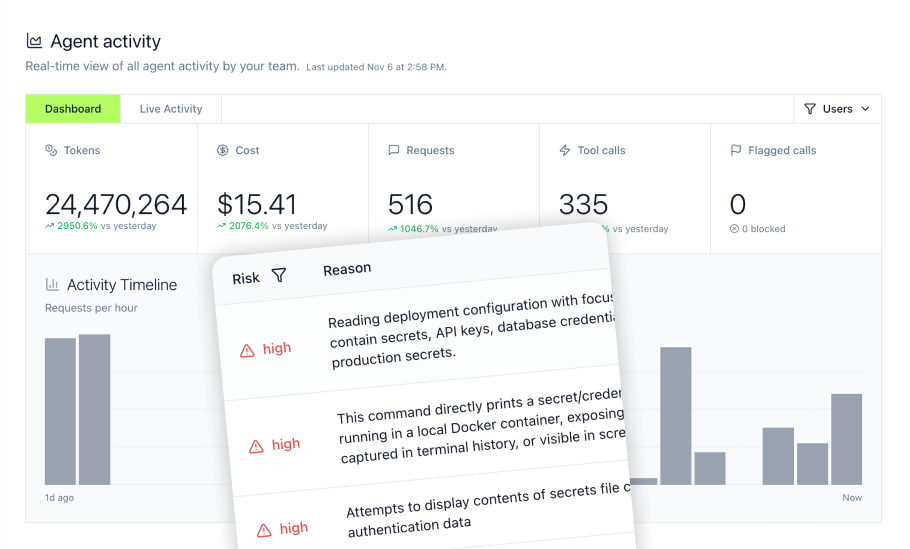
MintMCP offers managed SaaS-first deployment with US and EU regions, with VPC or self-hosted deployment available on request. The Gateway and Agent Monitor provide two-layer governance: the Gateway covers MCP traffic, while Agent Monitor provides visibility into local non-MCP agent activity such as file operations, bash commands, and prompt submissions across Claude, Cursor, ChatGPT, Gemini, and Copilot workflows.
Getting Started: Book a demo at mintmcp.com/contact
2. MCP Manager
MCP Manager's Primary Focus
MCP Manager provides a centralized control plane for managing multiple MCP server connections through a single endpoint. The platform focuses on solving token management and access control challenges that emerge at organizational scale.
Organizations managing multiple teams and MCP servers benefit from MCP Manager's registry approach. The platform offers:
- Central registry of available MCP servers with configuration management
- Project-level RBAC for controlling which teams access which Jira projects
- OAuth token lifecycle handling for Atlassian connections
- Payload filtering to prevent context window overflow
- Identity passthrough that maintains individual user accountability
Jira-Specific Capabilities
MCP Manager addresses common Atlassian integration challenges:
- Handles token lifecycle management for Jira integrations
- Tool provisioning lets administrators enable specific Jira operations while disabling others
- PII detection identifies sensitive data before it reaches external LLMs
Tradeoffs to consider
A registry-first control plane can help centralize MCP server management, but teams should evaluate whether it includes MCP-specific governance primitives such as SCIM-driven per-use-case tool bundles, tool-update approval policies, and per-agent identity controls. MintMCP addresses these requirements with Virtual MCP Bundles, Agent Bundles, and centralized audit logs.
Setup Process
Configuration typically requires:
- Adding the Atlassian remote server URL to the gateway
- Configuring tool provisioning, selecting which Jira operations to enable
- Setting up identity and RBAC policies
- Connecting AI clients through the gateway URL
Trial Availability: Free trial available; check current pricing and onboarding terms
3. TrueFoundry
TrueFoundry's Primary Focus
TrueFoundry positions itself as a unified AI infrastructure platform that includes MCP gateway capabilities alongside model deployment and agent orchestration features.
The platform targets platform engineering and ML platform teams building AI agents in code who want a broader infrastructure layer. Key characteristics include:
- Unified platform combining MCP gateway, model serving, and agent orchestration
- Performance-focused architecture for tool-call workflows
- Integration with broader AI development workflows
- User and team-level access controls
Technical Approach
TrueFoundry's gateway functionality emphasizes:
- LLM observability alongside MCP monitoring
- Guardrails for runtime policy enforcement
- Support for building agents programmatically
- Managed SaaS and self-hosted control plane deployment options
Considerations
TrueFoundry requires commitment to a broader AI infrastructure platform, making it most suitable for organizations already invested in or planning to adopt a unified model deployment, agent orchestration, and gateway approach. Teams should evaluate whether they need that broader platform layer or a data-permissions-first MCP gateway focused on SSO, SCIM-driven RBAC, Virtual MCP Bundles, credential management, and audit logs.
Pricing: Contact sales for platform pricing
4. Kong AI Gateway
Kong's Primary Focus
Kong AI Gateway extends the Kong API management platform with AI-specific capabilities, including MCP server routing and governance features.
Organizations already running Kong for API management can extend their existing infrastructure to cover AI agent traffic:
- Leverages existing Kong deployment and expertise
- API-level policy enforcement and rate limiting
- Integration with Kong's broader ecosystem of plugins
- Enterprise support through existing Kong contracts
Gateway Characteristics
Kong's approach applies traditional API gateway patterns to MCP traffic:
- Route management for multiple backend services
- Authentication and authorization at the API layer
- Logging and observability through Kong's standard tooling
- Plugin architecture for custom policy implementation
Considerations
Kong AI Gateway can fit teams already standardized on Kong, but it requires API platform and DevOps expertise to manage configuration. Teams should evaluate whether the deployment provides MCP-specific primitives such as Virtual MCP Bundles, Agent Bundles, tool-update policy, hosted MCP connectors, and OAuth brokering for stdio and hosted MCP servers. Setup complexity is higher than purpose-built MCP gateways, with longer deployment timelines for enterprise configurations with custom policies.
Pricing: Contact sales; requires Kong enterprise subscription
5. Docker MCP Gateway
Docker Gateway's Primary Focus
Docker MCP Gateway provides an open-source option for developers experimenting with MCP or running single-user configurations without organizational governance requirements.
The open-source approach suits specific scenarios:
- Individual developers testing MCP integrations locally
- Proof-of-concept deployments before enterprise evaluation
- Teams comfortable managing infrastructure directly
- Cost-sensitive environments without compliance requirements
Technical Characteristics
Docker Gateway offers basic OAuth handling for MCP servers:
- Containerized deployment model
- Local server management without cloud dependencies
- Community-supported development
- No licensing costs
Considerations
Docker Gateway is better suited to developer-led and self-managed deployments than to fully managed enterprise governance use cases:
- Limited centralized access control features compared to enterprise gateways
- Support and operational guarantees depend on how the deployment is managed
- Self-hosted infrastructure management required
- Performance depends on deployment pattern, enabled controls, and workload characteristics
- Teams must operate their own connector runtime, scaling, update review process, and audit pipeline
Pricing: Free, open source
6. Amazon AgentCore
AgentCore's Primary Focus
Amazon AgentCore provides MCP gateway capabilities as part of AWS's broader AI agent infrastructure, targeting organizations committed to the AWS ecosystem.
AWS-native organizations benefit from integration with existing services:
- Native integration with Amazon Bedrock and other AWS AI services
- IAM-based access control using existing AWS identity infrastructure
- CloudTrail integration for audit logging
- AWS usage-based pricing model
Technical Characteristics
AgentCore applies AWS patterns to MCP server management:
- AWS-specific deployment model
- Integration with AWS security and compliance tooling
- Managed service approach with AWS support tiers
- Scaling handled through AWS infrastructure
Considerations
AgentCore can be a fit for AWS-standardized teams, but it creates tighter coupling to AWS infrastructure. Organizations using multi-cloud or non-AWS infrastructure should evaluate how Jira MCP governance, identity, audit logs, credential management, and AI client coverage work outside AWS-native workflows. Setup time depends on your AWS environment and IAM configuration, and typically requires AWS expertise.
Pricing: AWS usage-based; costs vary by consumption
Making the Right Choice for Your Jira Integration
Selecting an MCP gateway depends on your organization's existing infrastructure, compliance requirements, and team expertise.
Authentication Handling Matters Most: Jira integrations require reliable OAuth session and credential lifecycle management. Any solution without automated lifecycle handling will create friction in production.
Deploy Governance Before Scale: Organizations that implement gateway architecture from the start avoid the painful migration required when ungoverned AI sprawl triggers IT security reviews.
Context Windows Have Limits: Without response filtering or scoping, cross-team Jira queries can overwhelm AI context limits, increasing API costs and degrading response quality.
Compliance Opens Doors: IT teams block AI deployments they can't audit. Complete logging for SOC 2 reviews, along with broader internal security and audit requirements, is a prerequisite for organizational adoption, not a nice-to-have.
Conclusion
Connecting AI agents to Jira in production requires more than a working MCP server. It demands the governance, security, and observability infrastructure that enterprises expect from any system touching sensitive data.
MintMCP Gateway delivers this infrastructure with managed SaaS-first deployment, OAuth brokering, SSO and SCIM-driven RBAC, Virtual MCP Bundles, and complete audit trails. The platform transforms local MCP servers into production-ready services without requiring weeks of DevOps configuration or custom security builds.
For organizations ready to move beyond AI demos and deploy governed Jira integrations at scale, MintMCP provides a fast path from proof-of-concept to production. The combination of SOC 2 Type II audited controls, granular access controls, credential management, and centralized observability addresses the specific concerns IT security teams raise when evaluating AI tool adoption.
Turn shadow AI into sanctioned AI infrastructure. Book a demo to see how MintMCP handles the complexity of enterprise MCP deployment while maintaining the speed and flexibility development teams need.
Frequently Asked Questions
What is an MCP gateway and why is it required for enterprise Jira integration?
An MCP gateway sits between AI clients, like Claude or Cursor, and MCP servers, handling authentication, access control, and audit logging. For Jira integration specifically, gateways solve production authentication and credential lifecycle challenges that direct MCP connections often do not address. Gateways also enforce role-based access so teams only see projects they're authorized to access.
How do MCP gateways handle Jira authentication and token management?
Enterprise gateways maintain OAuth sessions with Atlassian and manage credential lifecycle centrally. When a user first connects through the gateway, they complete a standard OAuth flow with their Atlassian credentials. The gateway then manages authentication and access policies transparently, reducing re-authentication friction and improving auditability.
What compliance certifications should I look for in an MCP gateway for Jira?
For enterprise deployments, look for SOC 2 Type II audited controls as a baseline. Complete audit trails are essential for compliance reviews, logging AI interactions with Jira data including who accessed what, when, and what operations they performed.
Can I control which Jira operations AI agents can perform through an MCP gateway?
Yes. Enterprise gateways provide granular tool access control. Administrators can enable read operations, such as viewing tickets and searching projects, while disabling write operations such as creating issues or modifying fields. This reduces attack surface and ensures AI agents operate within approved boundaries.
How long does it take to deploy an MCP gateway for Jira integration?
Deployment time varies by solution. MintMCP offers managed SaaS-first deployment designed to help teams move quickly. More complex enterprise configurations with custom RBAC policies typically take longer to deploy than basic managed setups. Solutions requiring existing infrastructure, like Kong, or platform commitment, like AgentCore, may extend timelines depending on organizational readiness.