Moonshot AI's Kimi K3 represents a significant milestone in open-weight large language models, offering 2.8 trillion parameters and a one-million-token context window. For enterprises evaluating this frontier model, the technical capabilities are compelling, but the governance challenges are substantial. Without proper controls, organizations risk data sovereignty violations, unpredictable costs from always-on reasoning, and governance risks associated with tool-enabled and self-hosted deployments. This article covers what enterprise teams need to know before deploying K3, from compliance gaps to the governance infrastructure required for production use.
Key Takeaways
- Kimi K3 is the first open-weight model at the 3-trillion-parameter scale, with full weights released on July 27, 2026 under the Kimi K3 License. The license permits self-hosting and fine-tuning, subject to its commercial-use conditions
- A preliminary UK AISI and U.S. CAISI evaluation reported a 32% ExploitBench score for K3. K3 completed 0 of 41 arbitrary-code-execution tasks and reached step 17 of 32 on the TLO cyber range. These results measure offensive cyber capability, not the security posture of the K3 service
- Data sovereignty requires contractual review: Kimi OpenPlatform is provided and controlled by MOONSHOT AI PTE. LTD. in Singapore, and its public privacy policy states that collected personal information is stored on servers in Singapore. Enterprises should verify the contracting entity, subprocessors, retention, transfer terms, and available compliance evidence for their account
- Reasoning output can materially affect API costs: K3 always reasons, and output tokens are billed at $15 per million. Moonshot does not publish a universal reasoning-token multiplier, so enterprises should measure reasoning and output volume on representative tasks
- Agent Swarm mode can coordinate up to 300 sub-agents and more than 4,000 tool calls per task. Moonshot warns that Swarm tasks consume substantially more credits than standard Agent tasks, making workflow budgets and usage monitoring important
- Open weights eliminate provider-side controls: once downloaded, organizations must bring their own audit trails, access controls, and kill switches
- Agent-framework vulnerabilities illustrate relevant integration risks, but they are not K3 vulnerabilities: CVE-2026-41264 affects Flowise's CSV Agent, while CVE-2026-30856 affects Tencent WeKnora's MCP client. They illustrate the need for sandboxing and tool identity controls but do not document flaws in Kimi K3
- Self-hosting is a data-center-scale deployment: Moonshot recommends a supernode configuration with 64 or more accelerators. This is a recommended production topology rather than a universal H100/A100 minimum, and infrastructure costs depend on the selected hardware, quantization, utilization, and availability targets
Understanding the Enterprise AI Landscape
Large language models have moved from experimental technology to production infrastructure across enterprise operations. The shift reflects a fundamental change in how organizations approach knowledge work, code development, and data analysis. Models like Kimi K3 extend these capabilities with repository-scale context windows and autonomous agent orchestration.
Benefits of LLMs in Enterprise Operations
Enterprise teams deploy large language models across several high-value use cases:
- Code development and review: Repository-scale analysis that spans entire codebases rather than file-by-file processing
- Multi-document synthesis: Regulatory analysis, due diligence research, and cross-jurisdictional compliance review
- Customer support automation: CRM integration, ticket classification, and response generation with context awareness
- Data analysis workflows: Query generation, report building, and pattern identification across internal systems
Kimi K3 specifically targets long-horizon tasks requiring sustained reasoning. The model's one-million-token context supports large repository-scale inputs, multi-document sets, and extended conversations when the selected material fits within the one-million-token limit. Native vision capabilities handle text, images, and video without separate adapters.
Beyond ChatGPT: Diverse Applications
The market for frontier language models has expanded significantly. K3 enters a landscape that includes Claude, Gemini, and GPT-4 variants, each with different strengths for enterprise workloads. K3's differentiation centers on:
- Always-on reasoning: Unlike models with optional thinking modes, K3 generates explicit reasoning chains before every output
- Agent Swarm capability: Coordinates up to 300 parallel sub-agents for complex research and analysis tasks
- OpenAI-compatible API: Uses an OpenAI SDK-compatible Chat Completions endpoint, but K3-specific reasoning history and request parameters require integration changes
For enterprises already running AI agents through tools like Claude, Cursor, ChatGPT, Gemini, or Copilot, K3 represents both an opportunity and a governance challenge. The model's power amplifies the need for centralized control over data access, tool permissions, and audit trails.
The Last Mile Problem in Enterprise AI
The technical capability of frontier models like K3 has outpaced the governance infrastructure most organizations have in place. This gap creates what the industry calls the "last mile problem": the distance between AI output and the systems of record where that output creates business value.
Challenges Deploying AI Agents at Scale
Credential sprawl: Each AI agent connecting to internal systems requires authentication. Without centralized management, organizations accumulate service accounts, API keys, and OAuth tokens across multiple teams and tools. K3's Agent Swarm mode can coordinate up to 300 sub-agents, multiplying delegated tool calls and permission decisions. Credentials should be scoped at the orchestrator, agent, and tool layers rather than assumed to map one-to-one to every sub-agent.
Audit trail fragmentation: Production AI deployments require complete logs of prompts, tool calls, responses, and reasoning traces for compliance investigations. Self-hosted K3 provides no provider-side logging; organizations must capture everything locally.
Access control complexity: Different teams need different tool permissions. A finance agent should not have the same data access as a development agent. K3's broad capability set makes granular tool-level access control essential rather than optional.
Shadow AI proliferation: Developers experimenting with K3 outside approved channels create security blind spots that compliance teams cannot monitor or audit.
Key Governance Requirements
Based on independent assessments and documented vulnerabilities, K3 deployments require:
- Runtime AI gateway: Intercept all K3 requests before execution for policy enforcement and approval workflows
- Tool call authorization: Validate which tools K3 can invoke based on user context and permissions
- Context capture and audit: Log every prompt, reasoning trace, tool call, and output with tamper-resistant storage
- Token efficiency monitoring: Track consumption per agent, per workflow, per user with workflow-level caps
- Kill switch capability: Emergency stop for runaway agents with configurable thresholds
- Policy-based routing: Direct tasks to appropriate model tiers based on complexity and cost
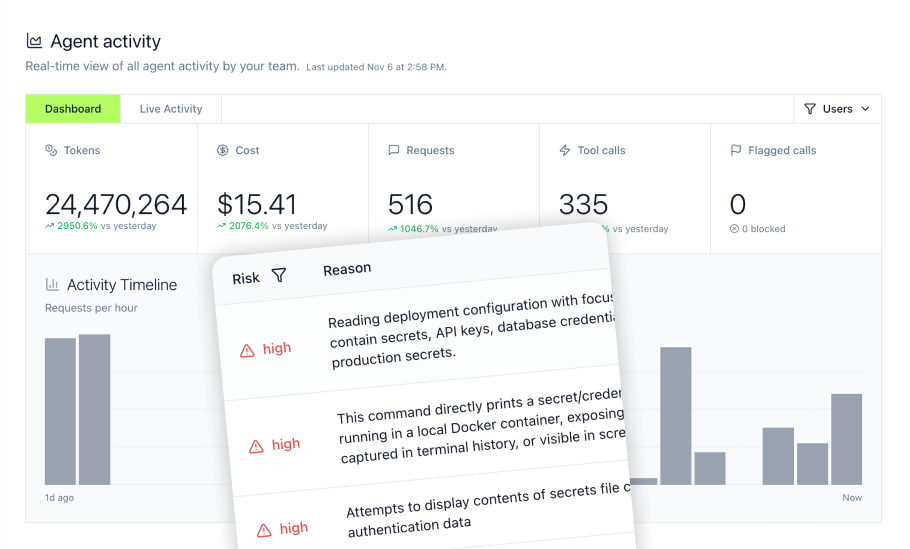
MintMCP's MCP Gateway governs K3's data and tool connections through Bundles, while its Agent Gateway builds on that foundation with agent identities, permissions, memory, and monitoring for long-running agents.
Kimi K3 Technical Capabilities
K3's architecture reflects several design decisions that enterprise teams should understand before deployment.
Core Model Specifications
| Specification | Detail |
|---|---|
| Parameters | 2.8 trillion |
| Context window | 1 million tokens |
| Modality | Text, image, video (native multimodal) |
| Reasoning | Always-on thinking mode |
| API compatibility | OpenAI-compatible Chat Completions API |
The model's always-on reasoning generates explicit chains before final outputs. This approach improves quality for complex tasks but creates cost implications: reasoning tokens are billed as output at $15 per million, so a task with short visible output can still carry meaningful output-token cost. Actual reasoning volume should be measured for each workload.
Agent Swarm and Tool Integration
K3's Agent Swarm mode coordinates parallel sub-agents for complex research and analysis. This capability enables multi-document research across hundreds of sources, parallel code analysis across repository branches, and distributed data collection and synthesis.
The official agent setup guide documents tool calling through Kimi's API. Vulnerabilities in third-party agent frameworks and MCP clients are still relevant architecture examples, but they should not be attributed to K3:
- CVE-2026-41264: Flowise's CSV Agent executed model-generated Python without adequate sandboxing; the issue was fixed in Flowise 3.1.0
- CVE-2026-30856: Tencent WeKnora's MCP client allowed tool-name collision and indirect prompt injection; the issue was fixed in WeKnora 0.3.0
These vulnerabilities underscore the need for tool registry validation and argument inspection at the gateway level.
Deployment Options
Enterprises can access K3 through three paths:
Hosted API: Immediate access through Moonshot's infrastructure. Pricing at $3 per million cache-miss input tokens, $0.30 cached, $15 output. Data residency concerns apply.
Kimi Business: The current organization plan provides a separate business workspace and member management. Public materials state that business data is not used for model training, but buyers should request the applicable security and compliance documentation before approval.
Self-hosted: The released weights enable deployment within infrastructure the organization controls. Moonshot recommends supernode configurations with 64 or more accelerators for production deployment, but actual hardware and cost requirements vary by serving configuration.
Critical Security and Compliance Concerns
Independent security assessments have documented specific concerns that enterprise buyers should evaluate carefully.
UK AISI and CAISI Cybersecurity Evaluation
The UK Artificial Intelligence Security Institute and the U.S. Center for AI Standards and Innovation conducted a preliminary evaluation of K3's cybersecurity capabilities. Key findings:
- ExploitBench score: 32% for K3
- Arbitrary code execution: K3 achieved 0 of 41 ACE tasks on ExploitBench
- Cyber range performance: Completed 17 of 32 steps on simulated attack path
- Assessment conclusion: K3 is "capable of autonomously attacking small, weakly defended and vulnerable enterprise systems when directed to do so and given initial network access"
These results measure offensive cyber capability, not the security posture of the K3 service. However, the open-weight release creates a different risk: attackers can fine-tune the model for malicious purposes without safety guardrails or usage logging.
Data Sovereignty and Compliance Gaps
K3's provider, MOONSHOT AI PTE. LTD., is based in Singapore. This creates compliance considerations for regulated industries:
Data residency: International API stores personal data on servers in Singapore. No published EU-only or US-only processing regions exist.
Applicable law and government-access risk: Enterprises should confirm the contracting entity, applicable law, subprocessor locations, cross-border transfer mechanism, and government-request terms through legal and procurement review.
Public compliance evidence:
- The public API security page states that the platform holds relevant security certifications but does not clearly name or publish the reports
- The Kimi Business Supplement references a data processing addendum
- Buyers should request the applicable DPA, transfer terms or SCCs, subprocessor list, retention schedule, security reports, and any required sector-specific agreement directly from Moonshot AI
Conflicting terms on training data: The API help page states that "API input and output are not used to train or improve models." The Kimi Business Supplement (June 1, 2026) states "Business customer content is not used for model training by default." However, the current public platform terms include broader language allowing content use to provide, develop, support, and improve the services unless separate written restrictions apply. Enterprise buyers should secure explicit written restrictions.
Risk Assessment by Data Type
| Data Type | Hosted API Review Level | Self-Hosting Consideration | Recommendation |
|---|---|---|---|
| Public marketing content | Low | Usually unnecessary | API may be acceptable after standard vendor review |
| Internal process documentation | Medium | Consider when local control is required | Confirm retention, training, access, and transfer terms |
| Customer PII, PHI, financial data | High | May be appropriate when local control is required | Do not use until contractual, security, transfer, and sector requirements are approved |
| Regulated workloads (HIPAA, SOX, PCI) | High | May be appropriate with validated controls | Obtain legal and security approval; self-host or use another approved service if hosted terms do not meet requirements |
Why Kimi K3 Demands a Governance Layer
Open-weight frontier models represent a paradigm shift: capability without control. Once weights are public, any organization can run K3 without provider-side usage monitoring, safety guardrails, audit trails, access controls, or cost visibility.
The Governance Gap
Enterprise AI execution problems persist across the industry. Teams report being stuck in pilot phases because the delivery layer between AI output and systems of record does not exist. K3 amplifies this gap because:
- Always-on reasoning generates unpredictable token consumption
- Agent Swarm can spawn hundreds of sub-agents autonomously
- Tool integrations have documented security vulnerabilities in related frameworks
- No provider controls exist for self-hosted deployments
Required Governance Controls
Runtime AI gateway: Intercept all K3 requests before execution with RBAC, policy enforcement, and human-in-the-loop approval for high-risk actions.
Tool call authorization: Validate which tools K3 can invoke based on context and user. CVE-2026-30856 demonstrated that ambiguous tool identity enables malicious tool substitution in some frameworks.
Context capture and audit: Capture the prompts, tool calls, outputs, and other events required by organizational policy and the risk level of the workload. SOX and HIPAA require appropriate controls and auditability for in-scope systems but do not universally mandate logging every model reasoning trace.
Token efficiency monitoring: Track consumption per agent, workflow, and user. Measure reasoning output on representative tasks rather than extrapolating from headline rates.
Kill switch and agent freezing: Emergency stop for runaway agents with configurable thresholds on token count, tool calls, and time. Agent Swarm's sub-agent coordination requires this capability.
Policy-based routing: Route tasks to appropriate model tiers and verify savings against quality and acceptance-rate targets. No universal savings percentage applies across workloads.
MintMCP's Agent Monitor provides visibility into agent actions across the organization, including off-gateway activity detection through hooks in Claude Code and Cursor. This captures the full picture of AI agent behavior, not just traffic routed through centralized gateways.
Implementation Considerations
Phase 1: Security and Compliance Assessment (Days 1-3)
Before technical integration, classify data sensitivity:
- Green: Public data, API acceptable
- Yellow: Sensitive data, self-hosting consideration
- Red: Do not send regulated or confidential data until the contracted processing location, transfer terms, and security controls have been approved
Expected time: 8-16 hours with compliance and security team involvement. Blocker risk: High for regulated industries. Healthcare, finance, and legal sectors often cannot use hosted API for customer data regardless of technical capability.
Phase 2: Technical Integration (Days 3-5)
For API deployment:
- Install OpenAI SDK:
pip install --upgrade openai httpx - Set environment variables with API key
- Configure client with Moonshot base URL and K3 model ID
- Critical: Preserve complete assistant message including
reasoning_contentin multi-turn conversations
Common failure: Forgetting to preserve reasoning history breaks subsequent tool calls.
Phase 3: Controlled Pilot (Days 6-14)
Run comparison against incumbent models on 50-100 representative tasks:
- Use pre-approved, non-sensitive data only
- Instrument cache hits, latency, token consumption, retry rates
- Monitor for excessive proactiveness (documented limitation)
- Calculate cost per accepted task, not cost per token
Success metric: K3 must beat incumbent on the metric that justifies migration (quality, cost, or speed) without introducing security gaps.
Phase 4: Governance and Contract Review (Days 11-12)
Before production deployment:
- Request Data Processing Agreement with explicit training opt-out
- Verify subprocessor list and data storage locations
- Confirm retention schedule and deletion process
- Establish incident notification SLA
- For EU operations: Verify Standard Contractual Clauses and transfer mechanism
Blocker risk: Medium. Public terms allow broad content use; enterprise terms need explicit restrictions.
Total Cost of Ownership
K3's official API prices are $0.30 per million cache-hit input tokens, $3 per million cache-miss input tokens, and $15 per million output tokens. Actual monthly cost depends on prompt size, reasoning and final-output volume, cache-hit rate, retries, tool calls, and Agent Swarm usage.
For self-hosting, Moonshot recommends supernode configurations with 64 or more accelerators. Actual cost depends on accelerator type, quantization, hardware utilization, context length, concurrency, networking, storage, redundancy, and engineering support.
Enterprises should not use a universal task-count break-even point. Compare API and self-hosting scenarios using measured tokens per accepted task, cache-hit rate, workload concurrency, hardware utilization, staffing, and uptime requirements.
Business Use Cases
Use Case 1: Repository-Scale Code Security Audit
Problem: Security review of large repositories can require substantial expert time and create release bottlenecks. Effort varies by codebase, scope, language, and assurance requirements.
Implementation:
- Index the repository and provide the relevant files or chunks that fit within K3's one-million-token context
- Prompt for vulnerability scan with OWASP Top 10 focus
- Agent Swarm spawns sub-agents for parallel file analysis
- Generate prioritized findings with code snippets
Governance requirements:
- Tool call monitoring to prevent unintended code execution
- Use only source code approved for the contracted processing region and terms; self-host when organizational policy requires local control
- CI/CD pipeline integration with output formatted for issue trackers
Pilot metrics:
- Confirmed findings after expert validation
- False-positive and false-negative rates
- Reviewer hours
- End-to-end latency
- Cost per accepted finding
Risk: All model-generated security findings require expert validation. ExploitBench measures offensive exploit-development capability, not vulnerability-detection accuracy.
Use Case 2: Regulatory Document Synthesis
Problem: Regulatory synthesis can require substantial legal and compliance review, with effort varying by document set, jurisdiction, and required assurance level.
Implementation:
- Feed 200-500 pages of regulatory documents into K3's long context
- Prompt for cross-jurisdictional comparison and gap analysis
- K3 Deep Research mode validates findings across sources
- Output structured compliance matrix with action items
Governance requirements:
- Complete audit trail for regulatory examination
- Self-hosted deployment for confidential legal interpretations
- Export to compliance management system
Pilot metrics:
- Source-grounded accuracy
- Citation verification rate
- Reviewer hours
- Cost and latency per accepted compliance matrix
Risk: Model may fabricate citations; all regulatory claims require source verification.
Use Case 3: M&A Due Diligence Research
Problem: M&A due diligence can require substantial analyst and adviser time, depending on the target, transaction complexity, and research scope.
Implementation:
- K3 Agent Swarm coordinates 50-100 sub-agents researching target
- Parallel workstreams: financial analysis, competitive landscape, regulatory exposure, tech stack
- Synthesize 1,000+ pages of findings into executive brief
Governance requirements:
- Human-in-the-loop approval for external data scraping
- Workflow-level budget limits (Agent Swarm costs unpredictable)
- Data classification for mixed public and proprietary data
- Output feeds into deal management platform
Pilot metrics:
- Verified findings per workstream
- Source coverage and citation accuracy
- Analyst review hours
- Cost per accepted deliverable
- Missed-risk and false-positive rates
Risk: Measure reasoning output on representative tasks rather than extrapolating from headline rates.
MintMCP's Role in Governed K3 Deployment
MintMCP combines an MCP Gateway for governed data and tool connections with an Agent Gateway for agent identities, permissions, memory, and monitoring. Together, these address the specific challenges K3 introduces for enterprise deployment.
Virtual MCP Bundles for Tool Access Control: MintMCP's Bundle architecture packages tool access, policy enforcement, and audit logging into single governance units per team or role. For K3 deployments, this means each team gets curated tool lists with SCIM-driven group membership, tool-level access control enables database reads while blocking writes, and new upstream tools require admin approval.
Agent Identities for K3 Agent Swarm: K3's Agent Swarm mode can spawn up to 300 sub-agents. MintMCP's Agent Identities provide per-agent persistent identity with scoped credentials, M2M authentication with rotation independent of human users, scoped tool access through Agent Bundles and Virtual MCP Bundles, and audit attribution tracking which agent performed which action.
Gateway Middleware for Inline Security: MintMCP's customer-authored Gateway Middleware runs in a JS sandbox on tool calls, enabling integration with existing DLP investments (Bedrock Guardrails, GCP DLP, Microsoft Purview, Nightfall, Skyflow), inline PII detection and masking, prompt injection attempt detection, and credential leakage prevention.
Shadow AI Detection: Agent Monitor uses hooks in Cursor and Claude Code to provide visibility into supported local, non-MCP agent activity, including shell commands, file access, and prompt submissions. The MCP Gateway separately governs MCP traffic routed through the gateway.
By building Agent Gateway on top of its MCP Gateway foundation, MintMCP provides the full governance stack that open-weight models like K3 require: governed connections, agent identities, memory scopes, and comprehensive monitoring across both centralized and distributed agent deployments.
Frequently Asked Questions
Can enterprises use Kimi K3's hosted API for customer data?
For most regulated industries, enterprises should verify the contracting entity, subprocessors, retention, transfer terms, and available compliance evidence before using the API. K3's hosted API is operated by MOONSHOT AI PTE. LTD. in Singapore, with personal data stored on servers in Singapore. Buyers should request the applicable DPA, transfer terms or SCCs, subprocessor list, retention schedule, and security reports directly from Moonshot AI. Healthcare, finance, and legal organizations handling customer PII, PHI, or financial data should either self-host K3 or use models with documented compliance certifications. Even for non-sensitive data, enterprises should secure explicit written restrictions on training data use, as public terms and business supplements contain conflicting language.
How does K3's cost compare to other frontier models in practice?
K3 is priced at $3 per million cache-miss input tokens, $0.30 per million cache-hit input tokens, and $15 per million output tokens. Because K3 always reasons, enterprises should measure total output usage rather than estimating cost from the visible final answer alone. Agent Swarm can also coordinate up to 300 sub-agents and more than 4,000 tool calls, so accurate cost modeling requires representative pilot workloads, cache-hit measurements, and workflow-level usage limits.
What security vulnerabilities are relevant to K3 tool integrations?
No K3-specific vulnerability is established by the two CVEs cited in this article. CVE-2026-41264 affects Flowise's CSV Agent, while CVE-2026-30856 affects Tencent WeKnora's MCP client. They illustrate broader risks involving unsandboxed model-generated code and ambiguous MCP tool identity. Organizations integrating K3 with tools should use sandboxing, immutable tool identifiers, registry validation, argument inspection, and gateway-level policy enforcement.
How does K3 perform on independent cybersecurity evaluations?
The UK Artificial Intelligence Security Institute and the U.S. Center for AI Standards and Innovation jointly evaluated K3's cybersecurity capabilities. K3 scored 32% on ExploitBench. The model achieved zero of 41 arbitrary code execution tasks. On simulated attack paths, K3 completed 17 of 32 steps. The assessment concluded that K3 is capable of autonomously attacking weakly defended systems when directed, but these results measure offensive exploit-development capability, not the security posture of the K3 service. The open-weight release creates additional risk: attackers can fine-tune the model without safety guardrails.
Should enterprises wait for K3's open weights or use the API now?
The weights were released on July 27, 2026. The decision now is whether to use the hosted API or self-host. For non-sensitive workloads where speed matters, the API enables immediate evaluation with the understanding that data residency and compliance limitations apply. For sensitive workloads, the released weights enable deployment within infrastructure the organization controls. Either path requires governance infrastructure: API deployments need gateway controls for token monitoring and audit trails; self-hosted deployments need the same controls plus the entire logging and monitoring stack since no provider-side capabilities exist. Organizations should not deploy K3 to production without a governance layer in place.