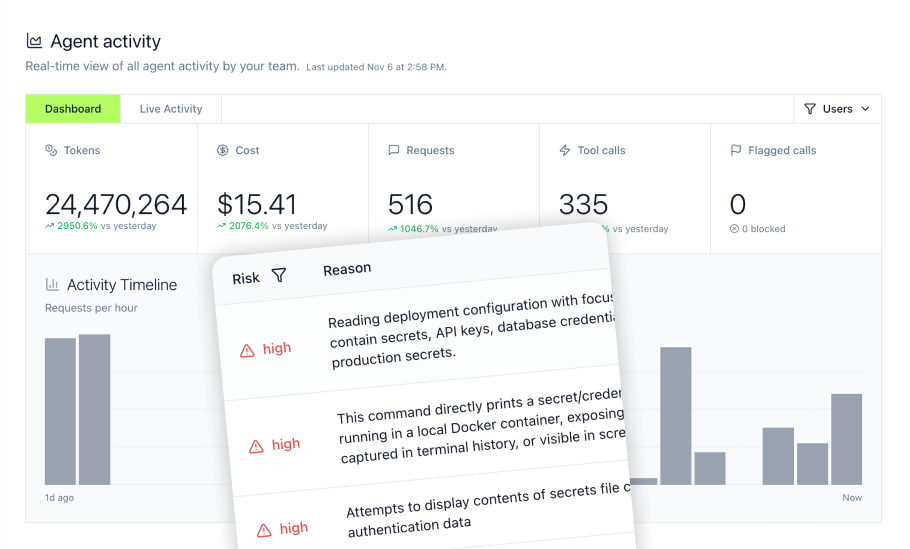
Agent gateways for Snowflake create a governed control layer between AI assistants like Claude, ChatGPT, and Cursor and your enterprise data warehouse. Instead of granting AI tools direct database access or building custom integrations for each assistant, organizations deploy a gateway that provides standardized access to Snowflake Cortex Analyst, Cortex Search, and Cortex Agents with centralized authentication and audit logging.
The right gateway transforms how business users access Snowflake data through agent identities, permissions, and monitoring. Product managers can query "Show weekly active users by feature for last 6 months" in natural language and receive instant results. Finance teams can generate variance analysis without writing SQL. Executives can access real-time KPIs through conversational interfaces. The challenge is choosing a gateway that delivers agent governance capabilities while maintaining the security and compliance your organization requires.
Key Takeaways
- MintMCP Agent Gateway provides agent identities, permissions, memory, and monitoring built on enterprise MCP infrastructure with Virtual MCP Bundles for team-specific Snowflake endpoints, OAuth brokering for authentication, tool-level access control, and complete audit trails
- Snowflake Managed MCP offers native integration with Cortex Analyst for teams already operating within the Snowflake ecosystem
- TrueFoundry serves organizations running Kubernetes-native infrastructure who need unified AI platform capabilities
- Bifrost provides an open-source, self-hosted option for teams with DevOps expertise who require full infrastructure control
- Workato MCP Gateway extends iPaaS connectivity for organizations needing Snowflake access alongside other application integrations
1. MintMCP Agent Gateway: enterprise agent governance for Snowflake
MintMCP Agent Gateway provides identities, permissions, memory, and monitoring for agents that work alongside users, built on enterprise Model Context Protocol infrastructure. Its architecture starts with SSO, SCIM-driven RBAC, IdP groups, Virtual MCP Bundles, tool-level policy, and audit logs, then enables AI agents on top. MintMCP's Agent Gateway builds on this MCP Gateway foundation with agent identities, scoped permissions, memory, and monitoring.
Unlike approaches that require complex infrastructure setup, MintMCP helps teams turn Snowflake MCP servers into governed production services with centralized observability and enterprise authentication for both human users and autonomous agents.
What makes MintMCP Agent Gateway different
MintMCP solves the fundamental challenge of giving agents governed access to Snowflake data while maintaining enterprise control. The platform's architecture wraps stdio, hosted, HTTP-streamable, and SSE MCP servers behind SSO-fronted remote MCP endpoints with OAuth brokering, SCIM-driven membership, and rule-based policy. This eliminates fragmented security policies and visibility gaps that create operational chaos when managing connections between AI agents and data warehouses.
Core capabilities for agent governance
- Hosted MCP Connectors: MintMCP runs connector instances on the customer's behalf with auto-scaling and sandboxed execution per connector, reducing infrastructure overhead for Snowflake connectivity
- OAuth Brokering: Add enterprise authentication to Snowflake MCP servers, including OAuth 2.x, bearer tokens, headers, and SSO-fronted access without rebuilding each server
- Real-Time Monitoring: Live dashboards showing Snowflake query patterns, tool call tracking, and security alerts across all MCP connections
- Granular Access Control: Configure Cortex Analyst tool access by role with read-only operations for analysts while restricting write tools to authorized administrators
- Virtual MCP Bundles: Create team-specific endpoints that expose only the minimum required Snowflake tools with SCIM-driven membership and fine-grained role-based access
- Agent Bundles: Give internal agents first-class identities with M2M auth, scoped Snowflake tools, and independent rotation and revocation
Agent-specific governance features
MintMCP enables natural language queries against Snowflake data warehouses without SQL knowledge through its Cortex Analyst integration. Agents can query engagement metrics, generate variance analysis, and access cross-functional KPIs with proper governance controls.
The platform provides tool-level permissions so organizations can enable cortex_analyst for business users and agents while restricting write operations to database administrators. Every query flows through the gateway with complete audit trails showing which user or agent accessed which data, when, and why.
Agent Bundles give autonomous agents their own identities separate from human users. Each agent receives scoped access to specific Snowflake tools with independent credential rotation and revocation. This enables organizations to deploy long-running agents that operate alongside employees with proper attribution and control.
Security and compliance
MintMCP implements defense-in-depth security through centralized governance, SSO enforcement, SCIM-driven RBAC, tool-level policy, credential management, and observability controls. The platform is SOC 2 Type II audited and compliant with HIPAA standards. Enterprise SSO, complete audit trails, PII detection, and role-based access control are built into every layer of the platform.
Organizations handling protected health information can request HIPAA documentation. MintMCP signs BAAs.
Enterprise integrations
- Snowflake data warehouse access with natural language queries and Cortex Analyst support
- Elasticsearch knowledge base search for documentation and log analysis
- Gmail integration for AI-driven response automation
- Claude, Cursor, ChatGPT, Gemini, and Copilot governance through centralized gateway and Agent Monitor coverage
Deployment and pricing
Deploy quickly with managed SaaS-first delivery, US and EU availability, hosted MCP connectors, pre-configured policies, and self-service access for developers. VPC and self-hosted deployment are available on request.
Contact for enterprise demonstration and pricing.
2. Snowflake Managed MCP
Snowflake Managed MCP provides native integration between AI assistants and Snowflake's Cortex services. The solution leverages Snowflake's existing infrastructure to enable natural language queries through Cortex Analyst.
Primary focus
Snowflake Managed MCP is designed for teams already operating within the Snowflake ecosystem who want quick setup without additional vendor relationships. The native approach means authentication and compute run through existing Snowflake accounts.
Key features
- Native Cortex Analyst integration for natural language to SQL conversion
- OAuth credentials or PAT token authentication through Snowflake UI
- Semantic view support for mapping business terminology to database schemas
- Cortex Search for unstructured data queries
- Usage billed through the existing Snowflake account, with Cortex AI, Cortex Search, and virtual warehouse charges based on the services invoked
Where Snowflake Managed MCP fits
Organizations using remote MCP-compatible clients such as Claude.ai, Claude Desktop, ChatGPT, and Cursor who want Snowflake-native access to Cortex Analyst, Cortex Search, Cortex Agents, SQL execution, and custom tools. Teams with existing Snowflake expertise can configure semantic views, OAuth, RBAC, and tool permissions directly within their Snowflake environment.
Considerations
The Snowflake-managed MCP server is a remote HTTP service that supports Claude.ai, Claude Desktop, ChatGPT, Cursor, and other compatible clients. Teams should instead evaluate whether they need one governance and audit layer across systems beyond Snowflake, including SaaS applications, internal tools, and other data sources.
3. TrueFoundry
TrueFoundry provides MCP gateway capabilities as part of a unified AI platform focused on Kubernetes-native deployments. The platform emphasizes performance optimization for high-throughput environments.
Primary focus
TrueFoundry serves organizations with Kubernetes infrastructure who need MCP gateway functionality alongside broader ML platform capabilities. The platform targets platform engineering teams managing AI workloads at scale.
Key features
- Kubernetes-native architecture for container orchestration
- Performance optimization for low-latency environments
- Unified AI platform beyond MCP gateway functionality
- Self-hosted deployment options for infrastructure control
Where TrueFoundry fits
Platform engineering teams with existing Kubernetes environments who need MCP gateway functionality integrated into broader AI infrastructure. Organizations prioritizing performance characteristics for high-throughput Snowflake query workloads.
Considerations
TrueFoundry's platform approach provides broader AI infrastructure capabilities, but teams should evaluate whether they need MCP-specific governance primitives such as Virtual MCP Bundles, Agent Bundles with M2M auth, and tool-update policy for Snowflake connections.
4. Bifrost
Bifrost provides an open-source MCP gateway implementation for organizations seeking self-hosted infrastructure control. Licensed under Apache 2.0, the project enables teams to run their own gateway without vendor dependencies.
Primary focus
Bifrost serves teams with DevOps expertise who require full infrastructure ownership for their Snowflake MCP connections. The open-source model provides transparency and customization options for organizations with specific requirements.
Key features
- Apache 2.0 licensed open-source implementation
- Self-hosted deployment via Go binary or Docker
- Customizable architecture for specific requirements
- No licensing fees for the gateway software
Where Bifrost fits
Platform engineering teams with strong DevOps capabilities who want to operate their own MCP gateway infrastructure. Organizations with compliance requirements that mandate self-hosted deployments.
Considerations
Self-hosted open-source gateways provide infrastructure control, but teams should evaluate the engineering investment required for authentication integration, governance stack development, and ongoing maintenance. The customer operates the runtime, scaling, and connector lifecycle rather than the vendor.
5. Workato MCP Gateway
Workato extends its iPaaS platform with MCP gateway capabilities, enabling Snowflake connectivity alongside other application integrations.
Primary focus
Workato serves organizations with existing iPaaS investments who want to add MCP support for Snowflake without deploying separate infrastructure. The platform leverages Workato's connector ecosystem for broad integration coverage.
Key features
- iPaaS-native MCP gateway functionality
- 1,200+ pre-built app connectors beyond Snowflake, with additional connectivity through universal and custom connectors
- Existing Workato workflow integration
- Managed service deployment
Where Workato fits
Organizations already using Workato for enterprise automation who want to extend their existing infrastructure with MCP capabilities for Snowflake access.
Considerations
Workato's MCP Control Plane provides OAuth-based authentication, user or agent identity-aware execution, server-level authorization, rate limiting, audit logs, tool execution traces, and composable MCP servers. Teams should compare this governance model with MintMCP's SCIM-driven Virtual MCP Bundles and Agent Bundles when they need team-specific endpoints and independently managed M2M agent identities.
Implementing your Snowflake agent gateway
Semantic view development
Semantic views are the foundation of effective Snowflake agent gateways. These views map business terminology to database schemas, enabling natural language queries that return accurate results. Semantic views can reduce ambiguity by applying consistent business terminology, relationships, and metric definitions across AI-generated queries.
Start with 3-5 core business metrics before expanding. Product teams might begin with weekly active users, feature adoption rate, and user engagement metrics. Finance teams could start with monthly recurring revenue, operating margin, and budget variance calculations.
Authentication strategy
OAuth security guidance supports short-lived access tokens and secure refresh-token practices for production deployments. Snowflake recommends OAuth for managed MCP connections because hardcoded tokens can increase credential-leakage risk. OAuth supports per-user authorization, short-lived access tokens, refresh-token workflows, and integration with enterprise identity providers.
Programmatic Access Tokens are also supported and can be associated with individual or service users. When PATs are used, restrict each token to the least-privileged role and avoid sharing one service-user token across multiple people or agents when individual attribution is required.
Role-based access control
Configure tool-level permissions based on organizational roles. Business analysts typically need read-only access to Cortex Analyst for querying data. Database administrators require write permissions for schema management. Executives need curated views that expose KPIs without underlying table access.
Virtual MCP Bundles enable per-team endpoints with different tool configurations. The product analytics team receives access to user engagement tables. The finance team accesses financial reporting views. Each team sees only the Snowflake tools relevant to their function.
Access control frameworks should extend to autonomous agents through dedicated identities with scoped permissions separate from human users.
Monitoring and cost management
Snowflake compute costs increase with AI query volume. Implement query result caching and rate limiting from day one to prevent cost overruns during initial adoption. As more employees gain natural-language access to Snowflake, query volume may increase, making usage monitoring and cost controls important from the start.
Monitor usage patterns to identify optimization opportunities. Frequently repeated queries benefit from caching. Long-running queries may indicate semantic view improvements needed. Error patterns reveal training gaps or data model issues.
Choosing the right Snowflake gateway for your organization
Organizations selecting an agent gateway for Snowflake integration should evaluate several factors based on their specific requirements and constraints.
Compliance requirements
Regulated industries need gateways with complete audit trails and HIPAA compliance capabilities. Native Snowflake MCP provides compute and authentication but may require additional governance layers for compliance reporting. Purpose-built enterprise gateways like MintMCP include these controls by default.
Multi-client deployment
Organizations using multiple AI assistants (Claude, ChatGPT, Cursor, Gemini, Copilot) need gateways that provide centralized governance across all clients. Snowflake's managed MCP server supports remote connections from Claude.ai, Claude Desktop, ChatGPT, Cursor, and other compatible clients, but its governance remains centered on Snowflake resources rather than connections across an organization's broader tool ecosystem. Enterprise gateways provide single-pane governance regardless of which AI client teams prefer.
Infrastructure ownership
Some organizations require self-hosted deployments for compliance or security reasons. Open-source options like Bifrost enable full infrastructure control but require DevOps investment. Managed gateways reduce operational burden but require vendor relationships. Evaluate your team's capacity for infrastructure management alongside compliance requirements.
Speed to production
Managed SaaS gateways generally reduce the infrastructure an internal team must operate. Self-hosted options require teams to manage deployment, authentication, scaling, upgrades, monitoring, and ongoing maintenance. Compare time to production through a proof of concept rather than assuming a fixed deployment timeline.
Getting started with MintMCP for Snowflake
MintMCP provides a managed path to governed Snowflake connectivity for enterprise teams through its Agent Gateway. The platform's Snowflake integration enables natural language queries through Cortex Analyst with complete audit trails, tool-level access control, and SSO enforcement for both human users and autonomous agents.
MintMCP's Agent Gateway builds on enterprise MCP infrastructure with dedicated capabilities for:
- Agent identities: Agent Bundles give internal agents their own identities with M2M authentication.
- Scoped permissions: Each agent receives access only to the Snowflake tools required for its role.
- Credential management: Agent credentials can be rotated or revoked independently.
- Memory and monitoring: Long-running agents can operate alongside employees while maintaining proper attribution in audit logs.
Virtual MCP Bundles support team-specific Snowflake access:
- Product teams receive access to user engagement tables and metrics.
- Finance teams access financial reporting views.
- Each endpoint exposes only the Snowflake tools required by that team.
- SCIM-driven membership and tool-level policies are applied based on IdP groups.
The platform also provides real-time monitoring that shows:
- Which agents and users are accessing Snowflake data
- What queries they are running
- Which tools they are invoking
- When agents attempt unauthorized operations
- When access patterns deviate from established baselines
Visit mintmcp.com/snowflake to explore the Snowflake integration capabilities or request a demonstration to see how MintMCP's Agent Gateway can govern your AI-to-Snowflake connections with proper agent identities and enterprise controls.
Frequently asked questions
What is an agent gateway for Snowflake?
An agent gateway for Snowflake creates a governed control layer between AI assistants (Claude, ChatGPT, Cursor) and your data warehouse. Instead of configuring each AI tool with direct Snowflake credentials, the gateway provides centralized authentication, audit logging, and access control. Agent gateways also enable autonomous agents with dedicated identities, permissions, and monitoring separate from human users. Business users and agents can query Snowflake data using natural language through Cortex Analyst while security teams maintain visibility and compliance.
How do agent gateways enable natural language Snowflake queries?
Agent gateways route AI requests through Snowflake's Cortex Analyst service, which converts natural language questions into SQL queries. Semantic views map business terminology (like "monthly recurring revenue") to database schemas, ensuring accurate translations. The gateway adds authentication, access control, and audit logging around this natural language interface for both human users and autonomous agents.
Should I use OAuth or PAT tokens for Snowflake agent connections?
OAuth 2.0 is recommended because it supports per-user authorization, short-lived access tokens, refresh-token workflows, and enterprise identity provider integration. Programmatic Access Tokens remain supported and are associated with a Snowflake user, but shared service-user PATs can reduce person-level or agent-level attribution. Restrict PATs to least-privileged roles and avoid sharing them when individual auditability is required.
Can web-based AI tools like ChatGPT connect to Snowflake through an agent gateway?
Snowflake's managed MCP server exposes a remote HTTP endpoint that compatible web and desktop clients can access, including Claude.ai, Claude Desktop, ChatGPT, and Cursor. Enterprise gateways like MintMCP add a centralized governance layer across Snowflake and other enterprise systems, enabling organizations to apply consistent authentication, tool policies, and audit logging across Claude, Cursor, ChatGPT, Gemini, and Copilot.
How do I prevent AI agents from accessing sensitive Snowflake data?
Agent gateways implement tool-level access control that restricts which Snowflake capabilities each user or agent can access. Analysts might receive read-only access to specific semantic views while write operations remain restricted to database administrators. Virtual MCP Bundles create separate endpoints per team with curated tool lists, ensuring each group sees only the data relevant to their function. Agent Bundles provide dedicated identities for autonomous agents with scoped permissions independent from human users.