Linear's official MCP server gives compatible AI agents authenticated access to Linear objects such as issues, projects, and comments. The challenge is not whether to connect Linear to your AI tools, but how to govern access consistently at enterprise scale. As organizations add more agents and AI clients, authentication, permissions, and activity records can become fragmented across separate connections unless they introduce a centralized control layer.
The right MCP gateway transforms Linear from an experimental AI integration into production-ready enterprise infrastructure. It provides centralized authentication, real-time monitoring, and the governance controls that security teams require before approving AI agent deployments.
Key Takeaways
- MintMCP Agent Gateway provides identities, permissions, memory, and monitoring for agents that work alongside users, built on enterprise MCP Gateway infrastructure with SCIM-driven RBAC, Virtual MCP Bundles, Agent Bundles, and complete audit logging
- Container-native approaches through Docker MCP Gateway suit teams using Docker Desktop, Docker CLI, or Docker Engine for local server lifecycle management
- Open-source gateways like Bifrost provide transparency and extensibility for platform teams requiring full infrastructure ownership
- Managed SaaS-first deployment accelerates production readiness with hosted connectors, pre-configured governance, and automated scaling
- Agent gateway selection depends on deployment speed requirements, authentication architecture needs, and existing infrastructure investments
- Production Linear deployments require tool-level access controls, comprehensive audit logs, and SSO integration across distributed AI clients
1. MintMCP Agent Gateway: governed Linear access for production agents
MintMCP Agent Gateway provides identities, permissions, memory, and monitoring for agents that work alongside users. Built on MintMCP's enterprise MCP Gateway foundation, it delivers authentication, tool-level access control, credential management, logging, rule-based policy, and agent governance with a data-permissions-first architecture that starts with SSO, SCIM-driven RBAC, and audit logs.
For Linear integration specifically, MintMCP helps teams turn Linear's official MCP server into a governed production service with centralized observability, enterprise authentication, and a SOC 2 Type II audited platform.
What makes MintMCP Agent Gateway different
MintMCP solves the fundamental problem organizations face when connecting AI agents to Linear and other project management tools. The platform's architecture supports stdio and Streamable HTTP servers, can host connector runtimes, and maintains compatibility with legacy HTTP+SSE servers. Clients connect through SSO-fronted remote endpoints with OAuth brokering, SCIM-driven membership, and rule-based policy.
This reduces fragmented security policies and visibility gaps that create operational chaos when managing point-to-point connections between AI agents and Linear.
Core capabilities for Linear
- Hosted MCP Connectors run connector instances on the customer's behalf with auto-scaling and sandboxed execution per connector, reducing the infrastructure overhead that typically delays production Linear deployment
- OAuth Brokering adds enterprise authentication to Linear MCP servers, including OAuth 2.x, bearer tokens, headers, and SSO-fronted access without rebuilding each server
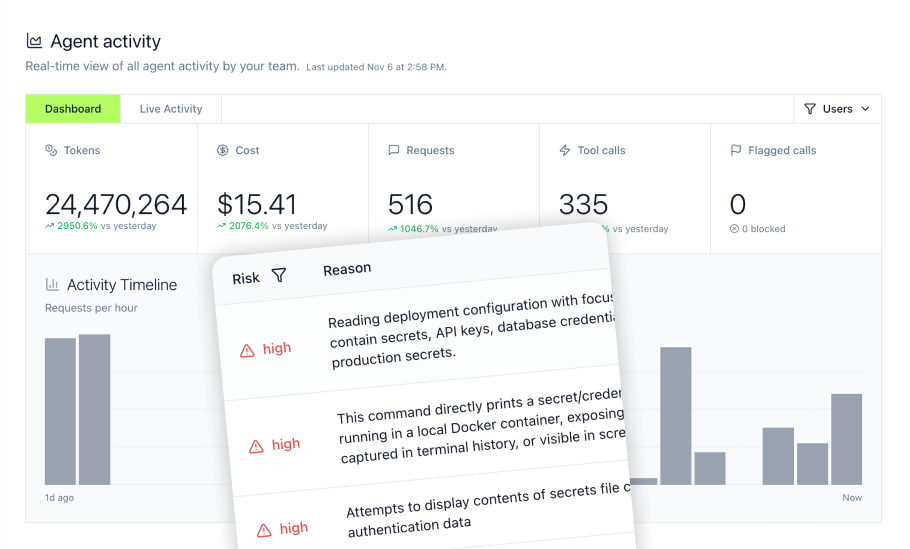
- Real-Time Monitoring provides live dashboards showing server health, usage patterns, tool call tracking, and security alerts across all Linear MCP connections
- Granular Access Control configures Linear tool access by role with read-only operations for analysts while restricting write tools to authorized administrators
- Virtual MCP Bundles create team-specific endpoints that expose only the minimum required Linear tools with SCIM-driven membership, curated tool lists, and fine-grained role-based access
- Agent Bundles give internal agents first-class identities with M2M auth, scoped tools, independent rotation and revocation, and an "act as agent" flow for connectors that require per-agent OAuth
- Custom Gateway Middleware runs customer-authored middleware in a JS sandbox with external DLP and guardrails integrations for masking, blocking, and policy enforcement
Linear-specific use cases
MintMCP enables three primary Linear integration patterns:
Automated Issue Triage: AI agents analyze new Linear issues, apply classification rules, assign priorities, and route to appropriate team members. This can reduce repetitive manual triage work while keeping classification and routing rules consistent.
Sprint Planning Assistance: Agents monitor team velocity, analyze capacity, recommend optimal sprint scope, and identify dependencies. Agents can prepare velocity, capacity, and dependency summaries before sprint planning sessions.
Automated Reporting: AI agents generate weekly status reports, monthly velocity trends, bug resolution metrics, and release notes directly from Linear data, reducing repetitive manual reporting work.
Security architecture
MintMCP implements defense-in-depth security through centralized governance, SSO enforcement, SCIM-driven RBAC, tool-level policy, credential management, and observability controls. The platform provides visibility into which teams and agents use which Linear tools, when they access data, and how frequently.
Enterprise integrations
- Snowflake data warehouse access with natural language queries
- Elasticsearch knowledge base search for documentation and log analysis
- Gmail integration for AI-driven communication automation
- Centralized gateway governance for Claude, Cursor, ChatGPT, Gemini, and Copilot, with Agent Monitor adding visibility into supported local non-MCP coding-agent activity
Compliance
MintMCP is SOC 2 Type II audited, compliant with HIPAA standards, and penetration tested. Enterprise SSO, complete audit trails, PII detection, and role-based access control are built into every layer. Visit the Trust Center for compliance documentation.
Deployment
Managed SaaS-first delivery with US and EU availability, hosted MCP connectors, pre-configured policies, and self-service access for developers. VPC and self-hosted deployment available on request.
2. Docker MCP Gateway
Docker's MCP Gateway brings container orchestration expertise to MCP server management, providing a Docker-native gateway to run and manage MCP servers with Docker Desktop, Docker CLI, and Docker Engine. The solution focuses on containerized hosting and lifecycle management for MCP servers at scale.
Core capabilities
- Container isolation for MCP server deployments including Linear MCP
- Docker Desktop, Docker CLI, and Docker Engine integration for server lifecycle, routing, credential injection, and container isolation
- Standard container security practices and image management
- Community-driven catalog of MCP server configurations
Where Docker MCP Gateway fits
Teams running MCP servers locally and organizations with existing Docker environments seeking to run and manage MCP servers. The container-native approach works well for developers who need local Linear MCP testing before production deployment.
Deployment considerations
Self-hosted through Docker Desktop or Docker Engine. The gateway is open source, while its integration with Docker AI Governance is currently invite-only. Teams should evaluate how much authentication, SCIM-driven RBAC, tool-level policy, audit logging, OAuth brokering, and agent identity governance they need beyond container lifecycle management.
3. TrueFoundry
TrueFoundry provides AI Gateway capabilities as part of a unified AI infrastructure platform that combines gateway functionality with MLOps capabilities for model deployment, fine-tuning, and monitoring.
Core capabilities
- Gateway functionality integrated with broader AI platform features
- Kubernetes-native deployment model
- Support for custom MCP server hosting
- Platform-level authentication and access controls
Where TrueFoundry fits
Organizations already building AI infrastructure who want unified MLOps and agent gateway capabilities in one platform. Teams that need both gateway functionality and model deployment, fine-tuning, or experiment tracking from a single vendor.
Deployment considerations
Hybrid deployment with managed SaaS and self-hosted control plane in customer's Kubernetes or cloud environment. Teams should compare whether they need the broader MLOps platform or focused MCP gateway capabilities like Virtual MCP Bundles and Agent Bundles with M2M auth.
4. Bifrost
Bifrost provides open-source MCP gateway capabilities under Apache 2.0 license, emphasizing transparency and extensibility for teams requiring full control over their infrastructure.
Core capabilities
- Open-source gateway implementation with community support
- Go binary or Docker deployment options
- Extensible architecture for custom integrations
- Self-hosted deployment with full infrastructure control
Where Bifrost fits
Platform engineering teams with DevOps expertise who require full infrastructure ownership. Organizations prioritizing open-source tools for transparency and those building custom AI agent platforms with specific requirements.
Deployment considerations
OSS-first, self-hosted model requiring the customer to operate the runtime, scaling, and infrastructure. Teams comparing Bifrost with managed alternatives should evaluate whether they want self-hosted orchestration or a managed SaaS-first gateway with hosted MCP connectors, SCIM-driven RBAC, Virtual MCP Bundles, Agent Bundles, and centralized audit.
5. Kong AI Gateway
Kong AI Gateway adds MCP capabilities through its AI MCP Proxy plugin, which is available with AI Gateway Enterprise on Kong Gateway 3.12 or later. It can proxy upstream servers, convert APIs into agent-accessible tools, and apply Kong authentication, traffic control, and observability policies.
Core capabilities
- Extension of existing Kong deployments with MCP support
- Leverage established authentication, rate limiting, and monitoring
- Unified management of APIs and MCP servers through single platform
- Existing integrations with identity providers and monitoring tools
Where Kong AI Gateway fits
Enterprises with established Kong API gateway investments seeking to extend existing infrastructure rather than deploy purpose-built MCP solutions. Organizations that want consolidated governance for both traditional APIs and MCP traffic.
Deployment considerations
Hybrid deployment with Konnect SaaS control plane and self-hosted data plane, or fully self-hosted. Teams should evaluate whether an API gateway extension provides MCP-specific primitives such as Virtual MCP Bundles, Agent Bundles, hosted connector runtime, tool-update policy, OAuth brokering for stdio servers, and audit logs designed around tool invocation.
6. IBM ContextForge
IBM ContextForge is an Apache 2.0-licensed open-source gateway, registry, and proxy that federates MCP, A2A, and REST or gRPC services through a unified management layer.
Core capabilities
- Federation across MCP, A2A, REST, and gRPC services
- Centralized authentication, authorization, plugins, rate limiting, and observability
- Deployment through containers, Kubernetes, OpenShift, IBM Code Engine, AWS, and Azure
Where IBM ContextForge fits
Platform teams that want an extensible open-source gateway and registry and have the engineering resources to deploy, secure, and operate it themselves.
Deployment considerations
Self-managed deployment options include containers, Kubernetes, OpenShift, IBM Code Engine, AWS, and Azure. Teams that require a commercial support agreement should verify its availability separately rather than assume it is included with ContextForge.
7. Lunar.dev MCPX
Lunar.dev's MCPX focuses on centralizing policy enforcement, access control, and observability to take MCP from local experimentation to governed production deployments.
Core capabilities
- Centralized RBAC and policy enforcement
- Built-in metrics and audit logs for tool usage, latency, errors, and agent actions, with broader LLM and API visibility available when paired with Lunar AI Gateway
- Support for STDIO and remote HTTP/SSE MCP servers
- Docker deployment for open-source MCPX and self-hosted Kubernetes, VPC, on-premises, or air-gapped deployment for MCPX Enterprise
Where Lunar.dev MCPX fits
Platform and infrastructure teams deploying MCP to production who need centralized access control, observability, and policy enforcement. Application teams building AI agents that require governed Linear access.
Deployment considerations
Open-source MCPX is self-hosted through Docker. MCPX Enterprise supports self-hosted Kubernetes, VPC, on-premises, and air-gapped deployment and adds centralized administration, agent inventory, and an organization-wide usage dashboard. Teams should compare whether they need managed SaaS-first deployment, hosted MCP connectors, SCIM-driven Virtual MCP Bundles, Agent Bundles with M2M auth, tool-update policy, and Gateway plus Agent Monitor coverage for both MCP and local non-MCP agent activity.
Essential selection criteria for Linear integration
Deployment speed vs. control tradeoffs
Purpose-built gateways like MintMCP provide fast managed SaaS-first deployment with hosted MCP connectors and pre-configured governance controls. Self-hosted open-source options require infrastructure setup but offer full control. Consider whether you need production Linear deployment quickly or can invest weeks building custom infrastructure.
Security and compliance requirements
Organizations in regulated industries may require a SOC 2 Type II audited vendor, audit logs, SSO, SCIM-driven RBAC, credential management, and tool-level access controls, depending on their regulatory and procurement requirements. Evaluate whether your gateway provides these controls natively or requires you to implement them yourself.
STDIO vs. remote server support
Linear's official MCP server supports remote endpoints, but many community-built MCP servers use STDIO transport. Solutions that only support remote HTTP or SSE servers limit ecosystem access. MintMCP supports stdio and Streamable HTTP upstreams, along with legacy HTTP+SSE compatibility and OAuth brokering for stdio and hosted connectors.
Authentication architecture
The current MCP authorization specification bases HTTP authorization on OAuth 2.1, while authorization remains optional and implementation varies across servers and clients. Some gateways broker OAuth and wrap stdio or hosted servers with enterprise SSO, while others require manual OAuth configuration per server. Consider whether you need shared service accounts, per-user authentication, per-agent identity, M2M auth, or an "act as agent" flow.
Observability and monitoring
Without comprehensive logging and monitoring, organizations face a visibility gap where they cannot see which Linear tools agents use or track data access. Essential metrics include tool call tracking, performance analytics, error rates, and cost allocation per team. Evaluate whether your gateway provides real-time dashboards, audit logs, and centralized observability.
Linear tool coverage
Linear's official MCP server provides tools for finding, creating, and updating Linear objects such as issues, projects, and comments. The available functionality continues to expand, so teams should review Linear's current documentation and inspect the tools exposed to their chosen AI client. Verify that your gateway can expose the tools your teams require with appropriate access controls.
Why MintMCP Agent Gateway for Linear integration
MintMCP Agent Gateway transforms Linear from experimental AI integration into governed enterprise infrastructure by providing identities, permissions, memory, and monitoring for agents that work alongside users. The platform's data-permissions-first architecture means your Linear integration starts with SSO, SCIM-driven RBAC, and complete audit trails built on MintMCP's enterprise MCP Gateway foundation.
Virtual MCP Bundles let you create team-specific Linear endpoints. Your product team gets full project management access while engineering gets issue management only. Analytics teams receive read-only query tools. Each team connects to one governed endpoint with exactly the Linear capabilities they need.
Agent Bundles give each AI agent its own identity with scoped Linear access, rotatable credentials, and independent revocation. No shared service account keys. When an agent's permissions need to change, you update one Bundle without touching other agents or user access.
Hosted MCP connectors mean MintMCP runs and scales your Linear connector instances. No Kubernetes pods to manage, no runtime scaling to configure. Deploy Linear MCP in minutes, not weeks, with the agent governance controls that security teams require.
MintMCP Agent Gateway builds on proven MCP Gateway infrastructure that already governs data and tool connections for Claude, Cursor, ChatGPT, Gemini, and Copilot. Now it extends that same governance model to the agents working alongside your users, with first-class agent identities, scoped permissions, and centralized monitoring.
Start your Linear integration with full agent governance from day one. Try MintMCP or book a demo to see how Agent Bundles and Virtual MCP Bundles transform Linear access for your organization.
Frequently asked questions
What is an agent gateway and why do I need one for Linear?
An agent gateway is a centralized control layer that manages communication between AI agents and tools like Linear. Without a gateway, organizations face fragmented security policies across individual MCP servers, zero visibility into which agents access which Linear projects, duplicated authentication logic, and inconsistent logging. Gateways transform this complexity into a manageable hub-and-spoke model with unified authentication, complete audit trails, and centralized monitoring.
How quickly can I deploy Linear MCP through an agent gateway?
Deployment speed varies by approach. Managed services like MintMCP Gateway provide hosted MCP connectors that can have Linear integration running in minutes with SSO-fronted access and pre-configured governance. Self-hosted open-source solutions require additional time for infrastructure setup, authentication integration, and security configuration.
What Linear tools are available through MCP?
Linear's official MCP server provides tools for finding, creating, and updating Linear objects such as issues, projects, and comments. The available functionality continues to expand, so teams should review Linear's current documentation and inspect the tools exposed to their chosen AI client. Enterprise gateways let you configure which tools each team or agent can access based on their role.
Can I restrict which Linear operations different teams can perform?
Yes, with the right gateway. Virtual MCP Bundles in MintMCP let you create team-specific endpoints with curated tool lists. Your product team might have full Linear access while support teams only get issue creation and commenting. Analytics teams can receive read-only access for reporting without write permissions.
How do agent gateways handle Linear API credentials?
Enterprise gateways centralize credential management so Linear API keys are not scattered across developer machines. MintMCP provides OAuth brokering, centralized credential management, and per-agent credential scoping through Agent Bundles. Each agent's credentials can be rotated or revoked independently.