Connecting AI agents to Salesforce without proper governance can create security blind spots that complicate compliance review. MCP (Model Context Protocol) gateways solve this by sitting between AI assistants and your Salesforce org, authenticating users, enforcing role-based access, and logging every interaction for SOC 2 Type II audited controls and GDPR-oriented governance. The MCP Gateway approach transforms scattered API key management into centralized, auditable infrastructure that IT and security teams can approve with clearer evidence and control.
This guide evaluates the top MCP gateways for Salesforce integration in 2026, covering deployment complexity, compliance posture, and total cost of ownership. Whether organizations need managed infrastructure with streamlined deployment or self-hosted control, these platforms enable AI agents to access Salesforce data securely, without the security risks of direct API key distribution.
Key Takeaways
- MCP gateways provide centralized authentication, audit trails, credential management, and role-based access control for AI agents accessing Salesforce, supporting SOC 2 Type II audited controls and GDPR-oriented governance
- Setup time ranges from minutes for initial managed setup to longer enterprise rollouts, while self-hosted Docker deployments depend on internal infrastructure, security, and operations requirements
- Enterprise teams often use MCP gateways to reduce manual credential handling, improve auditability, and standardize AI access to Salesforce
- Organizations use AI-assisted Salesforce workflows to improve consistency, but results vary based on implementation scope and process design
- Salesforce API allocations start at 100,000 requests per 24-hour period for Enterprise Edition and scale with licenses and purchased capacity, requiring gateway-level rate limiting to prevent avoidable quota pressure (Salesforce API Limits)
- ROI timelines vary based on deployment scope, user count, and the amount of workflow automation introduced
1. MintMCP Gateway: From Local MCP to Enterprise Deployment, Fast
MintMCP Gateway transforms stdio-based MCP servers into production-ready services with built-in authentication, monitoring, and compliance controls. For Salesforce integration, this means deploying AI agents that query accounts, update opportunities, and manage cases, all with complete audit trails, centralized credential management, and revocable access controls.
What Makes MintMCP Different
MintMCP addresses the core Salesforce AI adoption blocker: security and governance without sacrificing speed. The platform is SOC 2 Type II audited, with continuous compliance monitoring via Drata, complete audit trails, PII detection, and role-based access control built into the platform. Managed SaaS-first deployment reduces setup overhead for Salesforce MCP servers, while full enterprise rollout timing depends on identity, policy, and approval requirements.
MintMCP is data-permissions-first: it starts with SSO, SCIM-driven RBAC, IdP groups, Virtual MCP Bundles, tool-level policy, and audit, then enables agents on top. This helps security teams keep Salesforce access aligned to governed permissions instead of retrofitting controls after agents are already deployed.
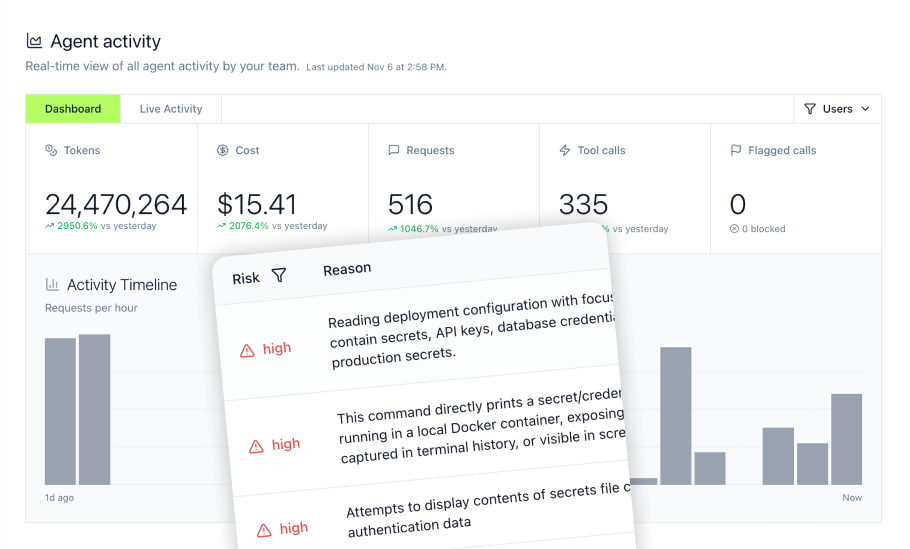
The Gateway + Agent Monitor model provides two-layer governance. The gateway covers MCP traffic, while Agent Monitor covers local non-MCP agent activity such as bash commands, file reads and writes, and prompt submissions through Claude Code and Cursor hooks. This visibility helps security teams detect and block risky operations around Salesforce-connected workflows before they expose sensitive customer data.
Core Salesforce Integration Capabilities
- OAuth brokering, OAuth, and SSO enforcement wrap Salesforce Connected Apps with enterprise authentication
- SSO and SCIM-driven RBAC maps IdP groups to Salesforce-related access policies
- Granular tool-level access control restricts AI agents to specific Salesforce objects and actions, such as read-only on Accounts or read/write on Cases
- Rule-based policy and tool-level allowlisting help prevent agents from accessing destructive operations or sensitive fields
- Real-time monitoring dashboards track Salesforce tool calls with user and agent attribution
- Audit log exports support downstream security review and evidence collection workflows
- Credential management reduces direct Salesforce credential distribution across AI clients
- Virtual MCP Bundles expose curated, per-use-case endpoints with SCIM-driven membership, preventing agents from accessing delete operations or sensitive fields
- Agent Bundles support per-agent identity, scoped tools, M2M authentication, and revocation independent of human users
Implementation Timeline
MintMCP deployment for Salesforce can start quickly for pilot setups, while full enterprise rollout typically depends on identity integration, policy design, and approval workflows:
- Salesforce Connected App creation: initial configuration time varies by org setup
- MintMCP server configuration: managed setup can begin quickly, with production hardening based on governance requirements
- RBAC policy definition: timing depends on how granularly teams map roles to Salesforce object permissions
- AI client connection: final connection steps vary by client type, including Claude, Cursor, ChatGPT, Gemini, and Copilot
Enterprise Governance Features
The platform integrates centralized governance with rate control to help manage Salesforce API consumption. Teams using high-frequency AI agents can configure gateway-level throttling to better manage Salesforce API consumption and reduce the risk of avoidable request-limit issues.
MintMCP also supports JavaScript Gateway Middleware in a JS sandbox, external DLP and guardrails integrations, Admin MCP, and tool-update policy controls. For Salesforce environments, these capabilities help teams inspect, transform, mask, block, approve, or audit tool behavior as upstream tools and workflows change.
For organizations deploying enterprise AI agents, MintMCP provides hosted MCP connectors run by MintMCP, including connectors for Snowflake and Elasticsearch, enabling AI assistants to combine CRM data with analytics warehouses and knowledge bases without requiring customers to operate connector runtimes themselves.
Compliance Posture
MintMCP is SOC 2 Type II audited, with continuous compliance monitoring via Drata. Enterprise SSO, complete audit trails, PII detection, role-based access control, and data encryption in transit and at rest are built into the platform. Customers handling protected health information can request HIPAA documentation, and MintMCP signs BAAs. Organizations seeking additional frameworks for AI governance can reference the NIST Cybersecurity Framework for additional controls.
2. TrueFoundry MCP Gateway
Where TrueFoundry Fits
TrueFoundry provides an MCP gateway for organizations running AI infrastructure across model serving, MCP routing, and observability. The platform is suitable for teams that prefer consolidated AI infrastructure over separate tools.
Primary Focus
TrueFoundry supports OAuth 2.0 authentication for Salesforce Connected Apps with RBAC configuration. The platform enables Virtual MCP Server creation, exposing operations like query and describe while restricting delete and modify_ownership tools from general users.
Key capabilities include:
- Air-gapped and VPC deployment options for regulated industries
- Real-time observability with usage pattern dashboards
- Support for multi-region deployments
Tradeoffs to consider
TrueFoundry can fit platform teams that want MCP routing alongside broader AI infrastructure. Teams focused specifically on Salesforce access governance should also evaluate whether they need MintMCP-style data-permissions-first controls such as SCIM-driven RBAC, per-use-case Virtual MCP Bundles, Agent Bundles with M2M auth, hosted MCP connectors, tool-update policy, and Gateway + Agent Monitor coverage for Claude, Cursor, ChatGPT, Gemini, and Copilot governance.
Implementation Considerations
Setup requires DevOps involvement for VPC configuration. The platform suits organizations that want unified AI infrastructure, combining model serving, MCP routing, and observability rather than managing separate tools. Contact vendor for enterprise pricing.
3. Docker MCP Gateway
Where Docker Fits
The open-source Docker MCP Gateway provides infrastructure control for teams with existing container and Kubernetes environments. Organizations prioritizing flexibility can deploy Salesforce MCP servers without relying on a managed gateway, configuring authentication, logging, and rate limiting through custom configuration.
Primary Focus
Docker deployments require manual OAuth configuration through Connected App setup and config file creation. A basic Salesforce server definition specifies OAuth credentials, scopes, and allowed operations:
- Configure
allowed_operationsto restrict AI agents toqueryanddescribewhile blocking create, update, and delete operations - Implement custom logging pipelines for compliance evidence
- Set up rate limiting middleware to prevent Salesforce API exhaustion
Tradeoffs to consider
A self-hosted gateway can give teams infrastructure control, but it also makes the customer responsible for operating connector runtimes, scaling, patching, audit pipelines, and production security controls. MintMCP addresses these gaps with managed SaaS-first deployment, hosted MCP connectors run by MintMCP, centralized observability, credential management, and policy controls built around Salesforce-connected AI workflows.
Implementation Considerations
Self-hosted deployment timing and infrastructure cost depend on scale, availability requirements, logging architecture, and internal DevOps maturity. Teams should plan for Docker or Kubernetes setup, configuration testing, high-availability design, security patching, and compliance evidence collection.
The Docker approach requires DevOps expertise for ongoing maintenance, security patching, and compliance configuration. Teams must implement audit logging and access controls independently.
4. Composio
Where Composio Fits
Composio targets developers building multi-tool AI agents with 1,000+ app integrations beyond Salesforce. The platform provides a managed gateway with a free tier, suitable for startups and development teams experimenting with AI agent architectures before committing to enterprise infrastructure.
Primary Focus
Composio offers pre-built Salesforce connectors with OAuth 2.0 support, reducing integration time compared to custom configurations. The platform addresses the N×M integration problem, where N AI clients need to connect to M tools, through centralized authentication and tool discovery.
Core features include:
- Pre-configured Salesforce connector with standard CRUD operations
- Developer-friendly SDK for custom tool creation
- SOC 2 Type II audited controls
- Community support with paid professional tiers
Tradeoffs to consider
Composio is developer-oriented and often fits teams building external customer-facing AI products. Enterprises using Salesforce for internal employee and internal-agent governance should also evaluate whether they need MintMCP-style SCIM-driven RBAC, Virtual MCP Bundles for per-use-case endpoints, Agent Bundles for per-agent identity, centralized audit logs, hosted MCP connectors, and rule-based policy designed for IT, security, and AI operations teams.
Implementation Considerations
Setup completes through the managed platform. The free tier is suitable for prototyping, while production deployments typically require paid plans with stronger governance and support. Paid plans are usage-based, with higher tiers adding expanded limits, support, and governance features.
5. Lasso Security
Where Lasso Security Fits
Lasso Security provides an MCP gateway with threat detection capabilities, targeting organizations that treat AI agents as potential attack vectors. The platform detects prompt injection attempts, data exfiltration patterns, and anomalous access behaviors, which can be relevant for financial services and healthcare deployments where Salesforce contains regulated customer data.
Primary Focus
Beyond standard OAuth 2.0 authentication, Lasso Security adds security-focused monitoring that analyzes AI agent requests for malicious patterns. The gateway can block requests that attempt to extract bulk customer records or bypass field-level security through prompt manipulation.
Security features include:
- Real-time threat detection for prompt injection attacks
- Data exfiltration monitoring with automated blocking
- Auditability and security monitoring for enterprise AI environments
- Support for regulated-environment security workflows
Tradeoffs to consider
Security-focused MCP gateways can help teams detect risky agent behavior, but Salesforce governance also depends on identity, permissions, tool scoping, credentials, and auditability. Teams should evaluate whether they need MintMCP capabilities such as SSO and SCIM-driven RBAC, Virtual MCP Bundles, Agent Bundles with M2M authentication, hosted MCP connectors, JavaScript Gateway Middleware, external DLP integrations, and Gateway + Agent Monitor two-layer governance.
Implementation Considerations
Deployment focuses on security-oriented configuration. The platform suits compliance-driven organizations where security review is the primary adoption consideration. Contact vendor for enterprise pricing.
Getting Started with MintMCP for Salesforce
For organizations seeking a fast path from Salesforce AI pilot to production deployment, MintMCP provides the infrastructure layer that satisfies both developers and compliance teams. The combination of managed deployment, SOC 2 Type II audited controls, SSO and SCIM-driven RBAC, credential management, and real-time monitoring addresses the governance gap that stalls many enterprise AI initiatives.
MintMCP's architecture enables security teams to enforce least-privilege access through granular RBAC, so sales representatives access Opportunities while support teams interact only with Cases. Every Salesforce API call flows through the gateway with full audit trails exportable to SIEM tools, providing evidence for SOC 2 and GDPR-oriented programs. Token revocation happens at the gateway level, reducing the need to rotate Salesforce API keys across multiple AI clients.
The platform's Virtual MCP Bundle capability lets administrators expose only safe operations, such as query and describe, while restricting delete and modify_ownership tools from general users. This prevents scenarios where an AI agent accidentally corrupts production data or violates field-level security policies. Combined with rate limiting controls, MintMCP helps organizations stay within Salesforce API allocations while supporting high-frequency AI agent workflows.
Start by configuring a Salesforce Connected App with OAuth 2.0 credentials, then connect through MintMCP's gateway interface. AI agents can securely query accounts, update opportunities, and manage cases, with every action logged for audit and revocable if needed.
Book a demo to see how MintMCP transforms Salesforce AI integration into governed, production-ready infrastructure.
Frequently Asked Questions
What is an MCP Gateway and how does it benefit Salesforce integration?
An MCP Gateway sits between AI agents like Claude, ChatGPT, Gemini, Copilot, or custom assistants and Salesforce, providing centralized authentication, role-based access control, credential management, and complete audit logging. Instead of distributing API keys to every AI tool, which creates access and revocation challenges, the gateway authenticates users through OAuth and SSO, applies policy, and logs every Salesforce interaction. This enables compliance teams to approve AI deployments with complete visibility into data access patterns.
How do MCP Gateways ensure security and compliance for Salesforce data?
Gateways enforce least-privilege access through granular RBAC, so sales representatives might access Opportunities while support teams only interact with Cases. All Salesforce API calls flow through the gateway with full audit trails exportable to SIEM tools. SOC 2 Type II audited platforms like MintMCP provide independently audited controls that help streamline internal security review. Token revocation happens at the gateway level, reducing the need to rotate Salesforce API keys across multiple AI clients.
Can MCP Gateways help manage shadow AI in a Salesforce environment?
Yes. Without a gateway, employees may connect AI tools directly to Salesforce using personal API keys or shared credentials, creating untracked data access that can undermine SOC 2 control objectives and GDPR-oriented governance requirements. Gateways provide centralized governance where IT controls which AI tools access which Salesforce objects, monitors usage patterns, and blocks unauthorized access attempts. This transforms shadow AI into sanctioned, auditable AI tool deployment.
What deployment options exist for MCP Gateways with Salesforce?
Options range from managed cloud platforms like MintMCP and Composio to self-hosted Docker deployments requiring internal DevOps work. Managed platforms handle infrastructure, security patching, and compliance operations, which can fit teams without dedicated gateway operations resources. Self-hosted options suit organizations requiring air-gapped environments or specific infrastructure control. Enterprise tiers may include VPC or self-hosted deployment options for additional infrastructure control.
What kind of AI tools can integrate with Salesforce via an MCP Gateway?
Any MCP-compatible client works with gateway-protected Salesforce access. This includes Claude, ChatGPT, Gemini, Copilot Studio, Cursor, Windsurf, and custom agents built with MCP SDKs. The MintMCP platform provides governance coverage for Claude, Cursor, ChatGPT, Gemini, and Copilot workflows, with setup timing depending on the client type, Salesforce configuration, and enterprise approval requirements.