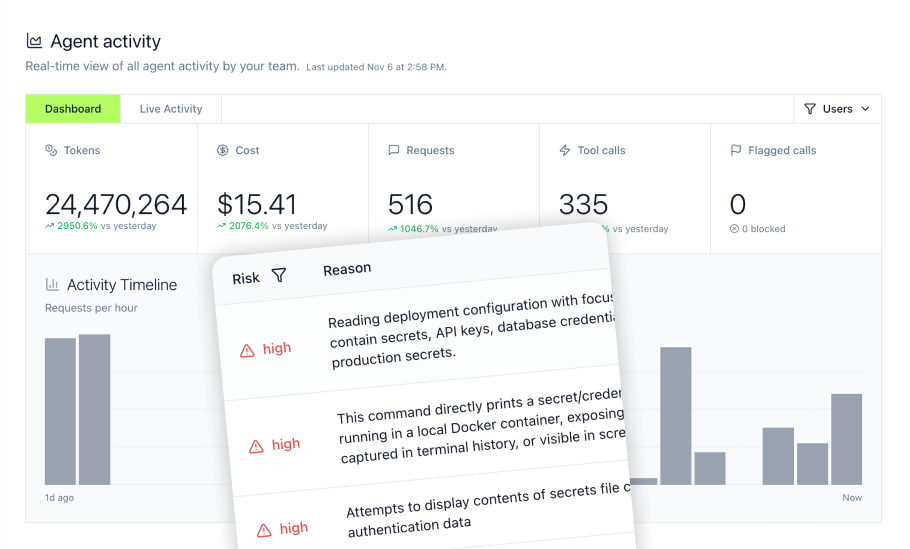
Connecting AI agents to Databricks environments without proper governance creates blind spots that compliance teams and security leaders cannot tolerate. MCP (Model Context Protocol) gateways solve this by providing centralized authentication, monitoring, and audit trails for every tool call AI agents make against lakehouse infrastructure.
The right gateway transforms scattered API integrations into a governed, observable system where organizations can track exactly which agent accessed which data, when, and why. With 71% of organizations now regularly using generative AI in at least one business function according to McKinsey, the question is no longer whether to deploy AI agents, but how to do so securely.
This guide evaluates the leading MCP gateway options for Databricks integration, starting with MintMCP's MCP Gateway, a production-ready solution that deploys in minutes with enterprise security controls built in.
Key Takeaways
- MCP gateways provide centralized control for AI agent tool calls, replacing direct API access with governed, auditable connections to Databricks
- Enterprise deployments require OAuth/SSO integration, complete audit trails, and role-based access control at the tool level
- Implementation timelines vary widely depending on identity, governance, and infrastructure complexity
- Unity Catalog integration is essential for production Databricks MCP deployments because Databricks managed MCP servers enforce permissions through Unity Catalog
- Properly implemented gateways can reduce manual governance overhead and improve visibility into agent activity, though results vary by deployment
1. MintMCP: From Local MCP to Enterprise Deployment, Fast
MintMCP transforms local MCP servers into production-ready infrastructure with one-click deployment, OAuth protection, and monitoring. The platform addresses the core challenge enterprises face: STDIO-based MCP servers are difficult to deploy securely at scale.
What Makes MintMCP Different
MintMCP Gateway provides centralized governance for all MCP connections, unifying authentication, audit logging, credential management, tool-level access control, and rule-based policy in a single platform. Rather than managing scattered credentials across teams, administrators register MCP servers with the gateway and expose curated tool sets through Virtual MCP Bundles.
Core Capabilities:
- One-click deployment for STDIO-based MCP servers with managed hosting
- Data-permissions-first architecture with enterprise SSO, SCIM-driven RBAC, and IdP group mapping
- OAuth brokering for stdio and hosted MCP servers, plus SAML and OIDC support for enterprise identity flows
- SOC 2 Type II audited infrastructure, compliance with HIPAA standards, penetration testing, encryption in transit and at rest, and complete audit trails
- Centralized observability for server health, usage patterns, audit logs, and security review workflows
- Granular tool-level allowlisting and rule-based policy by role, including read-only tool exposure while excluding write tools
- Virtual MCP Bundles for per-use-case endpoints with SCIM-driven membership, curated tool sets, and policy enforcement
- Agent Bundles with per-agent identity, M2M authentication, and “act as agent” flows for connectors that require per-agent OAuth
- Hosted MCP connectors run by MintMCP, with isolated connector execution and no customer-managed Kubernetes runtime required
- JavaScript Gateway Middleware in a JS sandbox for inline policy, transformation, masking, and external DLP or guardrails integrations
Databricks Integration Strengths:
For organizations running AI agents against Databricks, MintMCP's broader connector and governance model illustrates the platform's approach to enterprise data integration. AI agents can work with governed data sources through curated MCP tools while policies enforce who can access what.
MintMCP's Gateway + Agent Monitor model adds a second layer of governance for teams using coding agents like Claude Code and Cursor. The gateway governs MCP traffic, while Agent Monitor provides visibility into local non-MCP agent activity such as bash commands, file reads and writes, and prompt submissions. Security teams gain visibility into installed MCPs, usage patterns, and the ability to enforce policy across Claude, Cursor, ChatGPT, Gemini, and Copilot workflows.
Where MintMCP Fits Best:
- Teams that need production MCP infrastructure without DevOps overhead
- Organizations requiring complete audit trails for compliance
- Enterprises deploying AI tools across multiple departments with different access requirements
- Companies seeking to turn shadow AI into sanctioned AI without disrupting developer workflows
Getting Started: Book a demo at mintmcp.com to see deployment in action.
2. TrueFoundry AI Gateway
TrueFoundry provides an AI gateway focused on high-throughput workloads, offering unified management for both LLM routing and MCP server deployment. The platform supports managed SaaS and self-hosted control plane deployment models for organizations that need more infrastructure control.
TrueFoundry's Primary Focus
The gateway handles model routing alongside MCP server management, making it suitable for organizations that need both capabilities in a single dashboard. Teams evaluating TrueFoundry should validate performance, latency, and throughput in their own Databricks workload rather than relying on best-case benchmark claims.
Key Features:
- Unified LLM and MCP management dashboard
- Managed SaaS and self-hosted control plane deployment options
- Multi-cloud infrastructure support
- Transparent pricing model separate from DBU consumption
- Platform-engineering-oriented controls for AI and ML workloads
Databricks Considerations:
TrueFoundry works independently of Databricks licensing, which can simplify cost modeling for organizations concerned about DBU-based pricing variability. The platform may require separate infrastructure setup, but it can provide predictable monthly costs depending on the deployment model.
Where TrueFoundry Fits:
- High-scale production workloads requiring consistent latency controls
- Multi-cloud environments where Databricks is one component among many
- Organizations prioritizing cost predictability over native integration
Tradeoffs to consider
TrueFoundry can be a fit for platform teams that want broader AI gateway and ML infrastructure control, but teams should evaluate whether they also need MCP-specific primitives such as SCIM-driven Virtual MCP Bundles, Agent Bundles with per-agent identity, hosted MCP connectors, and two-layer governance across both MCP and local agent activity.
3. Databricks Native MCP
Databricks offers MCP server capabilities in Public Preview as part of its platform, with managed servers for Vector Search, Genie spaces, SQL warehouses, and Unity Catalog functions. This approach leverages existing Databricks licensing and integrates directly with Unity Catalog governance.
Native Integration Approach
The managed MCP servers work through Unity Catalog, meaning permissions flow through existing governance infrastructure. Organizations already using Databricks can add MCP capabilities within the platform, but compute pricing still applies based on the managed server type and workload.
Available Managed Servers:
- Vector Search MCP for managed embedding retrieval
- Genie Spaces MCP for natural language SQL queries
- SQL warehouse MCP for AI-generated SQL execution
- Unity Catalog Functions MCP for custom tool creation
Configuration Requirements:
Setup depends on the Databricks MCP mode you choose, along with Unity Catalog configuration and OAuth application setup for external clients.
Where Databricks Native Fits:
- Organizations fully committed to the Databricks ecosystem
- Teams with existing Unity Catalog governance in place
- Use cases that don't require integration with external tools or multi-cloud infrastructure
Tradeoffs to consider
Databricks native MCP is strongest inside the Databricks ecosystem. Teams that need cross-tool MCP governance across Databricks, SaaS apps, coding agents, and internal systems should also evaluate whether they need a vendor-neutral gateway with centralized SSO, SCIM-driven RBAC, tool-level policy, credential management, and one audit stream across multiple AI clients.
4. Cequence AI Gateway
Cequence positions its gateway for rapid deployment scenarios, featuring OAuth automation and a natural language interface for configuration. The platform focuses on reducing time-to-value for Databricks-specific MCP server deployments.
Cequence's Deployment Model
The gateway emphasizes fast setup, with deployment messaging focused on minutes rather than hours. Managed OAuth handling reduces configuration burden for teams without dedicated identity engineering resources.
Primary Capabilities:
- Automated OAuth token management
- Natural language interface for non-technical users
- Databricks MCP server guides and configuration flows
- Logging and access control for enterprise review workflows
Configuration Pattern:
Cequence provides guidance for common Databricks integration patterns. The OAuth workflow reduces setup burden in areas that often slow down MCP deployments.
Where Cequence Fits:
- Teams needing fastest time-to-first-deployment
- Organizations without dedicated identity engineering resources
- Databricks-only environments with limited external integration requirements
Tradeoffs to consider
Cequence may help teams move quickly on Databricks-specific setup. Teams should still evaluate whether they need broader MCP governance primitives such as SCIM-driven per-use-case bundles, agent identity governance, tool-update policy, hosted connectors across many systems, and centralized observability for multiple AI clients.
5. Docker MCP Gateway
Docker provides container-based isolation for MCP servers, leveraging existing container security infrastructure. This approach suits organizations with mature Kubernetes operations and supply chain security requirements.
Container-First Architecture
The Docker approach deploys MCP servers as isolated containers with resource limits, network policies, and signed images. Organizations with existing container security tooling can extend those practices to MCP infrastructure.
Technical Characteristics:
- Container-level security isolation per MCP server
- Supply chain security patterns with signed container images
- Integration with existing Kubernetes infrastructure
- Custom resource limits and network policies configured by the platform team
Operational Requirements:
This option requires more hands-on configuration than managed alternatives. Teams need container orchestration expertise and ongoing operational responsibility for MCP server lifecycle management.
Where Docker Fits:
- Organizations with existing container security infrastructure
- Teams comfortable with DIY operations and custom tooling
- Environments requiring maximum isolation between MCP servers
Tradeoffs to consider
Docker's container-first model can give infrastructure teams control over isolation and runtime operations, but it can also leave the customer responsible for connector runtime management, scaling, policy design, and ongoing operations. MintMCP addresses this with managed SaaS-first deployment, hosted MCP connectors, SCIM-driven access control, audit logs, and tool-level policy management.
6. Microsoft Azure API Management
Microsoft's gateway integrates with Azure ecosystem services such as Azure Entra ID, Azure Functions, and Azure Cosmos DB for organizations heavily invested in that stack. The approach bundles MCP capabilities with broader Azure API management.
Azure Ecosystem Integration
The gateway leverages Azure Entra ID for identity management and integrates with Azure Container Apps for deployment. Organizations using Azure for primary infrastructure gain operational consistency at the cost of flexibility.
Integration Points:
- Native Azure Entra ID authentication
- Azure Policy integration for governance
- Defender for Cloud security monitoring
- Azure Container Apps deployment model
Configuration Approach:
Setup follows Azure patterns: service principal creation, API permission configuration, and network security group rules. Organizations familiar with Azure administration can apply existing practices to MCP gateway deployment.
Where Microsoft Azure Fits:
- Organizations with Azure as primary cloud provider
- Teams requiring native Azure Entra ID integration
- Environments where Azure operational consistency outweighs multi-cloud flexibility
Tradeoffs to consider
Azure API Management can fit teams standardized on Azure API infrastructure. Teams evaluating it for MCP should also assess whether they need MCP-specific governance primitives such as Virtual MCP Bundles, Agent Bundles, OAuth brokering for stdio and hosted MCP servers, tool-update policy, and a single governance layer across Claude, Cursor, ChatGPT, Gemini, and Copilot.
Choosing the Right Gateway for Your Databricks Integration
The decision between gateways depends on existing infrastructure, compliance requirements, and operational preferences. ROI depends heavily on deployment scope, governance maturity, and existing platform investments.
Critical Success Factors:
Unity Catalog governance is non-negotiable for production Databricks deployments. Databricks managed MCP servers enforce permissions through Unity Catalog, so organizations should align MCP configuration with existing Unity Catalog permission models before scaling agent access.
OAuth configuration accounts for significant setup time across all solutions. Block dedicated time for identity provider integration, whether Azure Entra ID, Okta, or Databricks OAuth, before assuming quick deployment timelines.
Monitor costs closely regardless of solution. Databricks native approaches include compute consumption that can vary significantly under load. External gateways can offer separate pricing models, but they also require their own infrastructure or platform budgets.
Deploy Production-Ready MCP Infrastructure Today
For enterprises seeking production-ready MCP infrastructure with minimal operational overhead, MintMCP Gateway delivers one-click deployment, enterprise authentication, and complete audit trails, transforming local MCP servers into governed, observable infrastructure.
The platform addresses the core security and compliance challenges that block AI agent adoption: centralized authentication through OAuth 2.0 and SSO, SCIM-driven RBAC, credential management, complete audit trails, and granular role-based access control at the tool level. Rather than building custom gateway infrastructure or managing scattered credentials across teams, organizations deploy MintMCP in minutes and gain immediate visibility into every agent interaction with Databricks resources.
MintMCP works with existing AI tool deployments without requiring changes to developer workflows, enabling teams to deploy in minutes instead of days. Security teams gain the governance controls they need, including who accessed what data, when, and through which tool, while developers maintain the AI-powered productivity tools they've already adopted. This approach transforms shadow AI into sanctioned, auditable infrastructure that meets enterprise security standards without creating friction.
Book a demo at mintmcp.com to see how MintMCP Gateway integrates with Databricks environments and enables secure, scalable AI agent deployments.
Frequently Asked Questions
What is the primary benefit of an MCP Gateway for Databricks integration?
MCP gateways centralize authentication, monitoring, and governance for all AI agent interactions with Databricks infrastructure. Instead of agents directly accessing clusters and APIs, the gateway validates permissions, logs activity, enforces rate limits, and manages OAuth tokens. This creates a complete audit trail of which agent called which tool and when, which is essential for compliance and security review.
How does MintMCP support compliance workflows for AI operations?
MintMCP is SOC 2 Type II audited, compliant with HIPAA standards, penetration tested, and built with complete audit logs, enterprise SSO, SCIM-driven RBAC, credential management, and role-based access control at the tool level. The platform's Virtual MCP Bundle approach exposes only the minimum required tools rather than entire MCP servers, limiting the attack surface. Enterprise SSO through SAML and OIDC ensures authentication flows through existing identity providers.
Can MCP Gateways integrate with existing enterprise data warehouses?
Yes. MintMCP offers connectors for Snowflake, Elasticsearch, and other enterprise data platforms. These connectors enable AI agents to query data warehouses using natural language while governance policies control access permissions. The database connectors support both shared service accounts and per-user authentication flows.
What are typical deployment times for MCP servers using a gateway solution?
Deployment times vary depending on the solution and configuration complexity. MintMCP's one-click deployment handles STDIO-based servers in minutes, while more complex OAuth configurations, particularly involving enterprise identity providers, can add setup time.
How do MCP Gateways help transform shadow AI into sanctioned AI projects?
Shadow AI grows when employees adopt AI tools faster than IT can govern them. MCP gateways address this by providing visibility and control without disrupting workflows. Teams continue using their preferred AI tools while the gateway enforces authentication, logs activity, manages credentials, and controls access to sensitive resources. Organizations can deploy AI tools with pre-configured policies that meet security requirements without creating friction.