GPT-5.2 marked a major December 2025 upgrade for professional work and long-running agent workflows. As of July 2026, however, OpenAI classifies GPT-5.2 as a previous frontier model and recommends GPT-5.6 for most new API deployments. Released December 11, 2025, GPT-5.2 delivered three model variants, extended context windows, and 98.7% on Tau2-bench Telecom under OpenAI's evaluation setup. For organizations deploying AI assistants and agentic tools such as Claude, Cursor, ChatGPT, Gemini, and Copilot, these capabilities create both opportunities and governance challenges that require robust infrastructure. Platforms like MintMCP Gateway address this by providing centralized security, authentication, and access controls for AI systems accessing internal data and tools.
This article examines what GPT-5.2 brought to enterprise AI, how it transforms business operations, and what governance frameworks organizations need to deploy these capabilities safely.
Key Takeaways
- GPT-5.2 was released in Instant, Thinking, and Pro variants, allowing teams to choose between lower-latency responses, deeper reasoning, and maximum capability based on workload requirements
- GPT-5.2 Thinking won or tied against top industry professionals in 70.9% of GDPval comparisons on well-specified tasks across 44 occupations, while critical work still requires appropriate human oversight
- GPT-5.2 charges $0.175 per million cached input tokens, a 90% discount from its $1.75 standard input rate, when eligible requests produce an exact-prefix cache hit
- Response compaction can extend long-running workflows by carrying forward task-relevant state in a smaller encrypted item, but it does not create unlimited memory or preserve a complete readable transcript
- OpenAI released several major model updates between December 2025 and July 2026 at varying intervals, requiring continuous model evaluation rather than governance policies tied to a fixed annual cycle
- The shift from "AI assistant" to "AI autonomous agent" demands governance frameworks built for permission-based execution, not just output validation
GPT-5.2's Core Capabilities
Three GPT-5.2 Variants
OpenAI released three GPT-5.2 variants for different workload requirements:
- Instant tier ($1.75/$14 per million tokens): Handles straightforward tasks requiring quick responses
- Thinking tier: Adds reasoning tokens for complex analysis and multi-step problem solving
- Pro tier ($21/$168 per million tokens): Delivers maximum capability for demanding professional workloads
Organizations can select a variant based on latency, reasoning depth, and budget. OpenAI did not publish a general 30-50% cost reduction from automatic tier selection, so teams need to evaluate routing strategies against their own workloads.
Expanded Context and Response Compaction
The GPT-5.2 reasoning model in the API supports a 400,000-token context window, while the GPT-5.2 Chat model is documented with a 128,000-token context window. The larger window can support extensive code, document, and project context, although it does not guarantee that every codebase or document collection will fit or be processed with perfect recall.
Combined with the /responses/compact API endpoint, GPT-5.2 can carry forward task-relevant state in an opaque encrypted compaction item while reducing the number of tokens passed into later requests.
This can support longer workflows, but it does not preserve every previous message or provide unlimited memory. Organizations should retain original prompts, tool events, decisions, and outputs separately when complete auditability or durable institutional memory is required.
Performance Benchmarks
GPT-5.2 demonstrates measurable improvements across enterprise-relevant metrics:
| Benchmark | GPT-5.2 Score | Note |
|---|---|---|
| GDPval pairwise comparisons | 70.9% wins or ties | Compared with 38.8% for GPT-5.1 |
| SWE-Bench Verified | 80.0% | Software engineering accuracy |
| Tau2-bench Telecom | 98.7% | Benchmark-specific tool-use result |
| Responses containing errors | 30% relatively less common | OpenAI evaluation with search and maximum reasoning |
GPT-5.2's Role in Large Language Models
Where GPT-5.2 Fits in the LLM Landscape
Large language models process and generate text by predicting token sequences based on training data patterns. GPT-5.2 builds on transformer architecture with several advances:
- Extended context processing: Up to 400K tokens in the GPT-5.2 reasoning API model
- Tiered reasoning: Dedicated thinking modes for complex analysis
- Tool-use performance: 98.7% on the Tau2-bench Telecom evaluation under OpenAI's test conditions
These capabilities position GPT-5.2 between general-purpose chat models and specialized agent systems. The model handles both conversational interactions and autonomous multi-step workflows.
Distinguishing Capabilities from Other Approaches
GPT-5.2 differs from earlier models in its execution reliability. GPT-5.2 showed stronger tool-use performance on Tau2-bench Telecom, but a benchmark score does not guarantee error-free execution across real enterprise tools. Organizations can support more autonomous workflows while retaining permission controls, monitoring, and human approval for high-impact actions.
OpenAI's published evaluations show improvements on professional-work, coding, long-context, and tool-use benchmarks, although organizations should evaluate the model against their own documents, workflows, and latency requirements before deployment.
Leveraging GPT-5.2 for Enterprise-Grade Deployments
Enterprise Security Requirements
Deploying GPT-5.2 at enterprise scale requires addressing several security concerns:
- Data classification: The extended context window processes sensitive documents alongside queries
- Access control: Determining which users and agents can invoke which capabilities
- Credential management: Handling API keys, OAuth tokens, and service account permissions
- Audit trails: Recording all model interactions for compliance and investigation
Secure Integration Architecture
Enterprise deployments benefit from centralized governance layers that handle authentication and authorization across AI tools. MintMCP Gateway provides OAuth 2.0 and SAML/SSO authentication, SCIM-driven role-based access control, granular tool-level permissions, and audit logs recording who called which tool and what data was touched. Agent Bundles give each agent credentials that can be rotated or revoked independently.
Key integration considerations:
- SSO integration for user authentication
- SCIM-driven group membership for access policies
- Per-agent identity with independently rotatable and revocable credentials
- Exportable audit trails for security review and incident investigation
Boosting AI Productivity with GPT-5.2 Capabilities
Workflow Automation at Scale
OpenAI reported that the average ChatGPT Enterprise user said AI saved 40-60 minutes per day. This was a broader ChatGPT Enterprise self-reported result rather than a GPT-5.2-specific productivity measurement. GPT-5.2's capabilities enable automation across several domains:
Code generation and review:
- Autonomous scanning of codebases within the context window
- 55.6% accuracy on SWE-Bench Pro coding benchmarks
- Real-time vulnerability detection during development
- Automated test generation and execution
Document processing:
- Multi-document synthesis maintaining coherent analysis
- Structured report generation with validated insights
- Contract review and compliance checking
- Research summarization across large document sets
Data analysis:
- Query generation across database schemas
- Pattern identification in structured datasets
- Anomaly detection and alerting
- Automated report generation
Integration with Development Workflows
Organizations connecting GPT-5.2 to development infrastructure need governed access to repositories, issue trackers, and CI/CD systems. MintMCP's connector catalog includes pre-configured integrations for GitHub, Jira, Linear, and other developer tools with enterprise authentication and access policies.
Driving AI Automation Platforms with GPT-5.2 Intelligence
The Agentic Shift
GPT-5.2's improved benchmark performance enables a fundamental change in AI deployment patterns. Rather than serving as suggestion engines requiring human approval, agents can execute multi-step workflows more autonomously:
- Receive task assignment
- Plan execution steps
- Access required tools and data
- Execute actions
- Self-correct on errors
- Report results
On GDPval, GPT-5.2 Thinking won or tied against industry professionals in 70.9% of pairwise comparisons on well-specified tasks. This benchmark result does not mean the model can automate 71% of all knowledge work, and production gains vary by workflow, controls, and implementation quality.
Building Production Agent Workflows
Production agent deployments require infrastructure for:
- Task orchestration: Assigning work to appropriate agents
- Tool access: Connecting agents to internal systems securely
- State management: Maintaining context across multi-step workflows
- Error handling: Recovering from failures gracefully
- Observability: Monitoring agent actions and outcomes
MintMCP's Agent Gateway builds on its MCP Gateway foundation to provide the control layer for agent identities, permissions, memory, and monitoring. Agent Bundles give each deployed agent its own rotatable credentials and permission scope independent of the creator's access level.
Enterprise AI Governance & Compliance for GPT-5.2 Agents
Security Risks in Autonomous Agent Deployments
The shift to autonomous execution introduces risks that traditional AI governance frameworks do not address:
Permission escalation:
- Agents accessing data beyond intended scope
- Tool chains enabling indirect access to restricted systems
- Credential sharing between agent instances
Data exposure:
- Large context windows processing sensitive information
- Response compaction creating encrypted state
- Cross-document reasoning revealing patterns from combined sources
Shadow AI:
- Developers using AI tools outside approved channels
- Local agent configurations bypassing governance controls
- Unauthorized model access through personal accounts
Compliance Framework Requirements
Organizations deploying GPT-5.2 need controls for:
- SOC 2 Type II: Controls for data security, availability, and confidentiality
- HIPAA: Protected health information handling with BAAs
- GDPR: Lawful processing, data-subject rights, security controls, and safeguards for international data transfers
- EU AI Act: Obligations depend on the system's risk classification and the organization's role, with later application dates for different categories of high-risk AI systems
MintMCP is SOC 2 Type II audited with continuous compliance monitoring. Enterprise SSO, complete audit trails, and role-based access control are built into every layer. Customers handling protected health information can request HIPAA documentation, and MintMCP signs BAAs.
Real-Time Monitoring and Detection
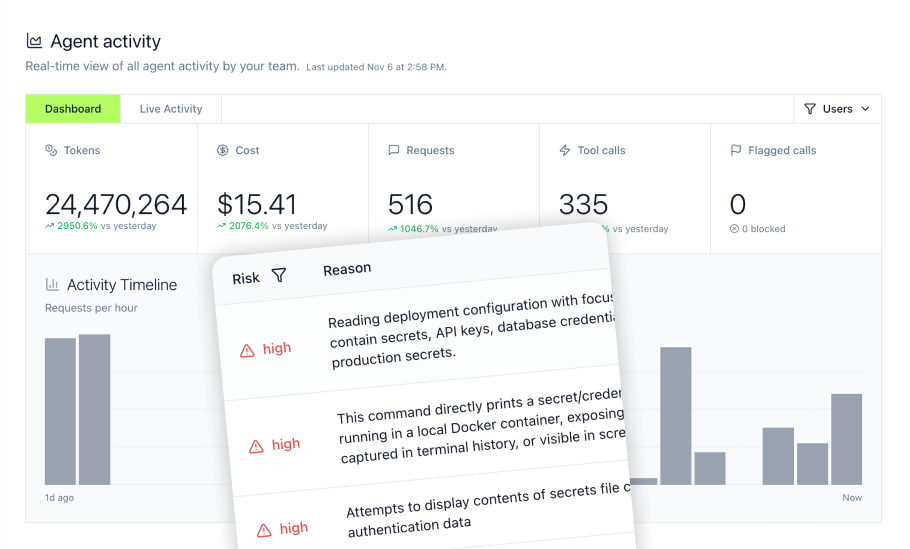
Agent Monitor provides visibility beyond the gateway:
- Visibility into local agent activity outside the MCP Gateway
- Monitoring of Bash commands and file reads or writes
- Visibility into prompt submissions and installed MCP tools
- Per-user activity context through Claude Code and Cursor hooks
This addresses the shadow AI challenge where developers use AI tools in ways that bypass centralized governance.
Solving the 'Last Mile Problem' for GPT-5.2 in the Enterprise
The Integration Challenge
GPT-5.2's capabilities mean little if agents cannot access the systems they need. The "last mile problem" describes the gap between model capability and practical utility:
- Database connections require credentials and access policies
- SaaS tools need OAuth flows and permission scoping
- Internal systems lack standardized APIs for agent access
- Each integration requires custom engineering work
As organizations connect agents to more MCP servers and internal systems, centralized credential management and tool governance can reduce fragmented access policies.
Bridging the Gap with MCP Gateway
MintMCP's gateway architecture addresses integration challenges through:
Pre-built connectors: Pre-configured integrations for systems such as Salesforce, GitHub, Slack, HubSpot, Notion, Linear, Gmail, and Stripe, with enterprise authentication and access policies.
Custom server hosting: STDIO server support automatically converts locally-run MCP servers to hosted, production-ready services with OAuth wrapping. No code changes required.
Virtual MCP (VMCP): Bundles multiple servers with role-based tool access. One endpoint per team or use case with SCIM-driven membership. Virtual MCP Bundles can provide one governed endpoint per team or use case, with curated tools and SCIM-driven membership.
Middleware hooks: Custom policy code running in a JS sandbox can inspect, transform, mask, or block tool activity before and after calls, with documented integrations for AWS Bedrock Guardrails, Google Cloud DLP, Microsoft Purview, Nightfall, and Skyflow.
Future-Proofing Your Enterprise AI Strategy with GPT-5.2 & MCP
The Model Context Protocol Standardization Wave
MCP adoption accelerated during 2025, with support across Claude, Cursor, Microsoft Copilot, Gemini, VS Code, ChatGPT, and other platforms. In December 2025, MCP moved under the Linux Foundation's Agentic AI Foundation.
This standardization means:
- MCP-compatible clients can connect to MCP servers when their transport and authentication requirements are supported
- A centralized gateway can enforce consistent governance across supported models and clients
- A shared protocol can reduce integration lock-in, although provider-specific features and controls still remain
Building Resilient AI Infrastructure
OpenAI released GPT-5.2 in December 2025, GPT-5.4 in March 2026, GPT-5.5 in April 2026, and GPT-5.6 in July 2026. The intervals varied, but the overall pace still supports continuous evaluation rather than policies tied to a single model version.
OpenAI reported that GPT-5.2 Pro crossed 90% on ARC-AGI-1 at roughly 390 times lower cost than o3-preview's earlier result. This was a benchmark cost comparison rather than a general measure of year-over-year enterprise efficiency.
Strategies for long-term success:
- Multi-model architecture: Route tasks to GPT-5.2, Claude, or Gemini based on workload requirements
- Version-agnostic governance: Build policies around capabilities and risk levels, not specific model versions
- Continuous evaluation: Automated testing pipelines that assess new models against production requirements
- Protocol-level investment: Focus on MCP-based infrastructure that works across model providers
Securing GPT-5.2 Deployments with MintMCP
Organizations deploying GPT-5.2 and future models face a critical infrastructure decision: build governance in-house or adopt a platform designed specifically for enterprise AI control. MintMCP provides the complete stack required to deploy GPT-5.2 safely at scale, from initial connection through ongoing monitoring and compliance.
MintMCP Gateway serves as the foundation, providing governed data and tool connections for Claude, Cursor, ChatGPT, Gemini, Copilot, and other AI systems users already run. Rather than managing credentials, OAuth flows, and access policies separately for each integration, MintMCP centralizes authentication through SSO, enforces tool-level permissions via SCIM-driven RBAC, and maintains audit logs for every interaction. Pre-configured connectors for Salesforce, GitHub, Slack, HubSpot, Notion, Linear, and other enterprise systems eliminate months of integration work, while custom STDIO server hosting converts local MCP servers into production-ready services without code changes.
As teams move from assisted workflows to autonomous agents, MintMCP Agent Gateway builds on this foundation to govern agent identities, permissions, memory, and monitoring. Agent Bundles provide each deployed agent with independently rotatable credentials scoped to specific tools and data, preventing permission escalation. Real-time monitoring through Agent Monitor detects local agent activity outside approved channels, including Bash commands, file access, and prompt submissions in Claude Code and Cursor environments. Custom policy code running in a JS sandbox enables inline data loss prevention, integrating with AWS Bedrock Guardrails, Google Cloud DLP, Microsoft Purview, Nightfall, and Skyflow to inspect, mask, or block sensitive data before it reaches the model.
MintMCP's approach treats governance as the foundation with agents enabled on top, ensuring security and compliance posture improves with each model upgrade rather than requiring emergency policy updates. Organizations can adopt GPT-5.6 or future releases with confidence, knowing their governance layer remains consistent across model providers and protocol versions.
Frequently Asked Questions
How does GPT-5.2's cached input pricing work, and what does it mean for governance costs?
OpenAI charges $0.175 per million cached GPT-5.2 input tokens, compared with $1.75 for standard input. Prompt caching works automatically for eligible prompts of at least 1,024 tokens, but the discounted rate applies only when a later request matches the cached prompt prefix and produces a cache hit. Organizations can improve cache-hit rates by placing reusable system instructions first and variable content later.
What is response compaction, and why does it matter for enterprise audit requirements?
Response compaction is GPT-5.2's mechanism for preserving conversation state across extended workflows. The /responses/compact API endpoint performs loss-aware compression into encrypted items that maintain task-relevant information while reducing token footprint. Because the compacted item is opaque rather than a readable transcript, organizations should maintain their own records of prompts, tool calls, approvals, and outputs when complete auditability is required. The compaction item can continue the model workflow, but it should not be treated as the organization's primary audit record.
How should enterprises approach frequent model releases?
The shift from annual to frequent release cycles means capability improvements arrive faster than traditional enterprise change management can absorb. Rather than treating each release as a major migration event, adopt continuous evaluation approaches: automated testing pipelines that assess new models against production requirements, capability-based policies that degrade gracefully across versions, and governance frameworks built around risk categories rather than specific model behaviors. Organizations using protocol-level infrastructure like MCP can often adopt new model versions without changing their governance layer.
What specific security considerations apply to GPT-5.2's extended context window?
The expanded context window creates data exposure scenarios that smaller-context models do not face. When an agent processes an entire codebase, compliance document library, or customer data extract simultaneously, traditional data classification controls may not prevent unintended correlation. Cross-document reasoning can reveal patterns that individual documents would not expose. Organizations should implement context-window-aware DLP policies, segment highly sensitive data from general agent workloads, and ensure audit logging captures complete context rather than just final outputs.
How do GPT-5.2's error rates affect enterprise deployment decisions?
In OpenAI's factuality evaluation, 93.9% of responses produced with search had no detected errors, compared with 88.0% without search. These are response-level evaluation results rather than a universal factual-claim error rate, and OpenAI continues to recommend verification for critical outputs. For enterprise deployments, this means distinguishing between permissible-error and zero-tolerance domains. Drafting internal communications, generating code suggestions, or summarizing research can tolerate occasional errors with human review. Generating compliance certifications, financial reports, or customer-facing legal language requires validation workflows regardless of model improvements. Governance frameworks should categorize use cases by error tolerance and apply appropriate validation requirements to each.