Claude Code subagents represent a fundamental shift in how development teams automate complex workflows, enabling specialized AI workers to operate in parallel with isolated context windows, dedicated tool permissions, and independent model choices. While subagents unlock significant productivity gains, enterprises deploying them at scale face critical governance challenges around visibility, credential management, and access control. Organizations can address these gaps through MCP Gateway infrastructure that centralizes tool access, enforces permissions, and maintains audit trails for governed MCP activity.
This article explains how Claude Code subagents function, their practical applications for enterprise development teams, and the governance architecture required to deploy them securely at scale.
Key Takeaways
- Claude Code subagents run in isolated context windows whose capacity depends on the model and plan, preventing raw subagent work from filling the main orchestrator's context while enabling parallel task execution
- One Duotach case study reports an 87% reduction for a combined SEO content-brief-and-article workflow and an 83% reduction for a technical SEO audit; these are scoped case-study results, not general enterprise subagent benchmarks
- Tool permission control is non-negotiable: when
toolsis omitted, a custom subagent inherits the tools available to subagents from the parent session, subject to Claude Code's global and background-agent filters; usetoolsordisallowedToolsto narrow access explicitly - Subagent descriptions should clearly state when the agent should be used; Anthropic recommends concise descriptions and suggests phrases such as "use proactively" when you want to encourage automatic delegation
- Model inheritance can create unexpected expenses. Claude Code resolves a subagent's model from its per-invocation setting, subagent definition, environment configuration, and then the main conversation model; explicitly selecting an appropriate model for each subagent remains important
Understanding Claude's AI Code Generation Capabilities
Claude Code functions as an agentic coding assistant that operates directly in terminal environments, capable of reading codebases, executing commands, and managing files across development workflows. Unlike autocomplete tools that suggest code inline, Claude Code takes action: it can review pull requests, write tests, generate documentation, and refactor code across multiple files.
The subagent architecture extends this foundation by allowing the main Claude Code session to spawn specialized workers for focused tasks. Each subagent operates with:
- Isolated context windows: A subagent reading 40 files does not pollute the orchestrator's context with raw grep output; it returns only a clean summary
- Configurable tool access: Explicit control over Read, Write, Edit, Bash, WebSearch, and MCP server permissions using least-privilege principles
- Independent model selection: Each subagent can run on different Claude models, with Haiku for inexpensive tasks and Opus for complex reasoning
- Nested execution: Subagents can spawn their own subagents, with a current default maximum of three layers below the main conversation; the depth is configurable
Claude Code currently allows up to 20 concurrent subagents by default, and the limit is configurable. Useful parallelism still depends on how independent the tasks are and how much context each result returns. Dynamic Workflows can coordinate tens to hundreds of parallel subagents for genuinely parallelizable tasks like benchmark suites or bulk edits, but such patterns require careful planning.
The Role of AI Agents in Modern Development Workflows
Subagents address a specific problem: complex development tasks require multiple specialized competencies that compete for context window space. A single code review might need security expertise, performance analysis, and convention checking, each drawing on different knowledge and tool access patterns.
Production-Ready Subagent Patterns
- Code reviewers: Read-only agents with Grep, Glob, and Read tools that analyze PRs for security issues, dead code, and convention violations
- Test writers: Agents with Write and Edit permissions scoped to
/tests/directories - Documentation generators: Agents that sync docs with code changes across multiple files
- Security auditors: Specialized agents checking for secrets, injection paths, and authentication gaps
One agency describes a production SEO workflow built around 14 Skills across six automated phases, reporting a reduction from 8 hours to 1 hour for a combined content brief and article workflow. Treat these figures as case-study outcomes rather than general enterprise subagent benchmarks.
Configuration Approach
The configuration follows a four-section system prompt pattern:
- Role definition: What the agent specializes in
- Context discovery: Where to look for relevant information
- Workflow sequence: Steps to complete the task
- Output format: Exact structure for returned results
Distinguishing Between AI Agents and Agentic AI
Claude Code subagents embody agentic AI principles through their reasoning loops, planning capabilities, and multi-step task execution. The distinction matters for governance: agentic systems make runtime decisions about which tools to call, what files to access, and how to sequence operations.
Key Agentic Characteristics
- Tool selection at runtime: The agent decides which MCP servers and tools to invoke based on task requirements
- Multi-step reasoning: Complex tasks get decomposed into subtask sequences with intermediate validation
- Context-aware planning: Agents adapt their approach based on discovered codebase structure
- Summary synthesis: Subagents return distilled insights rather than raw outputs
This autonomy creates governance challenges. When tools can appear, change, or disappear via list_tools, and tool descriptions themselves become an injection surface, enterprises need infrastructure that controls what agents can access before they make runtime decisions.
Governing Claude Code Subagents with a Data-Permissions-First Approach
Enterprise governance for Claude Code subagents starts with controlling data and tool access, not with granting broad permissions and restricting afterward. This data-permissions-first architecture creates a foundation where autonomous agents operate within defined boundaries from their first action.
Core Governance Problems
MCP Gateway addresses:
- Scattered credentials: Developers configuring subagents locally end up with API keys across laptops; one leak exposes the entire toolchain
- No access control: Subagents reach any connected system with whatever permissions happen to be available
- Missing audit trails: Without adequate audit controls and logging, teams may struggle to support SOC 2 evidence, HIPAA-required activity review, or internal risk reporting
- Config sprawl: Every developer configures every MCP server independently, creating N installs, N auth flows, and N points of failure
The Virtual MCP abstraction bundles approved connectors and a curated tool surface behind one governed endpoint. Different VMCPs can expose read-only versus read-write tool sets over the same underlying connector, ensuring a code review subagent cannot invoke write operations through that governed connector even if its system prompt gets manipulated.
Centralizing Tool Access and Identity for Claude Code Subagents
When enterprises scale from a handful of subagents to dozens or hundreds, the question "who did what" becomes the central governance concern. Subagents operating through whichever human credential happens to be available collapse the audit log, over-privilege the agent, and break rotation policies.
Agent Identity Model
Agent Gateway treats autonomous agents as first-class non-human principals. Each subagent can receive:
- Its own identity: Named, org-scoped principal in the same authorization model as humans
- Scoped MCP access: Purpose-built toolset independent from human user permissions
- Independent credentials: Bearer keys, M2M OAuth tokens, or workload identity federation
- Attributable audit trails: Every tool call tied to the specific agent identity
Authentication Mechanisms
Authentication scales from simple to secure:
- Bearer keys: Static key on every request with name, expiry, and individual revocation
- M2M tokens: OAuth client-credentials exchange for short-lived tokens where secrets stay out of the request path
- Workload identity federation: The agent's own infrastructure (K8s service account, cloud role, CI job identity) mints short-lived OIDC tokens
This architecture ensures that credentials can be rotated or revoked for individual agents without affecting other agents or human users.
Monitoring and Auditing Claude Code Subagent Activity
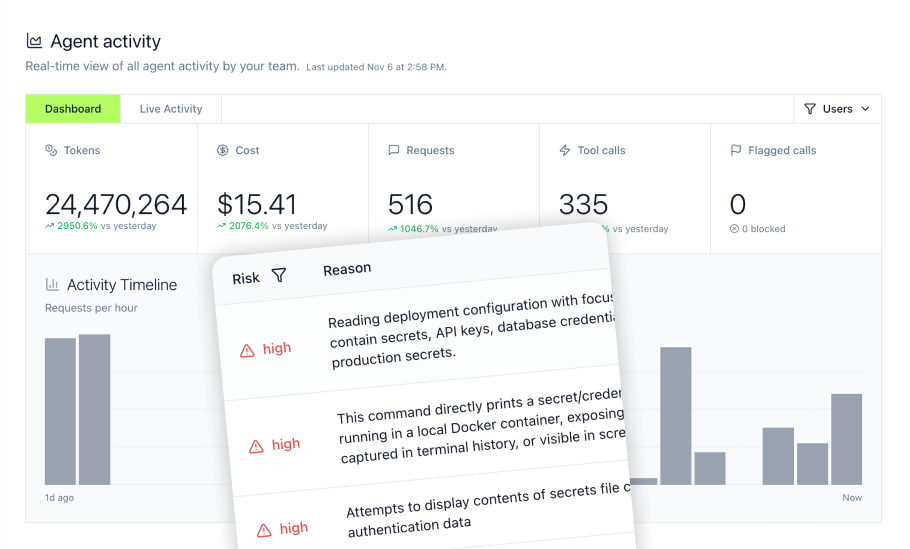
Visibility into agent activity extends beyond gateway request logging. Agent Monitor captures what coding agents do across the organization, including prompts, file access, commands, MCP tool calls, usage, and token costs.
Monitoring Capabilities
- Live activity feed: Supported agent activity across the org in real time with filtering by user, agent, tool, or time
- File access tracking: Detection of reads to sensitive paths like
.envfiles and SSH keys - Command logging: Bash execution, package installs, and git operations
- Usage attribution: Token spend by model, user, agent, and session with cache-hit visibility
- SIEM export: OTLP or Splunk HEC integration for tool calls, prompt submissions, and access-policy changes
Coverage can vary by supported client, agent, and hook phase. The two-layer visibility model separates gateway governance (traffic routed through MCP connections) from broader agent activity capture (local operations within development environments).
Current Claude Opus 5 API pricing is $5 per million input tokens and $25 per million output tokens, so explicitly selecting an appropriate model for each subagent remains important for cost management.
Implementing Runtime Guardrails for Claude Code Subagent Security
Visibility alone does not prevent dangerous actions. Guardrails determine what can happen at runtime through three complementary layers:
Mint Guard
Provides managed detection policies for:
- Prompt injection (blocks at high confidence)
- Credentials and secrets exposure
- PII detection
- Harmful content screening
Rules
Enable declarative matching and enforcement:
- Tool name conditions
- Argument pattern matching
- Regex-based content detection
- Actions: flag, block, ask-user, mask, or notify
Gateway Middleware
Supports customer-authored logic:
- JavaScript running in a sandbox for transformations and policy enforcement
- External DLP and classifier integrations
- Resource allowlists and custom policy rules
- Fail-closed behavior for policy-critical checks
MintMCP Guardrails enforce policy on governed gateway and tool interactions, while Claude Code's own permissions and hooks are needed to constrain local Bash and file operations. Agent Monitor can provide visibility into supported command activity where coverage is available.
Leveraging Virtual MCPs for Claude Code Subagent Deployment
Virtual MCPs serve as the unit of deployment, access control, tool curation, audit, and administration for subagent workflows. Directory groups can drive membership through SCIM, helping organizations apply consistent access policies without requiring every developer to configure each MCP server separately.
Deployment Patterns
- Role-based VMCPs: Engineering team subagents get database read access; security team agents get broader audit permissions
- Read/write separation: Same underlying connector exposed through two VMCPs with different tool curation
- Project-scoped access: VMCPs configured for specific repositories or service boundaries
- Credential isolation: Each VMCP injects appropriate credentials per call without storing long-lived secrets
For teams scaling subagent usage, the MintMCP guides provide practical configuration approaches that balance developer productivity with security requirements.
Company-Owned Memory for Persistent Claude Code Subagents
Claude Code subagents start with fresh context by default, but current Claude Code also supports resumable subagents and optional persistent memory. Coworker Agents address a broader enterprise use case: long-running autonomous agents that can work through Slack, schedules, or manual runs with company-owned memory, governed tools, and reviewable operating state.
Characteristics of Company-Owned Agent Memory
- Git-backed storage: Instructions, memory, and run history stored as reviewable files
- Scoped access: Private, team, organization, and customer memory contexts
- Version history: Full audit trail of memory changes over time
- Portability: Memory the company owns and can move, not hidden inside an opaque vendor system
Coworker Agents can operate through Slack mentions, scheduled triggers, or manual runs. They continue work across days, maintain governed tool access through VMCPs, and operate with sandboxed execution and secret brokering where the run sees only placeholders.
This addresses the enterprise concern that agents become "black boxes" with hidden state that cannot be reviewed, audited, or governed.
Comparing Claude Subagents: Pricing, Performance, and Capabilities
Pricing Tiers
- Pro
- Monthly cost: $20 monthly or $200 annually
- Usage: Standard Pro usage
- Best for: Individual Claude Code use
- Max 5x
- Monthly cost: $100
- Usage: 5x Pro usage
- Best for: Frequent individual use
- Max 20x
- Monthly cost: $200
- Usage: 20x Pro usage
- Best for: Intensive individual use
- Enterprise
- Monthly cost: $20/seat plus usage at API rates
- Usage: Metered by model and task
- Best for: RBAC, SCIM, audit logs, and Compliance API
Case-Study Results
- Combined content brief and article workflow: 8 hours reduced to 1 hour
- Technical SEO audit: 6 hours reduced to 1 hour
These figures come from Duotach's own SEO automation workflow and should be treated as case-study outcomes rather than general Claude Code subagent benchmarks. ROI depends on implementation effort, workload mix, model usage, and labor assumptions.
Building Enterprise-Ready Claude Code Subagent Infrastructure
Organizations moving from experimental subagent use to production need infrastructure that covers the full governance lifecycle:
- Identity for each agent
- Access control for tools and data
- Visibility into agent activity
- Policy enforcement for risky actions
- Memory management for persistent workflows
MintMCP provides these controls through connected infrastructure components:
- MCP Gateway centralizes tool access and credential management, reducing scattered API keys across developer laptops.
- Virtual MCPs curate tool access by role or use case, including read-only and read-write tool surfaces.
- Agent Gateway gives subagents first-class identities with scoped permissions, independent credentials, and attributable audit trails.
- Agent Monitor provides visibility into supported file access, commands, MCP tool calls, usage, and token costs, with SIEM export.
- Guardrails enforce runtime policy through managed detection, declarative rules, and customer-authored middleware.
As subagent usage grows across projects and teams, governance complexity grows with it. Without centralized controls, every new subagent can add more credential configuration, tool-access decisions, and audit gaps.
MintMCP centralizes these controls so organizations can scale Claude Code subagents while maintaining consistent identity, permissions, monitoring, and runtime policy enforcement.
Frequently Asked Questions
How do Claude Code subagents differ from simple LLM API calls?
Subagents operate as autonomous workers with their own context windows, system prompts, and configurable tool permissions rather than simple stateless request-response interactions. By default, they start in the main session's working directory; optional worktree isolation can give a subagent an isolated repository copy. They can read files, execute commands, spawn nested subagents, and return synthesized summaries. This architecture enables complex multi-step workflows that API calls cannot support, but it also introduces governance requirements around what actions agents can take and how those actions are audited.
What happens when a subagent's description does not trigger auto-invocation?
Claude Code routes tasks to subagents based on description matching. Vague descriptions like "a helpful coding assistant" rarely trigger invocation. The fix requires clear task boundaries in descriptions with specific frameworks, languages, and task types to improve routing reliability.
Can subagents access MCP servers that require user-specific authentication?
Yes, but this requires proper credential architecture. Through MCP Gateway, subagents can access connectors with per-user OAuth, per-agent credentials via Agent Gateway, or shared credentials where appropriate. The key is ensuring that credential handling flows through governed infrastructure rather than embedding API keys directly in agent configurations or inheriting whichever human credential happens to be available.
How should enterprises handle subagent tool inheritance to prevent permission creep?
When tools is omitted, a custom subagent inherits the tools available to subagents from the parent session, subject to Claude Code's global and background-agent filters. The recommended pattern is to always specify tools: [Read, Grep, Glob] for read-only agents and explicitly deny Write/Edit capabilities. For additional safety, implement SubagentStop hooks that validate outputs before merging results, checking for secrets in diffs and verifying that files touched match the expected scope.
What compliance documentation exists for Claude Code subagent deployments?
Anthropic maintains SOC 2 Type II assurance and offers a HIPAA-ready Enterprise configuration with a Business Associate Agreement. For Claude Code specifically, BAA coverage requires zero data retention on qualified accounts; standard-retention Claude Code is not covered. The AI system alone does not make organizations compliant. Enterprise deployments still need appropriate identity, access, audit, and security controls for their regulatory requirements. MintMCP's Trust Center documents the compliance posture for the governance layer.