Engineering teams are deploying AI agents across their workflows, yet the gap between adoption and measurable impact remains significant. While 90% of engineering teams now use AI tools, many still struggle to connect adoption with measurable engineering outcomes. This disconnect stems from a common pattern: teams adopt AI coding assistants without the governance infrastructure to ensure consistent, secure, and measurable outcomes.
The solution requires more than installing another IDE extension. AI coworkers that deliver sustained value need context engineering, policy enforcement, persistent identity, and audit capabilities. In engineering teams, AI coworkers are long-running agents that can live in Slack, hold memory, continue work across days, and operate alongside developers during standups, code review, and incident response.
MintMCP's gateway provides the governance layer that transforms ad-hoc AI tool usage into enterprise-ready workflows. MintMCP frames this as two connected layers: MCP Gateway for governed data and tool connections, and Agent Gateway for the identities, permissions, memory, and monitoring needed to run AI coworkers safely across engineering workflows.
This article outlines practical strategies for implementing AI coworkers across three critical engineering functions: daily standups, code review processes, and incident response workflows.
Key Takeaways
- Context engineering is foundational: Teams using structured context files reduce context drift and help AI suggestions stay aligned with team conventions, with research showing an 86% reduction in context drift
- AI can create technical debt without review guardrails: Uplevel's study found 41% more bugs among teams using GitHub Copilot, reinforcing the need for context, review, and governance practices
- Engineering AI coworkers need Agent Gateway controls: Long-running agents require identity, permissions, memory, and monitoring on top of governed MCP tool access
- Standup automation surfaces hidden blockers: AI-powered standup workflows can help teams identify blockers earlier by synthesizing work activity across commits, tickets, and team conversations
- Incident resolution can accelerate with AI orchestration: AI-assisted triage can help responders correlate logs, recent deployments, alerts, and runbook steps faster during incidents
- PR review efficiency depends on governance: AI-generated code still needs review workflows and quality gates so teams do not trade speed for avoidable rework
Redefining Developer Productivity: The Rise of AI for Software Development
AI for software development has moved beyond autocomplete suggestions into territory that affects every phase of the development lifecycle. Modern AI coworkers participate in planning discussions, generate code, review pull requests, write documentation, triage incidents, and synthesize meeting outcomes.
What AI Coworkers Mean for Engineering Teams
The shift from AI tools to AI coworkers represents a change in interaction model. Rather than invoking specific functions, engineers work alongside agents that maintain context across sessions, understand team conventions, and take autonomous action within defined boundaries.
This model requires new infrastructure. AI coworkers need access to internal systems: version control, project management, communication channels, observability platforms, and databases. Each connection point introduces security and governance considerations that traditional API integrations did not anticipate.
For engineering teams, MCP Gateway governs the tools and data those agents can reach. Agent Gateway governs the agent itself, including persistent identity, scoped permissions, memory, and monitoring across sessions.
Boosting Human Potential with AI
The productivity gains from AI coworkers come from task types that consume engineering time without demanding senior expertise: boilerplate code generation, documentation updates, status report compilation, log correlation during incidents, and repetitive code review comments.
AI assistance can support developers with code generation and debugging, QA teams with test case suggestions, operations engineers with runbook execution, and product managers with sprint summaries.
The critical insight from research is that raw productivity metrics often mislead. Uplevel's study found that teams using GitHub Copilot showed no measurable cycle time improvement while introducing 41% more bugs. The difference between teams that capture value and those that accumulate technical debt is governance.
Streamlining Daily Standups with AI: Automated Reporting and Insights
Daily standups consume significant engineering time, and the disconnect between ritual and value creates an opportunity for AI intervention.
AI's Role in Efficient Standup Meetings
AI standup automation addresses three problems: time spent preparing updates, inconsistent blocker visibility, and documentation gaps. Agents can synthesize activity from GitHub commits, pull request status, Jira tickets, and Slack conversations into coherent status summaries.
The measurable impact appears in blocker detection. AI-powered analysis of work patterns can flag stalled tasks, repeated assignment changes, delayed reviews, and dependencies that might not surface in a quick verbal update.
Automating Status Reports and Blockers
Implementation requires connecting AI agents to the systems where work happens. MintMCP Gateway provides one-click activation for connectors including Slack, Linear, GitHub, and Jira. These integrations feed context to AI agents that generate standup summaries, identify stalled work items, and flag dependencies.
Practical setup steps:
- Connect project management tools (Linear, Jira, Asana) via MCP for real-time task status
- Enable commit and PR monitoring through GitHub integration
- Configure blocker detection rules based on task age, assignment changes, and comment patterns
- Set up async update collection with live discussion for flagged items only
The hybrid model, where AI handles async status collection and humans discuss only flagged issues, reduces the manual coordination work that often makes standups feel repetitive.
Automated Code Review Tools: Elevating Code Quality with AI Coworkers
Automated code review tools address the bottleneck where code quality meets development velocity. AI code review systems typically combine static analysis, dynamic analysis, rule-based checking, and natural language processing for contextual feedback.
AI-Driven Code Analysis and Suggestions
AI code reviewers excel at pattern recognition across large codebases. They identify security vulnerabilities, flag style inconsistencies, suggest performance optimizations, and catch common mistakes before human reviewers spend time on them.
The efficiency gains are substantial when governance is present. Without proper tooling, review bottlenecks compound. AI pre-review reduces the cognitive load on human reviewers by handling mechanical checks.
Integrating AI into Your Code Review Process
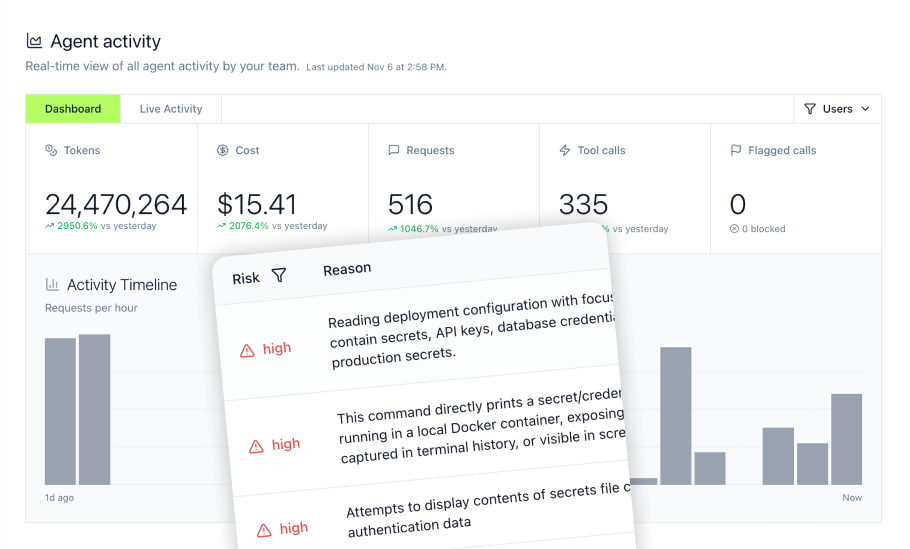
MintMCP's Agent Monitor provides the security layer that makes AI code review enterprise-ready. The platform detects PII exposure, credential leakage such as API keys and tokens, risky bash commands, and prompt injection attempts during AI-assisted review sessions.
Configuration approach:
- Deploy Agent Monitor hooks in Cursor and Claude Code for real-time visibility
- Configure detection rules for security-sensitive patterns such as hardcoded credentials and SQL injection vectors
- Set up approval workflows for AI suggestions that modify authentication or authorization code
- Enable audit logging for review activity
The Claude Code security guide details additional configurations for teams using Anthropic's coding assistant.
Ensuring Secure and Compliant Code with AI
Security teams require visibility into what AI agents do during code review. Agent Monitor tracks activity across the organization, including local agent activity through hooks in Cursor and Claude Code. This addresses the shadow AI problem where developers use AI tools without centralized oversight.
Together, MCP Gateway and Agent Monitor provide two-layer governance: the gateway governs approved MCP traffic and tool access, while Agent Monitor extends visibility to local non-MCP agent activity such as file reads, shell commands, and prompt submissions.
Best AI for Software Development: Choosing the Right Tools for Your Team
Selecting AI tools for engineering teams requires evaluating capabilities against governance requirements. The best AI for software development balances productivity features with security controls.
Key Considerations for AI Tool Selection
Governance features matter most:
- Context awareness: Does the tool support structured context files such as AGENTS.md or CLAUDE.md?
- Access controls: Can you restrict which repositories, databases, or APIs the agent accesses?
- Audit logging: Does every AI action get recorded with user and agent attribution?
- Policy enforcement: Can you block specific actions or require approval workflows?
- Agent identity: Can each long-running AI coworker operate with its own scoped credentials and revocation path?
Teams without these capabilities can see quality issues when AI suggestions violate team conventions, security policies, or architectural decisions that the AI lacks context to understand.
Evaluating AI Solutions for Developer Workflows
MintMCP's Bundle architecture packages tool access, policy enforcement, and audit logging into single governance units per team, role, use case, or agent identity. Each Bundle ties SCIM group membership to a curated MCP server list, custom policy rules, and an isolated audit trail.
This approach differs from platforms requiring manual configuration of separate plugin, access rule, and credential objects. Bundles cascade policies from organization to team level and sync automatically with identity provider group changes.
Evaluation criteria:
- Setup time: Enterprise deployments should have a clear path from pilot to organization-wide rollout without re-implementation
- Integration depth: Native or hosted connectors for your existing tools
- Compliance posture: SOC 2 Type II audited, compliant with HIPAA standards, penetration tested infrastructure, and BAA support for healthcare customers
- Scaling path: Clear upgrade from team to enterprise tiers without re-implementation
- Agent Gateway coverage: Governance for agent identity, permissions, memory, and monitoring, not only tool connections
Collaborative Software Development Tools Enhanced by AI Coworkers
Collaboration happens across multiple platforms: version control, project management, communication channels, and documentation systems. AI coworkers amplify collaboration by maintaining context across these tools and surfacing relevant information to the right people.
AI as a Catalyst for Enhanced Teamwork
Cross-functional teams benefit from AI that understands context beyond code. For engineering teams, this pattern applies to sprint planning, design reviews, and retrospectives. AI agents can pre-populate meeting agendas with relevant PR activity, summarize discussion outcomes, and create follow-up tickets automatically.
Integrating AI into Your Collaborative Ecosystem
MintMCP Gateway offers connectors for the tools where collaboration happens: Slack, Notion, Linear, GitHub, and Google Workspace. These integrations enable AI agents to participate in collaborative workflows with appropriate access controls.
The Virtual MCP abstraction bundles multiple servers with role-based and use-case-based tool access. A product team's VMCP might include Notion, Linear, and Figma access while excluding production database connections that belong to the platform team's bundle.
Incident Response Software: Accelerating Resolution with AI-Powered Orchestration
Incident response represents one of the highest-value applications for AI coworkers. The combination of time pressure, distributed system complexity, and repetitive diagnostic steps makes incidents ideal for AI assistance.
AI's Role in Rapid Incident Resolution
AI can help responders correlate logs across services, identify recent deployments that might explain behavior changes, and suggest runbook steps based on similar past incidents.
Automating Investigations with AI Agents
Effective incident response AI requires access to observability data: metrics, logs, traces, and deployment history. MintMCP integrations for Datadog, Splunk, PagerDuty, and Sentry enable AI agents to query these systems during incidents.
Implementation phases:
- Phase 1, visibility: Connect AI to monitoring and alerting systems. Train on historical incident data.
- Phase 2, triage: Enable automated severity classification and initial diagnostic queries.
- Phase 3, resolution: Approve autonomous actions for low-risk scenarios such as service restarts and config rollbacks.
The governance layer remains critical. Teams should enforce approval workflows for destructive actions, and every agent action should be logged for post-incident review.
DevOps Automation Tools: Integrating AI for Continuous Improvement
DevOps automation extends beyond deployment pipelines into configuration management, infrastructure provisioning, and continuous feedback loops. AI coworkers participate in each area.
Supercharging CI/CD with AI Agents
AI integration can support planning, design, build, test, review, and deploy workflows across the software development lifecycle.
CI/CD pipelines benefit from AI that predicts test failures based on code changes, suggests optimal test ordering, and generates deployment documentation automatically. These capabilities reduce cycle time while improving documentation quality.
MintMCP Gateway centralizes MCP server management, access control, and logging so engineering teams can apply consistent governance across AI-assisted DevOps workflows. The platform's logging capabilities feed into SIEM platforms such as Splunk and Sentinel for security monitoring.
For long-running DevOps agents, MintMCP's Agent Gateway builds on the MCP Gateway foundation by governing agent identity, scoped permissions, memory, and monitoring across sessions.
Securing Your AI Coworkers: Governance and Compliance in AI Development
AI agent security requires infrastructure designed for the threat model that autonomous agents introduce. Traditional API security addresses human-initiated requests; AI coworkers make autonomous decisions that require different controls.
Ensuring Enterprise-Grade Security for AI Agents
The MCP security whitepaper outlines risks specific to Model Context Protocol deployments: credential exposure through tool calls, data exfiltration via prompt injection, and privilege escalation through multi-hop agent workflows.
MintMCP addresses these risks through:
- Data-permissions-first architecture: Start with SSO, SCIM-driven RBAC, IdP groups, Virtual MCP Bundles, tool-level policy, and audit, then enable agents on top
- Per-agent identity: Each AI agent receives its own persistent identity with scoped credentials that rotate independently of human user credentials
- Agent Bundles: Per-agent identity, scoped tools, M2M authentication, and an "act as agent" flow for connectors that require per-agent OAuth
- Tool-level access control: Enable database reads but block writes; allow Slack message posting but restrict channel creation
- Custom policy code execution: Inline DLP integration with AWS Bedrock Guardrails, Google Cloud DLP, Microsoft Purview, Nightfall, and Skyflow
Protecting Sensitive Data in AI-Driven Workflows
Shadow AI detection through Agent Monitor hooks identifies local agent activity in developer tools. MDM-pushed enforcement configurations help apply consistent policy across developer machines.
The platform's JS sandbox middleware enables custom guardrail policies with block, flag, or alert actions. Pre-built templates cover OpenAI moderation, jailbreak detection, and credential masking.
Deploy AI Coworkers with MintMCP's Governance Platform
Engineering teams seeking to deploy AI coworkers across standups, code review, and incident response need a governance foundation that scales from pilot to production. MintMCP Gateway provides the centralized security, observability, and policy enforcement layer that transforms AI tool experimentation into enterprise-ready workflows.
MintMCP provides two connected layers for engineering AI coworkers. Its MCP Gateway governs data and tool connections for the AI systems users already run, including Claude, Cursor, ChatGPT, Gemini, and Copilot. Its Agent Gateway builds on that foundation with controls for agent identities, permissions, memory, and monitoring.
The platform's architecture addresses the core challenges teams face: shadow AI usage without oversight, credential exposure through tool calls, inconsistent policy application across teams, and lack of audit trails for AI actions. MintMCP's Bundle system packages tool access, policies, and logging into governance units that sync automatically with identity provider groups.
MintMCP's enterprise deployment capabilities include:
- Prebuilt and hosted connectors for GitHub, Jira, Slack, Linear, Notion, Datadog, and other engineering tools
- Virtual MCP Bundles for per-use-case endpoints with SCIM-driven membership, curated tools, and access policy
- Agent Bundles with per-agent identity, scoped tools, M2M authentication, and "act as agent" flow
- Agent Monitor hooks that detect local agent activity in Cursor and Claude Code
- Per-agent identity with scoped credentials and independent rotation
- Tool-level access controls that enable reads while blocking writes, or allow specific API endpoints
- Custom policy middleware with inline DLP from AWS Bedrock Guardrails, Google Cloud DLP, Microsoft Purview, Nightfall, and Skyflow
- Audit trails with user and agent attribution for AI actions
MintMCP is SOC 2 Type II audited, with continuous compliance monitoring via Drata. Enterprise SSO, complete audit trails, PII detection, and role-based access control are built into every layer of the platform. Customers handling protected health information can request HIPAA documentation, and MintMCP signs BAAs. The Trust Center provides full security documentation access.
Teams can roll out AI coworkers in phases: pilot with early adopters, team expansion with progressive rollout, and organizational scale with production policies. This phased approach validates governance rules, collects feedback, and builds internal expertise before broad rollout.
Frequently Asked Questions
What is an Agent Gateway for engineering AI coworkers?
An Agent Gateway is the control layer for agents that work alongside users. It governs agent identities, permissions, memory, and monitoring so long-running engineering agents can operate safely across repositories, issue trackers, observability systems, and collaboration tools. In MintMCP's model, Agent Gateway builds on MCP Gateway: the MCP Gateway governs data and tool connections, while the Agent Gateway governs the agent as an operating identity with scoped access and visibility across time.
How do AI coworkers handle proprietary code and sensitive data during code review?
Enterprise deployments vary in how they handle model routing, data processing, and hosting boundaries. MintMCP's middleware layer enables token masking and PII detection before data reaches external AI models. Configure tool-level policies to block code from specific directories or containing certain patterns from AI processing. The Agent Monitor provides visibility into what data AI agents access during code review sessions.
What training is required for engineering teams adopting AI coworkers?
Designate AI champions who receive deeper training on context file management and policy configuration. Team sharing sessions during the expansion phase help spread practical knowledge. Engineers should receive hands-on orientation to use AI coding assistants with proper context. The Claude Cowork guide provides frameworks for measuring AI agent effectiveness and building context engineering practices.
How do you measure ROI from AI coworker deployments?
Avoid conflating time savings with productivity gains. The Uplevel study showed zero cycle time improvement despite reported productivity increases. More defensible metrics include: error rates in production, documentation currency, junior engineer onboarding time, and incident mean time to resolution. Track blocker identification in standups, code review cycle time with AI pre-review, and incident resolution speed with AI-assisted triage.