Persistent AI agents often hold more privileges than required, yet many organizations still struggle to reconstruct what those agents accessed, triggered, or changed. As agentic AI adoption accelerates, the gap between rapid deployment and security governance creates substantial breach exposure. Organizations deploying Claude, Cursor, ChatGPT, Gemini, and Copilot need structured frameworks that treat AI coworkers as first-class identities requiring distinct security controls through an MCP gateway that centralizes authentication, access control, and audit logging.
AI coworkers are long-running agents that can live in Slack, hold memory, continue work across days, and operate alongside employees. That persistence changes the security model. Teams need MCP Gateway controls for governed data and tool connections, plus Agent Gateway controls for agent identities, permissions, memory, and monitoring.
This article provides actionable strategies for securing AI coworkers through governance frameworks, comprehensive audit logging, granular access controls, and continuous monitoring to support compliance workflows and operational security.
Key Takeaways
- Over-permissioned AI agents create substantial attack surface that structured governance frameworks can address
- Structured AI governance reduces operational risk by replacing ad-hoc controls with consistent identity, access, logging, and review workflows
- Agent Gateway extends MCP Gateway by governing persistent agent identities, permissions, memory, and monitoring
- Audit logging should capture agent identity, trigger identity, step-level trace, credential reference, correlation ID, and decision rationale
- Shadow AI detection addresses agents operating outside sanctioned channels, where visibility gaps create ungoverned attack surfaces
- Per-agent identity with scoped credentials enables audit attribution and independent credential rotation without affecting human user access
Implementing Granular Access Control for AI Agents: A Zero-Trust Approach
Access control for AI agents differs fundamentally from traditional application security. AI coworkers make autonomous decisions, interact with multiple data sources simultaneously, and can chain tool calls in ways that amplify initial permission grants. A zero-trust approach assumes no default access and requires explicit authentication and authorization for every request.
The Principle of Least Privilege in AI Agent Access
The principle of least privilege requires that AI agents receive only the minimum permissions necessary for their specific tasks. Organizations implementing this approach through automated privilege enforcement can reduce permission drift compared to manual access reviews.
Effective least-privilege implementation involves:
- Scope permissions to specific data sets and operations rather than granting broad database access
- Enable read-only access by default, requiring explicit approval for write operations
- Implement time-bound credentials with regular rotation to limit exposure windows
- Configure granular tool-level controls that enable specific functions, such as database reads, while blocking others, such as writes and deletions
- Define memory boundaries so agents retrieve only approved private, team, organization, or customer context
MintMCP Gateway enables tool-level access control where administrators can permit specific operations while blocking others. This granularity prevents agents from accumulating excessive permissions over time, addressing the common pattern where initial deployment permissions expand without corresponding security reviews.
Leveraging OAuth and SSO for Agent Authentication
Authentication for persistent agents requires moving beyond shared service accounts to individually scoped credentials. Shared credentials across multiple agents block attribution and amplify breach impact since compromising one credential affects all agents using it.
OAuth 2.0 patterns for agent credentials and enterprise SSO for human access enable:
- Per-agent identity assignment with unique, verifiable credentials
- Automatic credential rotation independent of human user credential lifecycles
- SSO integration through Okta, Microsoft Entra ID, or Google Workspace for unified human identity management
- Scoped session tokens that expire automatically, reducing persistent credential risk
MintMCP supports OAuth 2.0, SSO, RBAC, and per-agent credentials that can be rotated or revoked independently. Each AI agent receives its own persistent identity with scoped credentials, enabling organizations to maintain audit attribution while supporting credential hygiene at scale.
Audit Logging for AI Agents: Ensuring Transparency and Accountability
Traditional system logging captures events at the application layer. AI agent audit logging requires capturing the entire workflow, including the human or system that triggered the agent, every tool call with inputs and outputs, the credentials used, and the reasoning behind decisions.
Six Essential Fields for AI Agent Audit Trails
Comprehensive AI agent audit trails should capture six essential fields:
- Agent Identity: Which specific agent executed the action, with unique identifier
- Trigger Identity: The human user or automated system that initiated the workflow
- Step-level Trace: Each tool call with inputs, outputs, and intermediate results
- Credential Reference: Which credentials or tokens were used for each external system access
- Correlation ID: Unique identifier linking all actions within a single workflow
- Decision Rationale: The reasoning or context that led to specific tool selections
Organizations commonly fail on correlation IDs, resulting in fragmented logs that make incident investigation difficult. The solution involves generating workflow IDs at the orchestration layer and injecting them into every downstream tool call.
Integrating AI Audit Logs with SIEM Platforms
Centralized logging becomes essential as agent deployments scale. Without a unified audit trail, teams often need to stitch together application logs, identity logs, and tool-level activity records manually.
Integration requirements include:
- Real-time event streaming to SIEM platforms such as Splunk, Microsoft Sentinel, and Datadog
- Configurable retention policies aligned with internal compliance and regulatory requirements
- Export capabilities for compliance investigations and incident response
- Structured log formats that enable automated analysis and alerting
- Memory history showing which memories were created, changed, retrieved, and used in high-impact workflows
MintMCP Gateway captures audit logs for MCP activity, including who made the request, what tool was called, and what data was touched, with per-user and per-agent attribution. Logs can be exported for SIEM workflows, and configurable retention policies support compliance requirements across regulated industries. Learn more about MCP data risk management for comprehensive audit strategies.
Establishing Robust AI Identity Governance for Persistent Agents at Scale
Identity governance for AI agents extends traditional IAM concepts to non-human principals. Rather than treating agents as extensions of their creators, mature governance programs assign distinct identities to each agent with permissions scoped independently of human user access levels.
For persistent AI coworkers, identity governance should also include memory scope. Agent memory should follow Git-like principles where practical: company-owned, scoped, versioned, reviewable, auditable, and portable. That makes memory an enterprise governance object rather than an opaque store that security teams cannot inspect.
Automating Agent Identity Management with SCIM
SCIM, or System for Cross-domain Identity Management, integration enables automatic synchronization between identity providers and AI governance platforms. When employees join or leave teams, their agent access permissions update automatically without manual intervention.
Automation benefits include:
- Automatic deprovisioning when employees leave the organization
- Group-based access inheritance where team membership determines agent capabilities
- Audit trail of identity changes for compliance investigations
- Reduced manual configuration that introduces security gaps
Automated identity synchronization helps prevent access gaps during employee transitions and reduces the risk of orphaned permissions.
Agent Bundles for Identity and Access Management
The Bundle concept packages tool access, policy enforcement, and audit logging into single governance units. Rather than configuring separate objects for permissions, policies, and credentials, administrators define Bundles that apply consistently to teams, roles, use cases, or individual agents.
MintMCP's Bundle architecture ties SCIM group membership to curated MCP server lists, custom policy rules, and isolated audit trails. Agent Bundles extend this model to non-human principals, giving each deployed agent its own rotatable credentials, scoped tools, M2M authentication, and "act as agent" flow for connectors that require per-agent OAuth. Bundles can require admin approval for new tool additions and cascade policies from organization to team level.
For teams building centralized agent security policies, Bundles eliminate the configuration complexity that causes security drift over time.
Safeguarding AI Coworkers Through Continuous Monitoring
Static access controls address initial deployment security but fail to detect behavioral anomalies or policy violations during operation. Continuous monitoring establishes baselines for normal agent behavior and alerts when deviations occur.
Detecting Shadow AI and Unsanctioned Agent Activity
Shadow AI refers to agents operating outside sanctioned channels, whether through unapproved tools, personal accounts, or local installations that bypass corporate governance. This creates ungoverned attack surfaces where over-permissioned agents access sensitive data without logging or policy enforcement.
Detection strategies include:
- MDM-pushed configuration that identifies local agent activity on managed devices
- Network traffic analysis for connections to known AI service endpoints
- Mandatory pre-deployment registration in central inventory before agents receive credentials
- Periodic inventory audits that reconcile deployed agents against approved lists
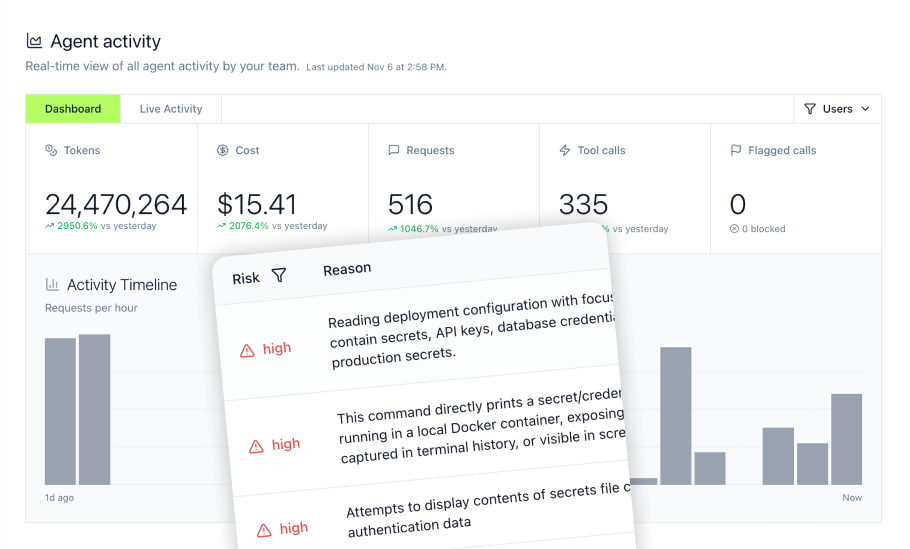
MintMCP's Agent Monitor tracks agent activity in real time across the organization, including MCP calls made outside the gateway through hooks in Cursor and Claude Code. MDM integration enables push of detect-only or enforce-mode configurations to developer machines for consistent policy application.
Together, MCP Gateway and Agent Monitor provide two-layer governance: the gateway governs approved MCP traffic and tool access, while Agent Monitor extends visibility to local non-MCP agent activity such as file reads, shell commands, and prompt submissions.
Mitigating Prompt Injection and Risky Behaviors
AI agents face unique attack vectors including prompt injection, where malicious inputs manipulate agent behavior, and credential leakage, where agents inadvertently expose API keys or tokens in logs or outputs.
Mitigation controls include:
- PII detection that identifies and masks sensitive data before logging or external transmission
- Credential scanning that blocks API keys, tokens, and secrets from appearing in outputs
- Risky command blocking for bash commands that delete files, modify permissions, or access sensitive directories
- Prompt injection detection using built-in rules that identify manipulation attempts
- Memory leakage detection where agents retrieve context from the wrong private, team, organization, or customer scope
Agent Monitor supports custom guardrail policies with block, flag, and alert actions. Security teams define rules specific to their environment and receive real-time notifications when agents attempt prohibited actions. For detailed guidance, review the MCP security whitepaper covering risks, controls, and governance strategies.
Building Zero Trust Security for AI Infrastructure
Zero trust architecture assumes that every request, whether from humans or AI agents, requires explicit verification. No agent receives default access based on network location, previous authentication, or inherited permissions.
The NIST AI Risk Management Framework provides governance guidance that maps well to zero-trust AI infrastructure, including risk mapping, governance, measurement, and ongoing management.
Zero trust for AI infrastructure requires:
- Mandatory authentication per request rather than session-based trust
- Mandatory authorization per resource rather than role-based blanket permissions
- Data encryption in transit and at rest for all agent communications and logs
- Provenance tracking across multi-step agent workflows to establish data lineage
- Immutable audit records that cannot be modified or deleted
MintMCP supports zero-trust AI infrastructure by enforcing authentication, authorization, and audit controls around governed MCP activity. Requests can be protected with authentication and authorization checks before agents access governed tools. Sandboxed execution and gateway-level inspection help isolate connector activity and reduce the blast radius of risky tool behavior.
For long-running agents, zero trust should extend beyond tool access. Agent Gateway adds controls for persistent agent identity, scoped permissions, memory boundaries, and monitoring across sessions.
Advanced Governance and Observability for Modern AI Architectures
Governance without observability creates blind spots where policy violations go undetected. Governance frameworks combined with real-time visibility into agent performance and security posture help teams scale AI adoption with clearer operational oversight.
The IMDA Model AI Governance Framework emphasizes structured governance practices for AI systems, including accountability, risk management, data governance, and human oversight. These principles map directly to persistent AI coworkers because agents act across systems, interact with sensitive data, and require clear accountability when workflows fail.
Observability requirements for AI coworkers include:
- Usage analytics by team and tool showing adoption patterns and potential shadow AI
- Latency monitoring that identifies performance degradation before it affects productivity
- Error tracking with root cause analysis for failed tool calls
- Policy violation dashboards aggregating security events across all agents
- Memory quality metrics showing memory freshness, review status, and usage in agent decisions
Agent Monitor provides org-level analytics on MCP adoption, usage patterns by team and tool, latency monitoring, and error tracking. Combined with MintMCP Gateway's audit logging, security teams gain centralized visibility into what AI coworkers access, when they access it, and whether their behavior aligns with organizational policies.
For organizations beginning their governance journey, a phased approach can start with governance ownership and progress through inventory, identity management, audit logging, access controls, and continuous monitoring.
Securing AI Coworkers with MintMCP: A Unified Governance Platform
Organizations deploying persistent AI agents require governance infrastructure that unifies identity, access control, audit logging, memory governance, and continuous monitoring. MintMCP provides two connected layers for AI coworker security. Its MCP Gateway governs data and tool connections for the AI systems users already run, including Claude, Cursor, ChatGPT, Gemini, and Copilot. Its Agent Gateway builds on that foundation with controls for agent identities, permissions, memory, and monitoring.
MintMCP's data-permissions-first architecture starts with SSO, SCIM-driven RBAC, IdP groups, Virtual MCP Bundles, tool-level policy, and audit, then enables agents on top. This ensures an agent's access is a subset of an already-governed permission model.
MintMCP Gateway centralizes authentication, authorization, and audit logging for MCP tool calls. Per-agent credentials with OAuth 2.0 patterns enable independent rotation and revocation without affecting human user access. Tool-level access controls prevent permission drift by enforcing least-privilege policies at the operation level rather than granting broad database or API access. Audit trails support compliance investigations by capturing agent identity, trigger identity, step-level trace, credential reference, correlation ID, and decision rationale.
Virtual MCP Bundles create per-use-case endpoints with SCIM-driven membership, curated tools, and access policy. Agent Bundles extend this model with per-agent identity, scoped tools, M2M authentication, and an "act as agent" flow for connectors that require per-agent OAuth. This gives security teams a reusable control model for both human teams and internal-agent governance.
Agent Monitor extends governance to agents operating outside the gateway, detecting shadow AI through MDM integration and hooks in Cursor and Claude Code. Custom guardrail policies can block, flag, or alert on prompt injection, credential leakage, risky commands, and organization-specific violations. Org-level analytics provide visibility into adoption patterns, latency trends, and policy compliance across teams and tools.
MintMCP's customer-authored Gateway Middleware runs in a JS sandbox and enables inline DLP integration with AWS Bedrock Guardrails, Google Cloud DLP, Microsoft Purview, Nightfall, and Skyflow.
MintMCP is SOC 2 Type II audited, with continuous compliance monitoring via Drata. Enterprise SSO, complete audit trails, PII detection, and role-based access control are built into every layer of the platform. Customers handling protected health information can request HIPAA documentation, and MintMCP signs BAAs. Security teams can review the full security posture in the MintMCP Trust Center.
Organizations using MintMCP gain stronger audit readiness, reduced manual governance work, and operational confidence that AI coworkers operate within defined security boundaries. For teams balancing rapid AI adoption with security requirements, MintMCP provides the governance infrastructure required to scale AI coworker deployments while maintaining audit attribution, access control, memory governance, and continuous monitoring across the agent lifecycle.
Frequently Asked Questions
What is the difference between traditional access control and AI agent access control?
Traditional access control grants permissions to users who make explicit, predictable requests. AI agent access control must account for autonomous decision-making, tool chaining where agents combine multiple permissions in unexpected ways, and the potential for agents to accumulate permissions over time without corresponding security reviews. Effective AI access control requires scoped, time-bound credentials with explicit tool-level permissions rather than broad role-based access.
What is an Agent Gateway for AI coworker security?
An Agent Gateway is the control layer for agents that work alongside users. It governs agent identities, permissions, memory, and monitoring so long-running agents can operate safely across enterprise systems. In MintMCP's model, Agent Gateway builds on MCP Gateway: the MCP Gateway governs data and tool connections, while the Agent Gateway governs the agent as an operating identity with scoped access, memory boundaries, and visibility across time.
Can AI agents be detected when operating outside sanctioned channels?
Yes. Shadow AI detection uses MDM-pushed configurations, network traffic analysis, and hooks in development tools like Cursor and Claude Code to identify agent activity that bypasses corporate governance. Detection can operate in monitor-only mode for visibility or enforcement mode that blocks unsanctioned activity. Organizations typically start with detection to understand their shadow AI landscape before implementing blocking policies.
How does audit logging for AI agents differ from traditional system logging?
Traditional logging captures events at the application layer. AI agent logging requires workflow-level traceability capturing the human or system that initiated the action, every tool call with full inputs and outputs, the credentials used for each external system, correlation IDs linking related actions, and the reasoning behind agent decisions. Without this granularity, incident investigation becomes difficult when agents chain multiple tools to accomplish tasks.
What role does zero trust play in securing AI coworkers?
Zero trust eliminates implicit trust based on network location or previous authentication. Every AI agent request should require explicit authentication and authorization verification. This prevents compromised agents from moving laterally through systems, limits the impact of credential theft, and helps ensure that agents cannot access resources beyond their explicitly granted permissions. Zero trust is particularly important for AI agents because their autonomous behavior makes predicting access patterns difficult.